Audience etiquette
How to be a well-mannered audience member
The key to audience etiquette is to know what is considered good manners for the type of performance you are attending. What is appropriate in one context doesn't always readily translate to another. 'One size fits all' can be a trap.
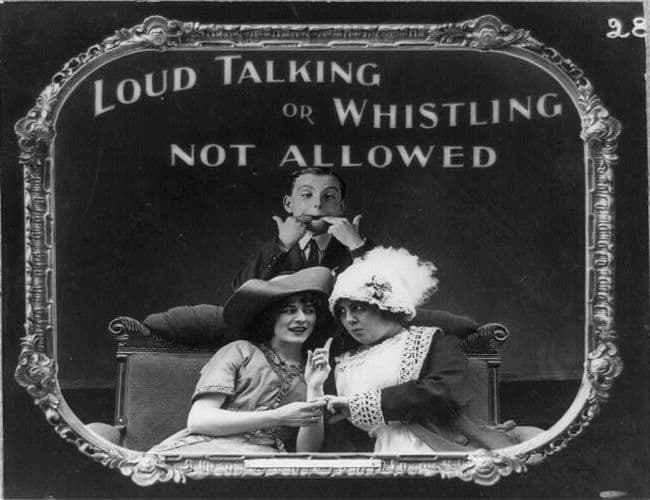 One of a series of 1912 humorous movie theater etiquette lantern slides made by Scott and Van Altena. The originals are held by Library of Congress, USA.
If you go the theater to watch a play, talking through it will upset members of the audience around you and perhaps even the cast on stage. The same applies to a musical presentation in a concert hall.
However if you go to a large outdoor political rally or rock concert you'll be free to comment, holler and shout to your heart's content.
So what is standard audience etiquette for listening to speakers?
Arrive early
The advertised starting time is generally the signal for the speaker to begin, not for you to be edging along a row to find your seat while whispering, "Excuse me. Excuse me. Oh, I'm so sorry! Was that your foot?"
Turn all electronic gadgetry off
You came to listen, not to take photos, text friends, send messages to your social media accounts, or video the event. Leave all of that to the people whose job it is to do it.
And if you must have your mobile/pager on, set it to vibrate and make sure you're seated on the end of a row near an exit. Leave the auditorium, hall or room before you take the message.
Talk only if you're invited to by the speaker
Sometimes a speaker will ask for comments or questions from the audience. Phrase your questions or responses respectfully and sincerely.
Interjections, (spontaneous comments), to challenge a speaker may be appropriate in some settings and absolutely not in others. Judge it very carefully.
Yelling, "Hah! That's a load of unsubstantiated tosh!" or "Give us your references!" may get you promptly escorted out the door.
Be prepared
If you need cough drops or tissues have them ready rather than having to rummage through your bag for them.
Chewing, munching, slurping, burping ...
The sound of someone chewing gum, munching popcorn or slurping on a water bottle can be disruptive to others. You may not think you're being distracting but if those around you experience your behavior as such, you are.
Hush, shhhhh ...
Keep private whispered conversations to an absolute minimum and make them brief.
Please don't fiddle, tap or rattle
If you're a habitual rattler of programs, keys or coins put them out of your own way to avoid temptation.
Stay alert and actively listen
Slouching, yawning and falling asleep does little for the speaker's confidence and the people around you will hate it if you snore!
Seats and feet
Please keep your feet on the floor, rather than resting them on the back of the seat in front of you.
Stay to the end
Either wait for a scheduled break or stay to the end of a speech before leaving. Exiting noisily or squeezing past other people trying to watch and listen is rude.
Show your appreciation
It's good manners to show your appreciation for the effort the speaker has made to plan, write and deliver a speech. If he makes you laugh, laugh. Clap when it's appropriate. A speaker needs your response. Your laughter, eye contact, and clapping all let him know he's doing a good job.
However if you feel he's not performing well, it is not considered good manners to make that public knowledge. So no eye rolling or disparaging comments.
Be kind. Audience etiquette follows the "do unto others as you would have done unto you" rule.
That doesn't mean lie to the speaker and pretend the performance you saw was faultless. It means, if you're asked, that you find the positive, acknowledge it, and if it's appropriate, offer some considered feedback on ways to improve.
Examples of thoughtless behavior
These come from my 'what-not-to-do' department. I witnessed both of them.
An older woman and her friend sitting a row in front of me shared a bag of peppermints through a violin concerto. They unwrapped them creak by creak in painfully loud slow motion oblivious to the glares from those near by, mine included.
Yet another occurred at a play. A mobile phone rang. It was answered and a conversation began. The lead actress stopped the play, left the stage, and reappeared in the aisle scanning the audience. Having found her man, she escorted him and his phone, amid cheers and clapping, to the exit.
Observing good etiquette is good for everyone
Good audience etiquette let's everyone do what they came to do, listen to the speaker or music, or watch the play.
This is live performance. You can't rewind because you missed a bit, or turn the volume up to hear over the top of unwanted background noise.
If you sincerely don't know what's expected for a particular type of public performance, ask someone who's got the experience to tell you. While you're at the event carefully observe the behavior around you. Take the best as a model for your own conduct.
"All speech, written or spoken, is a dead language, until it finds a willing and prepared hearer."
Robert Louis Stevenson: 1850-1895
- Return to top of audience etiquette page



From fear to fun in 28 ways
A complete one stop resource to scuttle fear in the best of all possible ways - with laughter.