- HOME ›
- Speech delivery ›
- Voice image
Voice image secrets
What's the quality of your speaking voice telling other people?
By: Susan Dugdale | Last modified: 11-13-2023
How is your vocal image?
Do you really know how others hear you?
And do you know what they think or feel about you, as a result of listening to your voice?
Is it good? Bad? Or, indifferent?
Our voice has an instant impact
It's well known that how we dress and present ourselves has an almost instant impact on the people we meet. In some situations, for example, job interviews, work presentations and special social occasions, that impact is critical.
We are judged on our appearance and those initial judgments form the basis of how we are perceived or thought of. At a job interview a crumpled shirt, scruffy trousers and scuffed shoes may say to a prospective employer: 'I don't care enough to make an effort.'
What's less well known is that voice or voice quality has a similar effect.
The vocal image secret
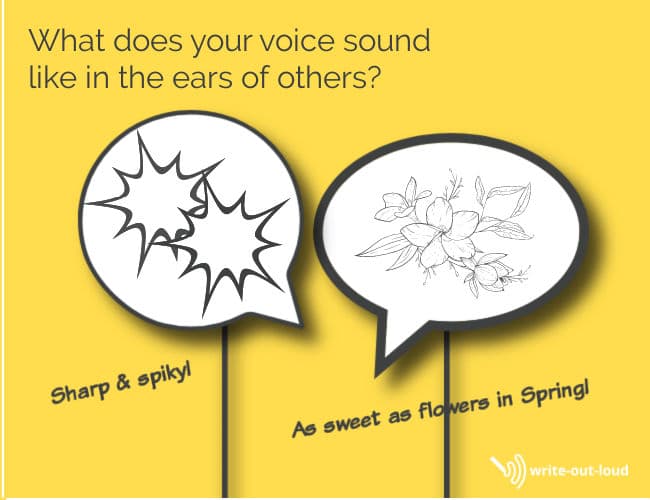
Voice image is the 'secret' of people who use their voices professionally. Actors, radio broadcasters, television presenters, politicians, tele-marketers, professional speakers, all of whom depend on the impression their voice makes for success, know its importance. They systematically work to sustain and improve it.
What you do with your voice, how you speak, matters. It can open doors for you, or slam them shut.
Like it or not, we make judgements, mostly unconscious, about each other based on how a voice sounds to our ears.*
*You'll find links to research and articles verifying the impact of voice on perception at foot of the page.
A negative voice image
In your mind summon up the sound of a voice making you want to put your fingers in your ears because hearing it is painful.
What are its qualities?
- Is it nasal as if the speaker had a peg on their nose?
- Does the speaker squeak?
The voice uses the upper/high registers continually. - The voice is monotonous. It drones on and, on and, on with little variation of pace or pitch.
- The speaker mumbles and the words blur into one another without distinction.
- It is too loud regardless of circumstance. The voice overwhelms its hearers.
- Is there a constant rising inflection at the end of each sentence? This makes you mentally answer everything you hear and question whether the speaker is sure of themselves.
- Is there a difficulty with some of the letter sounds? For example, 'S' or 'R' or any other single, double or multiple letter combination.
- Is it shrill?
The speaker has hard piercing tones like that of a concrete cutter. - Is it sing-song?
The speaker swings through a habitual up-down pitch range
regardless of subject matter. - The speaker is hesitant. The words are held back and arrive timidly.
- Does it race? The speaker gabbles at break neck speed.
- It is too quiet as if it's embarrassed to be heard.
- Is the accent so broad it swamps clear communication?
What personality traits have you attributed to the speaker based on how their voice sounded to you?
Have you decided they are:
- shy (tentative, as if tip-toeing through what they have to say)
- lacking in self-esteem (voice too quiet to be heard)
- lazy (allows sentences to slide away incomplete, or uses too many filler words)
- careless (doesn't articulate clearly - mumbles)
- arrogant (too loud for too long)
- over-anxious or nervy (motor-mouth - speaking rate too fast)
- boring (monotone delivery)
- lacking intelligence (voice too high, too many filler words, upward inflections, speaking rate too slow ...)
- a complainer or whinger (nasal quality in voice)
- easily influenced (uses vocal patterns popularized by prominent "influencers")
- incapable of leadership (too quiet, too hesitant, too many fillers ...)
- indecisive (voice not strong enough, loud enough ...)
- immature (using sing-song inflections)
- and more...
A positive voice image
Let's focus now on a voice that you love listening to.
What are its qualities?
- Does it sound natural, relaxed and free?
- Is it varied and flexible?
The pace, pitch, tone, and volume shift organically without effort in harmony with what is being spoken about.
What personality traits do you automatically assume about the speaker?
Would you say they are more likely to be confident, authoritative, intelligent, understanding, independent, attentive, interesting, energetic, dynamic, mindful of others, warm, caring, respectful...
And now listen to yourself
The easiest and most effective way to do this is to record yourself.
Merely listening to yourself inside your own head won't give you the clear feedback you need.
There can be a vast difference between what we think we sound like and what we actually do. I know because I've experienced it. Hearing myself let me know exactly what I sounded like and where I needed to put the effort in. We lie to ourselves!
Ideally what you want is a 1 - 2 minute sample of your normal speaking voice - the voice you'd use naturally without self-consciousness.
Talk about your day, who you're meeting after work, what you're planning for dinner, your last vacation - any topic that is relatively easy to find something to say about.
Play back the clip and listen as objectively as possible to what you hear.
If you were somebody else, what would you think about the speaker?
What aspects of delivery do you need to focus on if you want a confident dynamic voice image?
Voice image ...
... is a collective package made up of equal parts of breath control, articulation, volume, pitch, tone, pausing and speaking rate.
A great voice image is strong in all of them.
Breath control
This is essential for flexible voice production. If you are holding your breath or breathing from the top of your lungs the quality of your voice will reflect that.
You'll find some useful breathing exercises here. They are the same ones for reducing anxiety. In doing them you'll receive a double benefit - a better voice and lowered tension.
Articulation
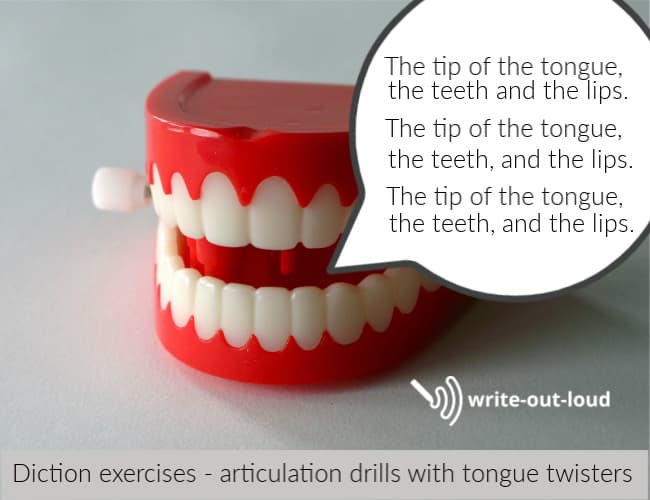
This is how you say your words. Are they clear? Are the endings, as well as the beginnings, distinctly audible? If you mumble or drop off starts and finishes of words, you'll find these old-fashioned tongue twisters useful as well as fun.
Proper pronunciation
This is knowing 'how' to say a word. It is different from articulation in that you can mispronounce words but still be speaking clearly!
You'll find some commonly mispronounced words and phrases on this page on proper pronunciation as well as a useful link to a larger list of frequently muddled words.
Volume, pitch and tone
Volume, pitch and tone cover how loud or quiet your voice is, as well as the range it travels through (high to low), and its quality. They're an essential part of what you need to understand to use your voice well.
Click the link for exercises to develop flexibility in these three aspects of vocal variety.
Pausing
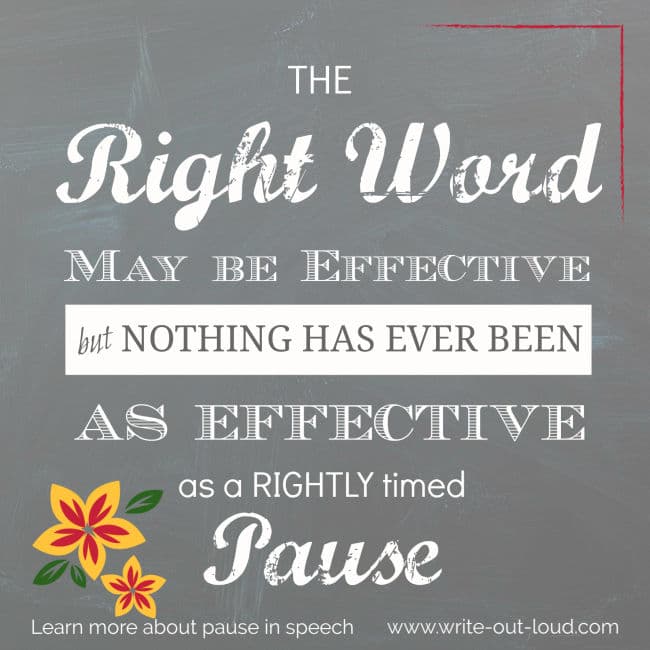
A pause in the right place for the right length of time gives your speech emphasis and definition. And as you know, silence can speak louder than words! ☺
Check out these exercises on how to make effective use of pausing.
Speaking rate
This refers to the speed your words come out of your mouth. Depending on the context, speaking either too fast or too slowly can be a problem.
Click the link to find exercises to help you achieve a variable and appropriate speaking rate.
For more help
If you need more than is available here (for instance, help with modifying a strong accent or a stubborn stammer), do seek professional advice. You'll find qualified voice coaches or speech therapists either online or in your local area.
If you'd like to better your vocal image in the company of others dedicated to improving their public speaking, try Toastmasters International.
Toastmaster clubs are all over the world. There's bound to be one near you. Check on the website link above to see.
If you speak in any way professionally (teach, sell, work in a call center ...), please do not ignore voice image. It may not be talked about openly in the same way that how you dress is, or your body language, but it is equally important.
Your voice can either help or hinder you. Please choose to make it work for you.
References
- Lifehack article by Ian Lee: People Judge Your Intelligence Based on the Tone of Your Voice and How Fast You Speak (Be sure to check the references.)
- Duke FUQUA,2014: Vocal Fry' Could Limit Success of Young Female Professionals
- Science Direct: Evolution and Human Behavior, 2013: Voice pitch and the labor market success of male chief executive officers
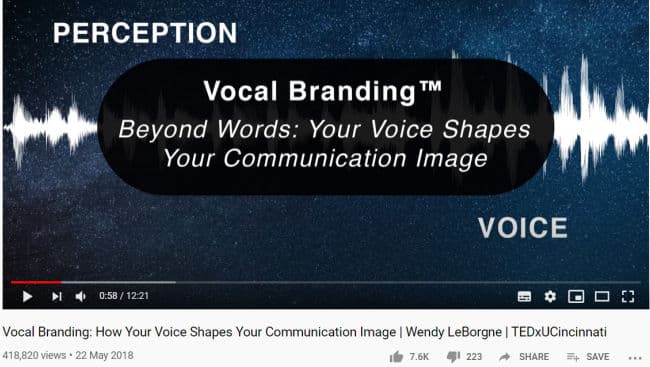
Do make time to watch Dr. Wendy LeBorgne's excellent TEDxTalk: Vocal Branding: How Your Voice Shapes Your Communication Image. She is an author-pioneer of research and education in the science and power of the elite voice. For more see: Dr Wendy - voice pathologist.
- Return to top of voice image




From fear to fun in 28 ways
A complete one stop resource to scuttle fear in the best of all possible ways - with laughter.