- HOME ›
- Speech delivery ›
- Speaking rate
Quick & easy tips for speaking rate
- how to pace your speech for maximum impact
By: Susan Dugdale
If you know you habitually speak too fast, or too slowly, and want to communicate well, it's time to learn more about adapting your rate of speech to meet the needs of your audience and your content.
What you'll find on this page:
- an overview of the result of speaking too fast or too slowly
- why flexible speaking rates have more impact
- how speech rate is interpreted
- 6 exercises to develop an effective speaking rate
- links to more articles on speech rate: how to calculate it - 2 easy methods and a quick reference guide on the average number of words per minute in speeches 1 through to 10 minutes long.
You need these tips if you speak too quickly
If you've ever been called a motor-mouth, you'll know it's because the words rocket out of your mouth.
Maybe it's because you have so many ideas you want to share, and maybe you need to get them out quickly because there are so many more coming up fast behind them!
It's fun and exciting to listen to fast speech, for a while. However, when your speech stops being stimulating and starts being uncomfortable, ears switch off.
And you need them if you speak too slowly
Slow word-by-very-slow-word turns ears off too.
People wait-and-wait for you to get on with it, eventually losing interest.
The answer is variety - developing a flexible speaking rate
The solution to the speaking too fast or too slowly problem is not the middle ground.
(A person speaking consistently at a moderate pace would become tedious to listen too.)
Rather it is to vary your speaking rate: to match it to meet the needs of your audience and, your content.
Let's imagine your speech as a journey
Picture in your mind the layout of your speech.
You'll have an introduction, followed by a series of main ideas with supporting examples or illustrations. To finish there'll be a conclusion.
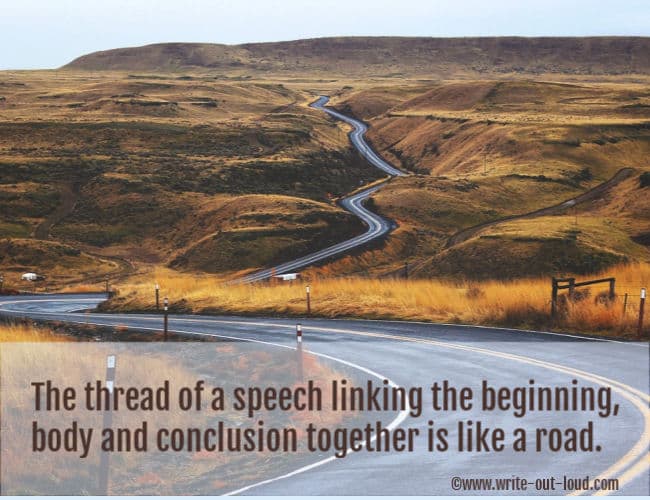
Now think of the thread, (the theme, the main ideas), linking it altogether.
That thread is similar to a road. When you give a speech you are taking your audience on a journey, a road trip.
Your mouth is the vehicle carrying both your message and your audience along. And you are its driver.
You are in complete control of how you deliver, or drive your speech from beginning to end.
Making choices on how you deliver your speech
As the driver you make choices affecting your message, and your audience.
Choosing to deliver your speech too fast
You can whirl them through your speech so fast the scenery blurs. So while you're busy negotiating a series of complicated hair pin bends at full throttle, that is rattling off a complex series of ideas with examples, your poor audience is gazing out the back window trying to work out what they've missed and where they are.
One by one your listeners will get dizzy and exhausted through the effort they're making to keep up with you. Then they'll close off their ears and sit quietly waiting for the ride to stop.
Choosing to speak too slowly
Or by contrast you can proceed so cautiously your passengers want to get out and walk. Listening to your speech is unadulterated tedium.
Becoming a responsive speaker
If you were a responsive driver (speaker) you would be continually adjusting your speed to meet the road conditions (your speech content) and the needs of your passengers (audience).
There would be places to slow, and perhaps even stop, for the audience to catch their breath. There would also be places where a quick burst of acceleration would give an exciting thrill.
Interpreting speech rate
A FASTER speaking speed signals urgency, excitement, passion or raw emotion.
In contrast a SLOWER speaking rate signals importance, seriousness or significant ideas. Slow says: 'LISTEN UP! YOU NEED TO KNOW THIS.'
A new concept or complex information may need to be delivered slowly to give the audience time to grasp it before moving on.
'Slow' is also useful for summarizing material.
The combination of slow, fast, and medium speeds makes your speech easier to listen to.
Negative connotations of going too fast or too slow
Both fast and slow rates of speech can be interpreted negatively by those listening to it.
Speaking too quickly could be seen as evidence of anxiety or fear.
Speaking too slowly could be interpreted as a lack of intelligence or, a lack of knowledge about the speech subject.
6 exercises to develop flexible speaking rate
1. Reading children's stories
Read a children's story silently several times to familiarize yourself with the flow. Go through it again noting which passages would suit taking more quickly and which should be slower. Then read it aloud and listen carefully to how speed alters interpretation. Repeat the exercise altering your speed over particular passages, noting the differences.
Record yourself if possible doing this and all the following exercises. Save all the versions you do. You'll then have them to refer back to. Recording takes out the guess work as you can hear exactly what you did, rather than what you imagined you did. It doesn't lie!
2. Read factual reports
Pick an information loaded report from a newspaper or magazine.
Go through it silently to familiarize yourself with the flow of material and then read it aloud. Make a note of which passages need careful or slow reading and which can be taken at a faster rate. Re-read aloud until you feel you have the mix of speeds right.
As an extension exercise read the report as if you were reading for an audience who knew nothing about the subject. Note what changes you made and why.
3. Experiment with one of your own speeches
Record and time yourself delivering a speech of your own at your current 'normal' speaking rate.
Note the time down. Now go through again having marked passages for slower or faster treatment. Note the new time and your new insights.
4. Practice with a partner
Practice with a partner. Go through any of the exercises above. Explain what you doing and ask them to listen for effectiveness. Get them to note examples where you did well and where you needed to alter your speech rate and why.
5. Listen to good speakers
Listen to speakers you admire. They could be radio presenters, preachers ... anybody accustomed to speaking in public. Note the different rates of speech they use over the course of their presentation and the effectiveness and experiment with them for yourself.
6. Play with material you are familiar with
Read or recite part of a text you know well quickly (or slowly). If you can record yourself, do so. If not, listen and note the effect it has on you. If you've recorded yourself, play it back. Ask yourself where was the speed effective? Where was it detrimental? Mark those places on your script. Read again incorporating your changes.
Exercise patience
And lastly, be patient with yourself. Changing your normal speaking rate is challenging. The habitual speed of words leaving our mouths is deeply ingrained. As children we are very effective sponges. We soak up everything around us, including the speech rates used by our significant adults. What was their normal speech speed becomes ours. It feels natural, comfortable and right!
Altering rate is not impossible but it does require awareness, effort and PRACTICE!
Related pages:
Developing a flexible speech rate is only PART of the skill set used by a successful speaker. You can put more in your tool box.
The magic of silence
Remember the image of your mouth as the driver? When your tongue is high revving, it's accelerating away. When you're stuck in first gear, it's crawling forward one little word at a time.
Now you've got control over rate, it's time to turn your attention to the brakes. Skilled use of the brakes are the key to effective silence.
Find out how to use the Power of the Pause.
PS. More on speaking rate!
Did you know the average 'natural' (ordinary conversational speech) speaking rate ranges between approximately 130-200 words per minute?
Speaking rate has multiple variations including regional and national. Listen to what is regarded as 'normal' to make any adjustments needed before you speak in public.
To find out more click speech rate.
Speech rate and words per minute
When you have a speech to give with a strict time limit it's useful to have an estimate of how many words will fit comfortably into the time allocated, before you begin to write.
For more see: How many words per minute in a speech: a quick reference guide for 1 through to 10 minute speeches.
- Return to top of quick and easy effective tips for speaking rate




From fear to fun in 28 ways
A complete one stop resource to scuttle fear in the best of all possible ways - with laughter.