- HOME ›
- How to write a persuasive speech
Writing a persuasive speech
By: Susan Dugdale | Last modified: 04-24-2023
Getting started with a 7 point action plan
To help you through the process of writing a persuasive speech from beginning to end, here's a 7 step checklist.
To get the most from it move through it sequentially - point by point. You'll find links to topic suggestion pages, explanations about how to structure your speech and the importance of audience analysis with examples and more.
In my experience, a successful persuasive speech can't be flicked out in five minutes! There may be brilliantly competent speakers who can do it if they know their subject, and their audience inside out. However the rest of us, me included, have to put the time in to achieve what we want to. ☺
Quick links to get around this page easily
Checklist for writing a persuasive speech
1. Selecting a persuasive speech topic
If you've already got a speech topic move on to setting a goal. For those who don't, read on.
A major part of the challenge of writing a persuasive speech can be choosing what to speak about.
If you're preparing the speech as part of a class exercise or for a public speaking club like Toastmasters you have seemingly unlimited choice. And that can be bewildering! The possibilities are vast. How do you narrow them down?
The answer is to choose something that you genuinely care about, fits the occasion AND that you know your audience will be interested in.
Speech topic suggestions to explore
- 100 Persuasive speech ideas
- 50 Good persuasive speech topics
- 105 Fun persuasive speech topics
- 309 'Easy' persuasive speech topics
- 310 Persuasive speech topics for college
- 108 Feminist persuasive speech topics
2. Setting a goal
The goal of writing a persuasive speech is to change or move the audience toward accepting your position on the topic. An essential part of that is knowing exactly what it is you want to achieve.
There are degrees of change. Do you want a little, or a lot?
Most wanted response or MWR
What you decide is called your most wanted response or MWR.
A realistic MWR is reached through analysis of your audience in relation to your topic.
Example: My topic is "obesity in children".
Audience - who are they?
I am speaking to mothers whose children all attend the same kindergarten.
The staff are concerned about the number of children who are over weight for their age.
The children mostly come from homes where both parents work.

Current food habits as reported by kindergarten staff
Food is bought already made up for a variety of reasons including time saving, convenience, and a lack of knowledge about how to prepare it any other way.
'Treat' food (sweets, cake etc.) is also used to pacify and/or to reinforce good behavior.
Fussy or picky eating is allowed principally because the effort and time required to change already established patterns is difficult to find.
The problem is compounded by lack of exercise.
Most Wanted Response (MWR) options
In setting the goal (MWR) for the speech I need to decide what approach will achieve the best results.
Do I want to influence the mothers to open their minds to the idea that allowing a child to establish habitual unhealthy eating patterns is detrimental to their children's growth and development?
Or do I want them to stop using treat and pre-prepared foods immediately and only offer home cooked healthy options instead?
The first approach is softly-softly. The second is direct or hard hitting.
3. Audience analysis
Who is your audience?
How you persuade, and your MWR (goal) is most effectively established when you understand who you are talking to.
In relation to the topic you're going to speak about are they:
- Hostile
- actively don't want to hear what you have to say for many reasons
which may include prejudice, fear, ignorance, inertia, cultural
difference, differing values/beliefs ...
- Neutral - no
decided opinion or beliefs and therefore no investment toward
maintaining the current state or moving toward a new one. This is the
middle ground.
- Motivated - actively seeking to change. These people are already aware of the 'problem' and are looking for solutions. They want to hear what you have to tell them and are likely to be ready to be convinced of the rightness of your solution.
What else do you need to know?
Aside from their anticipated baseline attitude, (hostile, neutral, motivated), toward your speech topic, what else would be useful to know about your audience?
Find out their:
- General Age
- Gender
- Shared fears, concerns or problems
- Cultural background(s)
- Shared interests, beliefs, values, goals, hopes, desires
- What obstacles there are to adopting the change you desire
The more you can find out, the more you can tailor writing a persuasive speech (including tone and language choice), and your MWR to fit.
For instance, going back to the obesity in children example above, we could decide, given what we've found out about the audience, the hard-hitting approach would generate too many obstacles to overcome.
Therefore we will be writing a persuasive speech with a non-threatening MWR that has mothers accepting a pamphlet on children's healthy snack choices to take home.
4. Keep it local
Where possible draw your examples from local material. The reason is we are more likely to care or respond when we actively know who or what is involved firsthand. We identify, and the more we identify, the more invested we are in finding a solution. The situation becomes real to us and we care.
5. Evidence and empathy
An essential part of putting together a good persuasive speech is finding credible evidence to support your argument.
Seek out reputable, reliable, quotable sources to back the points you make. Without them your speech will fail its purpose.
Persuasion is a synthesis of emotional as well as intellectual appeal.
Emotional content will be dismissed unless it is properly backed. Conversely purely intellectual content will be dismissed if it lacks empathy or feeling. You need both - in equal measure.
6. Balance and obstacles
Seek out and address the opposition's arguments, or obstacles in the path of adopting your course of action, fairly and respectfully. Find the elements you share. Openly acknowledge and be clear about them. This builds credibility and trust and as a result your points of departure are more likely to be listened to.
7. Choosing a structural pattern
Once you've decided your topic and its angle, done your audience
analysis, fixed what you want to achieve (MWR), researched for evidence,
and addressed the obstacles, you're finally ready to begin writing.
What pattern or model will you use?
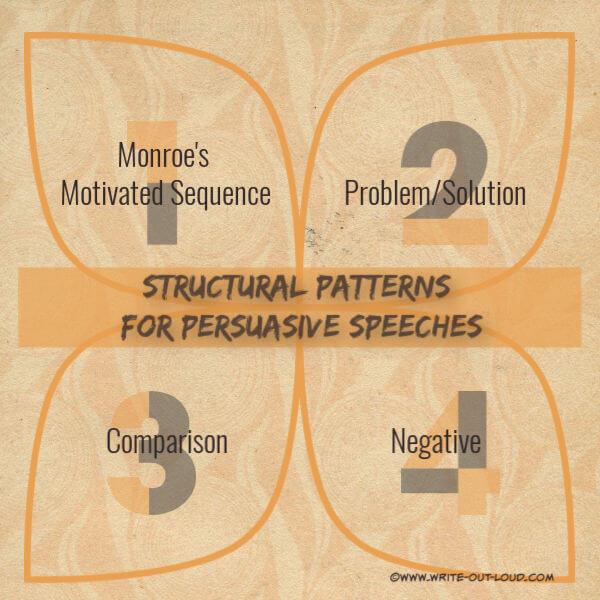
1) Monroe's Motivated Sequence
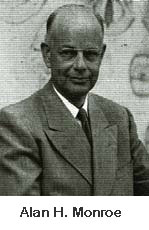
This is a tried and tested model developed in the 1930's by Allan H Monroe. Monroe's Motivated Sequence follows the normal mind-flow or thought sequence someone goes through when someone else is persuading them to do something.
It's a pattern used over and over again by the professional persuaders: marketers, advertisers, politicians ...
Monroe's Motivated Sequence in action
You can find out more about the five steps involved in writing a persuasive speech using Monroe's Motivated Sequence here. There's an explanation with examples of each step, and a printable blank outline template to download.
There's also an example persuasive speech to read that uses the method.
2) Problem/Solution
This is a two step pattern. The first part outlines/explains the problem
and the second provides the solution which includes meeting the
obstacles and giving evidence.
3) Comparison
In this pattern the method is to compare an item/object/idea/action against another similar item/object/idea/action and establish why the item/object/idea/action you are supporting is superior.
Example: Why a SBI website is better than a Wordpress site if you want to build an online business
- Reason One
Wordpress primarily is a blogging platform and blogging is not a business model - Reason Two
Wordpress does not supply fully integrated step-by-step instructions to build a sustainable e-business - Reason Three
Wordpress does not provide its users with constant and fully tested upgrades/updating
With each comparison point compelling, relevant evidence is provided and obstacles are met.
(If
you're curious check out the SBI v Wordpress comparison. There are many more than three reasons why SBI is the preferred online
business platform! Wordpress or SBI? And these days you can actually have both through SBI.)
4) Using the negative to persuade
In this model the reasons why you are against the opposition of your chosen topic are highlighted.
Example: The topic is Teenage Binge Drinking and the angle is to persuade parents to take more control
- Leads to anti-social behavior - for example, mindless vandalism, drunk-driving, and unprotected sex
- Impacts on growing brains - an overview of current research
- Has implications for developing addictions - alcoholism, nicotine ...
Each
negative reason is backed with evidence. One piles on top the other
creating an urgency to solve the problem. Your positive solution coming
at the end of the speech clinches the argument.


More speech resources
For more about the processes involved in writing a successful speech check these pages:

For more about delivering your persuasive speech persuasively please don't overlook these pages. They are gold! Writing is a only part of the process. How you deliver completes it.





From fear to fun in 28 ways
A complete one stop resource to scuttle fear in the best of all possible ways - with laughter.