- HOME ›
- Speech examples ›
- Student Council speeches
Student Council Speeches
By: Susan Dugdale
How to write a winning speech: a template, guidelines, plus example speeches
Student Council Speeches mark the end of an election campaign.
Will yours be successful?
The final answer is in the hands of your fellow students. It's entirely their decision.
However, up until they mark their voting papers 'yes' or 'no' you have the potential to make their choice of candidate for the upcoming year 'you'.
How to write a great student council speech
Use the quick links below to find what you need to write a great student council speech, whether it's the President, Vice-President, Secretary or Treasurer role you're after.

- the primary purpose of your speech
- a template that includes all the necessary elements of a good Student Council speech
- points to consider carefully before you write
- an example Student Council President speech
- an example Student Council Vice President speech
- an example Student Council Secretary speech
- an example Student Council Treasurer speech
- a printable speech planner and outline to download
- vital tips for rehearsal. These make the difference between looking and sounding polished and bumbling.
- a link to a collection of videoed student council speeches
- how to manage anxiety about speaking in front of others
Understanding your speech purpose
Understanding the nature or purpose of your speech could make all the difference between winning and losing.
Student Council speeches are persuasive speeches. Their ultimate goal is to get you the YES vote.
To help you achieve that use the template, (framework or pattern), below to cover all the essential elements you need to pull together.
In addition, it will structure your speech logically, and effectively, from its opening through to its close.
(I've turned the template into a printable enabling you to plan and outline your speech efficiently and easily. You can download it from the link further down the page.)
Student Council speeches template
Introduction

- Greeting - Attention Getter - The Hook
You'll need an opening statement or rhetorical question to sit your audience up with open ears and minds. For more see: How to write a speech introduction: 12 of the best ways to start.
- Who you are - your name, your place or grade in the school, and maybe, your hobbies or interests, and the clubs or teams you're a member of. For example, Amnesty International, the speech and debate club, cross-country and basketball.
And if you've used a campaign slogan work it in. It'll jog people's memories. 'Ah, yes, that person!', they'll think. Being known and familiar gives you a head start. - What you want - the role you are campaigning for: President, Vice President, Treasurer, Secretary, Historian...
- What you are going to do for the audience - benefits to them in exchange for their vote.
(Brief summary -you will expand this in the body of your speech.) - Credibility - your qualification or expertise establishing your fitness for the role you want.
(Brief summary - you will expand this in the body of your speech.) - Transition leading to...
Body
- Your Main Idea 1 - For example: your goal for the role, what you want to achieve, how you plan to do it, the benefits to your audience - what painful problem(s) will you solve for them, your fitness for the job, transition to...
- Main Idea 2 - Supporting ideas - details and examples - transition to...
- Main Idea 3 - Supporting ideas - details and examples - transition to...
NB. Only include a second and third idea if you have time to expand on them. If not, move through to the conclusion.
Conclusion
- Summary of main points
- Re-statement of what you want - to be elected to the role you're running for
- Re-statement of the benefits to the audience
- Closer, clincher, call for action
Points to consider BEFORE you write your speech

You'll make a better job of completing the printable student council speech template if you take the time to go through the points below.
And then, read the student council speech examples, before you start to write.
Research the role
Know the scope of the position you're campaigning for.
What tasks are you expected to fulfill?
What skills do you need to do them well?
Organizational? Time-management? Communication? Leadership?
What qualities are you expected to show?
Empathy, honesty, loyalty, creativity, reliability, inclusivity...Think about your audience
Who are you speaking to?
What are their concerns?
What problem(s) do they want or expect you to solve on their behalf?What tone or choice of vocabulary is best suited to them?
Avoid trying to impress with either 'big' words or use of slang. Both are traps! Be yourself. Authentic. Real.
Keep your language conversational rather than overly formal and use smaller rather than large sentences.
Try using active rather than passive words. These convey enthusiasm. For examples, see this page on using action verbs. You'll discover how to go from boring bla bla bland to dynamic excitement.
What 'hook' will you use to get them to listen? Humor?
Humor is good if it is relevant and inclusive rather than exclusive. (No 'in' jokes!).Your goal in the role you want
What exactly do you want to achieve?
Is it possible?
Do you have a plan?Avoid setting up expectations that you will deliver beyond your capability. :-)
It might be very tempting, but can you really reduce school hours, increase academic standards, introduce a range of exciting new extracurricular activities, as well as have a 'green day' and a movie night every month? Please keep it real!
Your credibility or qualifications
What makes you fit for the role? Your previous leadership experience? Your personal characteristics?Now is not the time either to be shy or arrogantly big-headed! Let the audience know how right you are for the role you want.
Set yourself apart from other candidates by sharing compelling personal stories or anecdotes that both support your pitch, and show you understand the key issues that matter to your fellow students.
Your school's requirements
Many schools require speeches to be submitted to staff members before they are delivered.If your speech does not meet pre- established criteria in any way you may find it is returned to you edited. It's safer to find out what those criteria are BEFORE writing to avoid having to re-write or worse, being disqualified entirely.
Fairness
You are competing against your peers but do so in way that reflects how you would want to be treated.Mockery and personal insults are not clever. They boomerang back on you, letting your audience know you're not to be trusted and neither are you ready for leadership.
Readily acknowledging the skill and expertise of your fellow candidates sincerely in a way that doesn't demean yourself, or them, shows an open mind and maturity.
Aim to have your speech ready BEFORE the deadline.
Give yourself time to prepare thoroughly, including time to review of your opponents' campaigns. That can be very useful for seeing their strengths as well as their weaknesses, which you can then respond to in your own material.
Student Council President speech example
Here's a sample student council speech. I've written it from the perspective of someone running for President.
As you read it, imagine it said aloud. That will help you get the rhythm and flow of language. The speech is between 3 - 4 minutes long, depending on how quickly you speak.
Vote Sophia Clarke for Student Council President
"I’ve got a question for you. I’m not asking you to shout your answer out, or raise your hand. All I’m asking is that you give it room in your mind. Let it sit for a bit, and have a think about it.
My question is – do you believe like I do, that all of us deserve the opportunity to make the best of ourselves? Not second best, 3rd, or even, highly commended. The BEST.
I’m Sophia Clarke. I’m in the 12th grade, and I’m running for president. My vision is that each student is enabled to develop the skills and confidence to become the bigger, better version of themselves. The best they can be. Regardless of who they are, and what they need to achieve that.
It’s an audacious goal. Some would say an idealistic, rather than a realistic, one.
However I say it’s awesome. And that you’re intelligent people who realize that reaching any goal starts with taking the first step.
So let me remind you why choosing me, Sophia Clarke, for president, is also choosing a better chance for yourself, and everyone else to grow.
I know you, and I know your needs well. I’ve served on your behalf in multiple roles through my years here; secretary, auditor, public relations officer, and have successfully taken on multiple issues. You’ll know some of those through directly benefiting from them.
It was me who was behind the push to get a regular anti-bullying program running throughout the school. That was two years ago, and now the Teens Against Bullying message underpins what we expect and strive for in our every day dealings with each other.
We know incidents of bullying are far fewer as a result. As our orange tee shirts say we ‘choose kindness, acceptance and inclusion’ for each other, and our selves.
Who has been involved in our mentoring-homework program? Either as a buddy-tutor or as a student getting a helping hand? And who, like me, is passionate about making sure that everybody gets a fair go?
In the past year, under my watch that program has escalated. We have over 50% more tutors across more subject areas and more students taking up the offer of help. That is a fabulous outcome for everybody. Truly win-win.
A tick in the box alongside my name is a tick for the continued growth of those programs. Their value is proven. They allow each of us to grow and experience the strength and confidence that comes from knowing that we can make a positive difference in other people’s lives as well as our own.
When you vote me for President you get my capacity to organize, to liaise, to listen and to speak, working for the benefit of everybody.
A 'yes' for me is a 'yes' for appreciating and celebrating diversity.
A 'yes' for me, Sophia Clarke for President, is 'yes' to a better you.
And together that is a 'yes' to a better life, and a better school, for all of us."
Student Council Vice President speech example
Like the speech above, this one runs to approximately 4 minutes when said aloud. Try it and see.
Nod your head if you've heard of the phrase '2nd fiddle' or '2IC'.
No?
What about 'sidekick'?
Not booting a ball in from a sideline but a trusty partner to whoever it is who has the leading role. Like Robin is for Batman.
Or like, {name of your country's Vice President or Prime Minister} is for {name of country's President or Prime Minister} or {name of your school's Vice Principal} is for {name of your school's Principal}!
Well, that's what I aspire to - to become the trusty, tried and true sidekick to the President on our student council.
My name is Jason Hull. I'm in Grade 12 and proudly standing in front of you today as a candidate for the role of Vice President. Yes, I am asking you to give me something of immense value - your vote.
I know what the issues, here at {name of school} are. As part of my campaign, I've interviewed you, and listened. I promise your ideas will be acted on.
Afterall I've trained for this role, put in the time. You know, I know how to get things done.
Last year I served as Secretary and the year before that I was a representative for the committee - proof that I'm committed to bettering our school environment not just for you, but for everybody!
With your support, I'll be your go-to guy when you want to make sure that your opinions and feedback reach the decision-makers.
One of my main goals as your Vice President is to champion your initiatives: amongst others, that's the library extensions you told me about, the desire for healthier food choices in our cafeteria, and the urgent need to increase and diversify the workforce and out-reach opportunities that so many of you mentioned.
Whether you're passionate about improving our school facilities, or enhancing our community involvement, I'll be there to guide and help you.
In the role of Vice President, I will work alongside the President fulfilling my duties to the best of my ability.
Together, we'll make sure that your concerns, and hopes are not just heard but actively pursued. Not 'I' will make sure, but 'we'.
There is no 'I' in we, and that too, is a prerequisite of the Vice President's position: the capacity to put aside ego and to work productively for the good of all.
Because together, we, the Vice President, the President and the other council members, are stronger and can achieve more.
The Vice President role may be a support act but it's a vital one. To succeed in it, collaboration is key. I promise to work hand in hand not only with the President but also with the entire student council team, our teachers, and our administration on your behalf.
Unity is strength. More than ever, we need to nurture understanding, kindness and respect for each other. Regardless of your grade, interests, or background, I want every one of you to feel valued and heard.
That's a goal many would say is impossible.
However, I say, we need to be the difference we want to see in the world. And to borrow those famous words of Helen Keller's: "Alone we can do so little. Together we can so much."
It would be an honor to be your voice, your eyes and your ears as Vice President.
So, I ask you, will you trust me to have your best interests at heart? Will you enable me to work on your behalf?
And are you willing to give me, Jason Hull, your vote for best sidekick, aka. Vice President?
I'll take those smiles, as a 'Yes'.
Thank you.
Example Student Council speeches for Secretary and Treasurer
Click the link to read an:
- example Student Council speech for the role of Secretary. Plus, an overview of the Secretary's main tasks and responsibilities.
- example Student Council speech for the role of Treasurer. Plus, an overview of the Secretary's main tasks and responsibilities.
(This page was getting far too long to include them both here. ☺)
Get the printable student council speech outline
Click on the image below to open a downloadable printable student council speech planner and outline pdf. (Please note it will open in a new window.)
Your completed outline will provide both the structure and the content you need to efficiently write your speech.
After you've finished writing your speech
Now that you've finished writing, you're ready to begin work on your delivery: how you present the speech to your audience.
The first step in that process is making sure your speech fits comfortably into whatever time you've been allocated.
After that comes rehearsal. The information you need for both steps is below.
Timing and word count
Student Council Speeches are generally brief: around 1-4 minutes long which isn't a lot of time! That's between approximately 150 - 600 words at an average speaking rate of 150 words per minute.
To be safe say your speech out loud as if you were delivering it for real and time it. In some schools going overtime can result in being disqualified.
Going faster to fit everything in
Please do not be tempted to say it faster to get everything you planned said. As a strategy it doesn't work. You'll end up gabbling: speaking far too quickly and people won't be able to understand what you're saying.
Cutting out extra material
If you have got too much material for the time limit, cut it. Choose the least important ideas to let go of first. Then move on to rephrasing to reduce the number of words used to express a point.
When you think it's done, repeat the test. Say it out loud as if you were actually giving it, and time it.
If you're now within the allotted time, you are ready for rehearsal.
For more about word count see: how many words per minute in a speech
How to rehearse your speech

Please, please rehearse your speech! Do not be tempted to wing it.
The more you rehearse the easier it will be to deliver it well.
Remember it is only 1 to 4 minutes long! In that time your goal is to have your audience ready to vote for you.
You can help them make that decision by being confident and prepared. You will show that through:
- your speaking style - natural, sincere, fluent, understandable (clear and able to be heard without straining)
- your body language - relaxed, open gestures, good eye contact and smiling
- your personal grooming or presentation because how you look 'speaks' too.
Make sure that your clothing and general grooming supports your speech because, like it or not, you will be judged on both!
Videoed Student Council speech examples
How do other people handle a Student Council speech? What's their content and delivery like?
Are they funny? Formal? Too hurried? Confident? Familiar with the audience?
It can help to look at what others have done. Even if it's only to decide their way will not be your way!
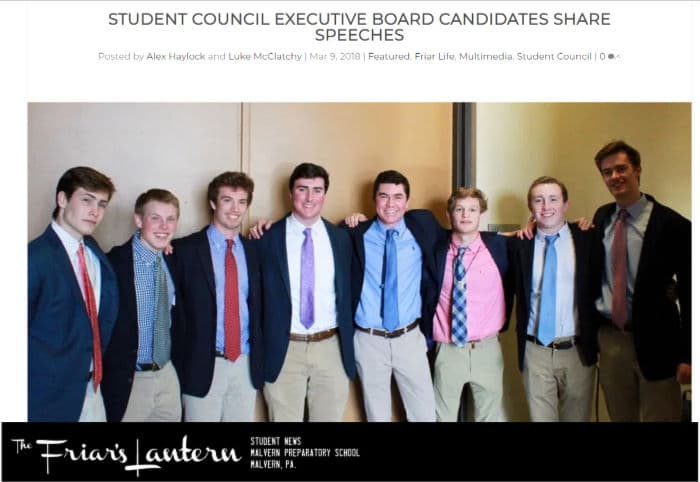
Click the link to access a collection ten videoed student council campaign speeches from the 2018 student council executive board candidates for Malvern Preparatory School, Malvern, Pennsylvania, USA.
At the foot of the article you'll find links to the videos of the school's 2015, 2016 and 2017 student council campaign speeches.
A word of warning
Elections can be very unpredictable. (That's an understatement!☺) You may have written and delivered a superb student council speech. You may even be the best candidate for the position you wanted, but nevertheless you need to understand that you might lose. Be prepared to lose graciously and to sincerely congratulate the winner.
PS. Panic not

If you find yourself getting anxious over the thought of delivering your speech, please check this page for help.



From fear to fun in 28 ways
A complete one stop resource to scuttle fear in the best of all possible ways - with laughter.