- HOME ›
- How to write a speech
How to write a good speech in 7 steps
By: Susan Dugdale
- an easily followed format for writing a great speech
Did you know writing a speech doesn't have be an anxious, nail biting experience?
Unsure? Don't be.
You may have lived with the idea you were never good with words for a long time. Or perhaps giving speeches at school brought you out in cold sweats.
However learning how to write a speech is relatively straight forward when you learn to write out loud.
And that's the journey I am offering to take you on: step by step.
To learn quickly, go slow
Take all the time you need. This speech writing format has 7 steps, each building on the next.
Walk, rather than run, your way through all of them. Don't be tempted to rush. Familiarize yourself with the ideas. Try them out.
I know there are well-advertised short cuts and promises of 'write a speech in 5 minutes'. However in reality they only truly work for somebody who already has the basic foundations of speech writing in place.
The foundation of good speech writing
These steps are the backbone of sound speech preparation. Learn and follow them well at the outset and yes, given more experience and practice you could probably flick something together quickly. Like any skill, the more it's used, the easier it gets.
In the meantime...
Step 1: Begin with a speech overview or outline
Are you in a hurry? Without time to read a whole page?
Grab ...
The Quick How to Write a Speech Checklist
And come back to get the details later.
Before you start writing you need to know:
- WHO you are writing your speech for (your target audience)
- WHY you are preparing this speech. What's the main purpose of your speech?
Is it to inform or tell your audience about something?
To teach them a new skill or demonstrate something?
To persuade or to entertain?
(See 4 types of speeches: informative, demonstrative, persuasive and special occasion or entertaining for more.)
What do you want them to think, feel or do as a result of listening the speech? - WHAT your speech is going to be about (its topic)
- You'll want to have thought through your main points and have ranked them in order of importance. And have sorted the supporting research you need to make those points effectively. - HOW much time you have for your speech eg. 3 minutes, 5 minutes... The amount of time you've been allocated dictates how much content you need. If you're unsure check this page: how many words per minute in a speech: a quick reference guide. You'll find estimates of the number of words required for 1 - 10 minute speeches by slow, medium and fast talkers.
Use an outline
The best way to make sure you deliver an effective speech is to start by carefully completing a speech outline covering the essentials: WHO, WHY, WHAT and HOW.
Beginning to write without thinking your speech through is a bit like heading off on a journey not knowing why you're traveling or where you're going to end up. You can find yourself lost in a deep, dark, murky muddle of ideas very quickly!
Pulling together a speech overview or outline is a much safer option. It's the map you'll follow to get where you want to go.
Get a blank speech outline template to complete
Click the link to find out a whole lot more about preparing a speech outline. ☺ You'll also find a free printable blank speech outline template. I recommend using it!
Understanding speech construction
Before you begin to write, using your completed outline as a guide, let's briefly look at what you're aiming to prepare.
The basic format for writing a speech is simple. It consists of three parts:
- an opening or introduction
- the body where the bulk of the information is given
- and an ending (or summary).
Imagine your speech as a sandwich
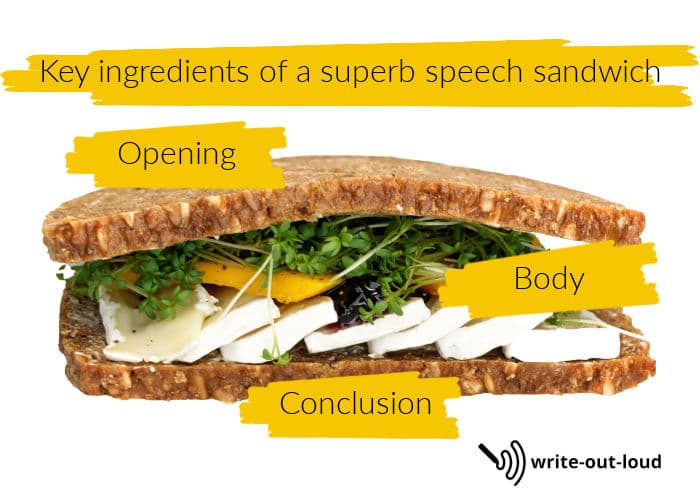
If you think of a speech as a sandwich you'll get the idea.
The opening and ending are the slices of bread holding the filling (the major points or the body of your speech) together.
You can build yourself a simple sandwich with one filling (one big idea) or you could go gourmet and add up to three or, even five. The choice is yours.
But whatever you choose to serve, as a good cook, you need to consider who is going to eat it! And that's your audience.
So let's find out who they are before we do anything else.
Step 2: Know who you are talking to
Understanding your audience
Did you know a good speech is never written from the speaker's point of view? (If you need to know more about why check out this page on building rapport.)
Begin with the most important idea/point on your outline.
Consider HOW you can explain (show, tell) that to your audience in the most effective way for them to easily understand it.
Writing from the audience's point of view
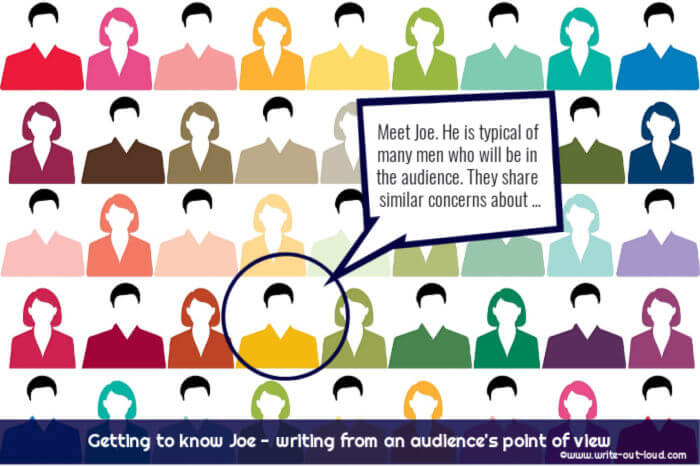
To help you write from an audience point of view, it's a good idea to identify either a real person or the type of person who is most likely to be listening to you.
Make sure you select someone who represents the "majority" of the people who will be in your audience. That is they are neither struggling to comprehend you at the bottom of your scale or light-years ahead at the top.
Now imagine they are sitting next to you eagerly waiting to hear what you're going to say. Give them a name, for example, Joe, to help make them real.
Ask yourself
:- How do I need to tailor my information to meet Joe's needs?
For example, do you tell personal stories to illustrate your main points?
Absolutely! Yes. This is a very powerful technique. (Click storytelling in speeches to find out more.) - What type or level of language is right for Joe as well as my topic?
For example, if I use jargon (activity, industry or profession specific vocabulary) will it be understood?
Step 3: Writing as you speak
Writing oral language
Write down what you want to say about your first main point as if you were talking directly to Joe.
If it helps, say it all out loud before you write it down and/or record it.
Use the information below as a guide
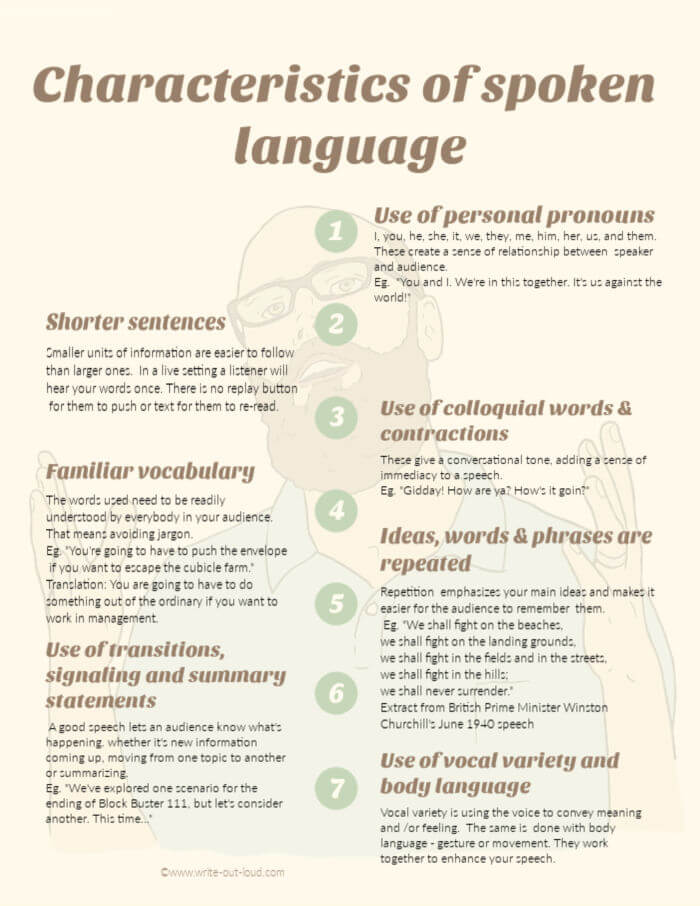
(Click to download The Characteristics of Spoken Language as a pdf.)
You do not have to write absolutely everything you're going to say down* but you do need to write down, or outline, the sequence of ideas to ensure they are logical and easily followed.
Remember too, to explain or illustrate your point with examples from your research.
(*Tip: If this is your first speech the safety net of having everything written down could be just what you need.
It's easier to recover from a patch of jitters when you have a word by word manuscript than if you have either none, or a bare outline. Your call!)
Step 4: Checking tone and language
The focus of this step is re-working what you've done in Step 2 and 3.
You identified who you were talking to (Step 2) and in Step 3, wrote up your first main point. Is it right? Have you made yourself clear? Check it.
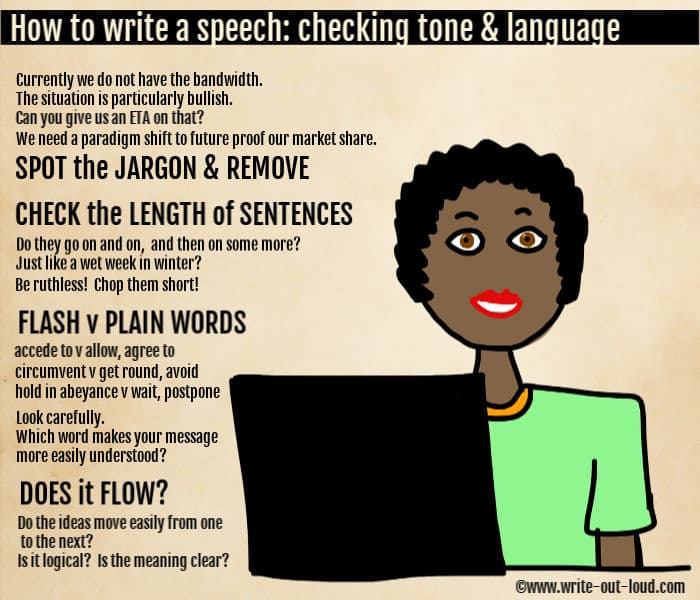
How well you complete this step depends on how well you understand the needs of the people who are going to listen to your speech.
Please do not assume because you know what you're talking about the person (Joe) you've chosen to represent your audience will too. Joe is not a mind-reader!
How to check what you've prepared
- Check the "tone" of your language.
Is it right for the occasion, subject matter and your audience? - Check the length of your sentences.
You need short sentences. If they're too long or complicated you risk losing your listeners. - Have you chosen words everybody will understand?
There are 5 cent words and $5.00 words. Why use a $5.00 one when a 5 cent one tells it better?
Example: He "spat" = 5 cents. He "expectorated" = $5.00Check for jargon too. These are industry, activity or group exclusive words.
For instance take the phrase: authentic learning. This comes from teaching and refers to connecting lessons to the daily life of students. Authentic learning is learning that is relevant and meaningful for students. If you're not a teacher you may not understand the phrase.
The use of any vocabulary requiring insider knowledge needs to be thought through from the audience perspective. Jargon can close people out.
- Read what you've written out loud.
If it flows naturally, in a logical manner, continue the process with your next main idea. If it doesn't, rework. - Remember you are writing "oral language".
You are writing as if you were explaining, telling or showing something to someone. It doesn't have to be perfect sentences. We don't talk like that.We use whole sentences and part ones, and we mix them up with asides or appeals e.g. "Did you get that? Of course you did. Right...Let's move it along. I was saying ..."
Click for more about the differences between spoken and written language.
And now repeat the process
Repeat this process for the remainder of your main ideas.
Because you've done the first one carefully, the rest should follow fairly easily.
Step 5: Use transitions
Providing links or transitions between main ideas
Between each of your main ideas you need to provide a bridge or pathway for your audience. The clearer the pathway or bridge, the easier it is for them to make the transition from one idea to the next.
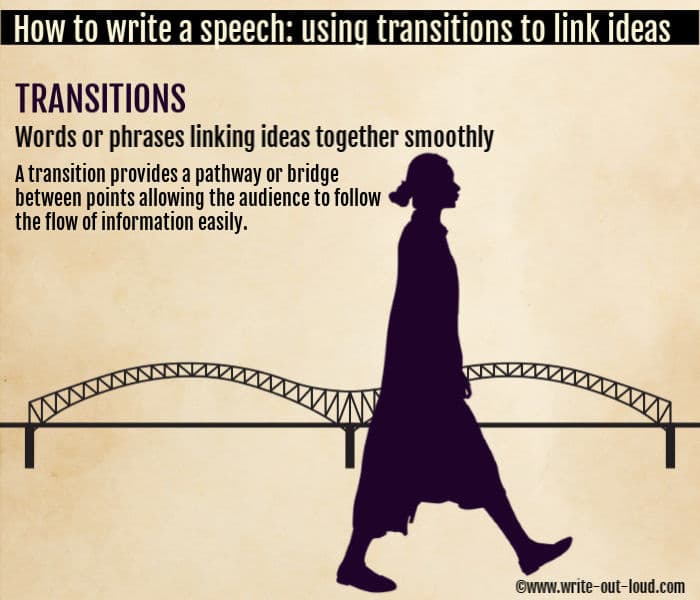
If your speech contains more than three main ideas and each is building on the last, then consider using a "catch-up" or summary as part of your transitions.
Is your speech being evaluated?
Find out exactly what aspects you're being assessed on using this standard speech evaluation form
Link/transition examples
A link can be as simple as:
"We've explored one scenario for the ending of Block Buster 111, but let's consider another. This time..."
What follows this transition is the introduction of Main Idea Two.
Here's a summarizing link/transition example:
"We've ended Blockbuster 111 four ways so far. In the first, everybody died. In the second, everybody died BUT their ghosts remained to haunt the area. In the third, one villain died. His partner reformed and after a fight-out with the hero, they both strode off into the sunset, friends forever. In the fourth, the hero dies in a major battle but is reborn sometime in the future.
And now what about one more? What if nobody died? The fifth possibility..."
Go back through your main ideas checking the links. Remember Joe as you go. Try each transition or link out loud and really listen to yourself. Is it obvious? Easily followed?
Keep them if they are clear and concise.
For more about transitions (with examples) see Andrew Dlugan's excellent article, Speech Transitions: Magical words and Phrases .
Step 6: The end of your speech
The ideal ending is highly memorable. You want it to live on in the minds of your listeners long after your speech is finished. Often it combines a call to action with a summary of major points.
Example speech endings
Example 1:
The desired outcome of a speech persuading people to vote for you in an upcoming election is that they get out there on voting day and do so. You can help that outcome along by calling them to register their support by signing a prepared pledge statement as they leave.
"We're agreed we want change. You can help us give it to you by signing this pledge statement as you leave. Be part of the change you want to see!
Example 2:
The desired outcome is increased sales figures. The call to action is made urgent with the introduction of time specific incentives.
"You have three weeks from the time you leave this hall to make that dream family holiday in New Zealand yours. Can you do it? Will you do it? The kids will love it. Your wife will love it. Do it now!"
How to figure out the right call to action
A clue for working out what the most appropriate call to action might be, is to go back to your original purpose for giving the speech.
- Was it to motivate or inspire?
- Was it to persuade to a particular point of view?
- Was it to share specialist information?
- Was it to celebrate a person, a place, time or event?
Ask yourself what you want people to do as a result of having listened to your speech.
For more about ending speeches
Visit this page for more about how to end a speech effectively. You'll find two additional types of speech endings with examples.
Write and test
Write your ending and test it out loud. Try it out on a friend, or two. Is it good? Does it work?
Step 7: The introduction
Once you've got the filling (main ideas) the linking and the ending in place, it's time to focus on the introduction.
The introduction comes last as it's the most important part of your speech. This is the bit that either has people sitting up alert or slumped and waiting for you to end. It's the tone setter!
What makes a great speech opening?
Ideally you want an opening that makes listening to you the only thing the 'Joes' in the audience want to do.
You want them to forget they're hungry or that their chair is hard or that their bills need paying.
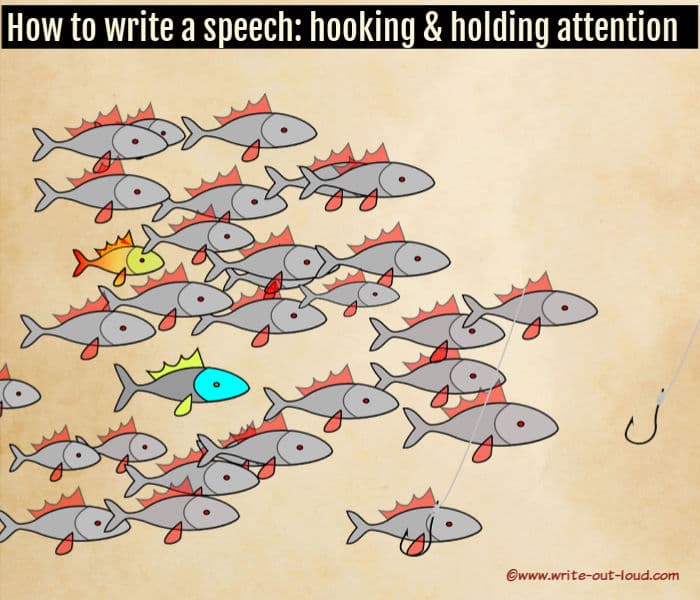
The way to do that is to capture their interest straight away. You do this with a "hook".
Hooks to catch your audience's attention
Hooks come in as many forms as there are speeches and audiences. Your task is work out what specific hook is needed to catch your audience.
Go back to the purpose. Why are you giving this speech?
Once you have your answer, consider your call to action. What do you want the audience to do, and, or take away, as a result of listening to you?
Next think about the imaginary or real person you wrote for when you were focusing on your main ideas.
Choosing the best hook
Ask yourself, if I were him/her what would appeal?
- Is it humor?
- Would shock tactics work?
- Is it a rhetorical question?
- Is it formality or informality?
- Is it an outline or overview of what you're going to cover, including the call to action?
- Or is it a mix of all these elements?
A hook example
Here's an example from a fictional political speech. The speaker is lobbying for votes. His audience are predominately workers whose future's are not secure.
"How's your imagination this morning? Good? (Pause for response from audience) Great, I'm glad. Because we're going to put it to work starting right now.
I want you to see your future. What does it look like? Are you happy? Is everything as you want it to be? No? Let's change that. We could do it. And we could do it today.
At the end of this speech you're going to be given the opportunity to change your world, for a better one ...
No, I'm not a magician. Or a simpleton with big ideas and precious little commonsense. I'm an ordinary man, just like you. And I have a plan to share!"
And then our speaker is off into his main points supported by examples. The end, which he has already foreshadowed in his opening, is the call to vote for him.
Prepare several hooks
Experiment with several openings until you've found the one that serves your audience, your subject matter and your purpose best.
For many more examples of speech openings go to: how to write a speech introduction. You'll find 12 of the very best ways to start a speech.

That completes the initial seven steps towards writing your speech. If you've followed them all the way through, congratulations, you now have the text of your speech!
Although you might have the words, you're still a couple of steps away from being ready to deliver them. Both of them are essential if you want the very best outcome possible. They are below. Please take them.
Step 8: Checking content and timing
This step pulls everything together.
Check once, check twice, check three times & then once more!
Go through your speech really carefully.
On the first read through check you've got your main points in their correct order with supporting material, plus an effective introduction and ending.
On the second read through check the linking passages or transitions making sure they are clear and easily followed.
On the third reading check your sentence structure, language use and tone.
Double, triple check the timing
Now go though once more.
This time read it aloud slowly and time yourself.
If it's too long for the time allowance you've been given make the necessary cuts.
Start by looking at your examples rather than the main ideas themselves. If you've used several examples to illustrate one principal idea, cut the least important out.
Also look to see if you've repeated yourself unnecessarily or, gone off track. If it's not relevant, cut it.
Repeat the process, condensing until your speech fits the required length, preferably coming in just under your time limit.
You can also find out how approximately long it will take you to say the words you have by using this very handy words to minutes converter. It's an excellent tool, one I frequently use. While it can't give you a precise time, it does provide a reasonable estimate.

Step 9: Rehearsing your speech
And NOW you are finished with writing the speech, and are ready for REHEARSAL.

Please don't be tempted to skip this step. It is not an extra thrown in for good measure. It's essential.
The "not-so-secret" secret of successful speeches combines good writing with practice, practice and then, practicing some more.
Go to how to practice public speaking and you'll find rehearsal techniques and suggestions to boost your speech delivery from ordinary to extraordinary.
The Quick How to Write a Speech Checklist
Before you begin writing you need:
- Your speech OUTLINE with your main ideas ranked in the order you're going to present them.
(If you haven't done one complete this 4 step sample speech outline. It will make the writing process much easier.) - Your RESEARCH
- You also need to know WHO you're speaking to, the PURPOSE of the speech and HOW long you're speaking for
The basic format
Your speech will have three parts:
- an opening or introduction
- the body where you present your main ideas
- an ending
Split your time allowance so that you spend approximately 70% on the body and 15% each on the introduction and ending.
How to write the speech
- Write your main ideas out incorporating your examples and research
- Link them together making sure each flows in a smooth, logical progression
- Write your ending, summarizing your main ideas briefly and end with a call for action
- Write your introduction considering the 'hook' you're going to use to get your audience listening
- An often quoted saying to explain the process is:
Tell them what you're going to tell them (Introduction)
Tell them (Body of your speech - the main ideas plus examples)
Tell them what you told them (The ending)
TEST before presenting. Read aloud several times to check the flow of material, the suitability of language and the timing.







From fear to fun in 28 ways
A complete one stop resource to scuttle fear in the best of all possible ways - with laughter.