- HOME ›
- Understanding demonstration speeches
What is a demonstration speech?
- the essentials of great 'how to' speeches
By: Susan Dugdale | Last modified: 08-27-2023
What are the characteristics of great demonstration speeches?
In a nutshell, an effective demonstration speech teaches. Your audience, through listening, watching or actively participating, learns something new.
As their guide, you will take them through a 'show and tell' covering each step of the process in chronological order from set-up to finish. Think of it as a 'how-to' type of speech.
It's a variation of an informative speech with visual aids, (often powerpoint presentations) and it's used everywhere: in classrooms, training centers, lecture theatres and other places: sometimes well, sometimes badly.
What's on this page:
- how to choose an excellent demonstration speech topic: 5 vital aspects to take into account before settling on a topic, links to 3 pages of good demonstration speech ideas
- how to plan, prepare and deliver a good speech - a step-by-step guide
- links to more resources eg. a printable demonstration speech outline, rehearsal guidelines ...
Choosing the perfect topic

Before you leap enthusiastically on a 'how to' topic and decide that's the one for you, it's a smarter, and better idea to think through the five following tips. They're here to help.
1.Who is your target audience? What will be of interest to them?
It's much, much harder to persuade a disinterested and bored audience that you have something vitally interesting to show and teach them!
Ask yourself:
- Why does my audience want to listen to my speech on xxx {insert your particular topic idea}?
- What benefit or value will they gain from it?
- Will it save them money?
- Will it save them time?
- Will it make them smile?
- Will it make them a better person? How?
Put yourself in their shoes. If you were them, is there an angle that could make your topic irresistibly appealing?
How are their lives going to be made better through your demonstration speech?
We pay attention and listen when we're satisfied there's something in it for us. (It's the WIIFM principle at work: What's in it for me?)
2. Can this topic be broken down into easily followed sequential steps?
If the answer is 'YES', how many steps are needed from start to finish? The fewer steps there are, the easier it is for an audience to follow you.
If the answer is 'NO' you'll need to think again.
3. Can this topic adapt to fit the setting for the speech?
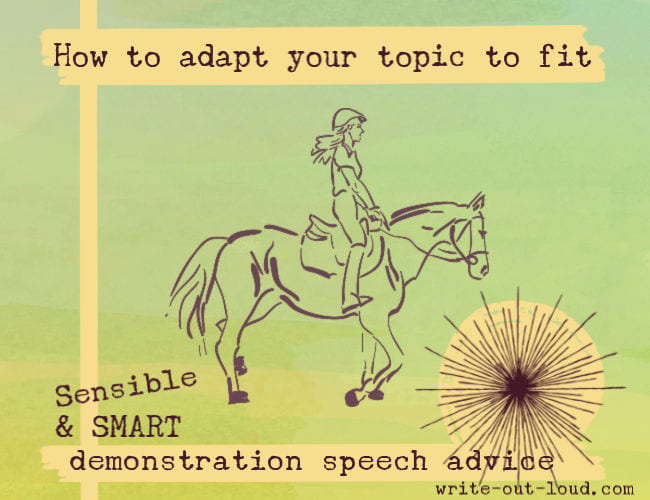
For example: My preferred topic is 'How to saddle a horse correctly'.
The setting for my speech is the classroom, or perhaps a hall. Understandably, I won't be bringing my horse along because I don't want to frighten it, or my teachers! ☺
However is there another way to show saddling a horse? Could I use video-clips I shot and edited? Or a sequence of photographs?
Before you get too involved in looking for alternatives to bringing along the real thing ...
4. Check the assessment guidelines
If your speech is part of an assessment process, be sure to ask before committing yourself to using media forms like power point or video. It would be really disheartening to find out too late that what you had used was not permitted.
5. Am I passionate about, or genuinely interested, in the topic?
Your enthusiasm (or lack of it) for what you are speaking about communicates directly with the audience. It bypasses your words and shows in your body language.
Are you committed? Are you interested? Do you really care?
Great demonstration speeches are a combination of confidence and information. You need both to succeed.
Now choose your topic!
Here's a collection of 290+ demonstration speech topics, including that evergreen favorite: 'how to choose a pet'.

There's another selection of good demonstrative speech topics here arranged by theme: business, entertainment, frugal living, caring, public speaking.
And yet another splendid collection here:

50 how to speech ideas focusing on soft skills.
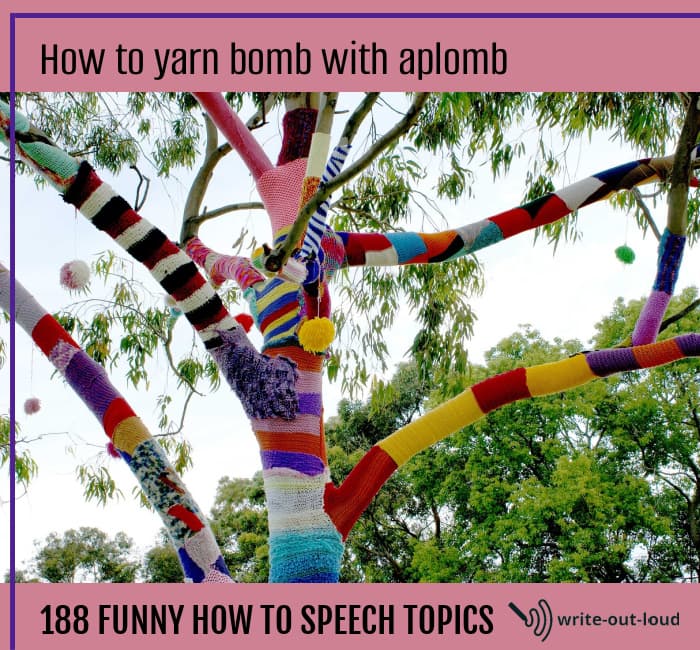
There's also 188 funny how to speech topics, including How to yarn bomb with aplomb! ☺
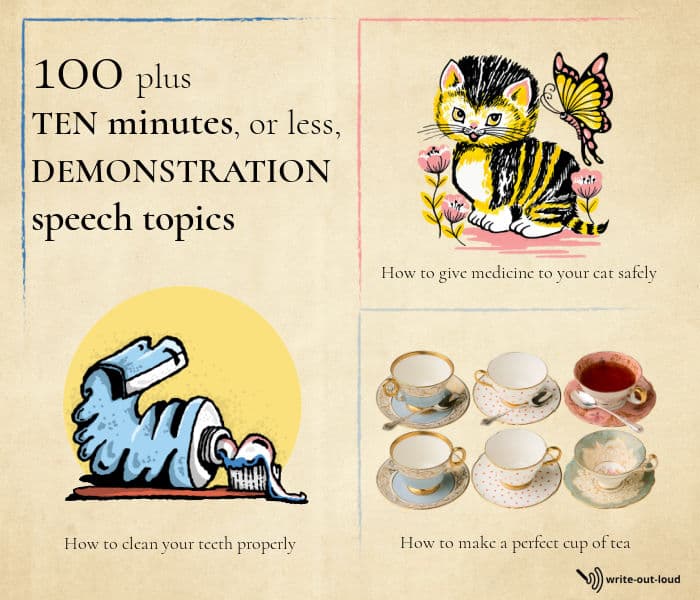
And 100+ 10 minutes (or less) demonstration speech topics.
When you've chosen come back for delivery suggestions. The success of your demonstration speech, aside from choosing a great topic, lies in your planning, preparation and delivery.
Planning, preparation & delivery of your speech
Planning and Preparation
The goal of any 'how to', or demonstration speech is to successfully teach those listening and watching a process or skill. Your speech's success, or failure, relies on how you teach or show the steps needed to achieve the desired result.

For example: if your demonstration speech is about 'how to knot a tie', then the desired result is an audience capable of knotting their own ties or at the very least, inspired to try. ☺
Use a structured 3-part format
To give yourself and your audience the best chance of achieving what you want, your 'show and tell' needs a well-thought through 3-part format.You will have an introduction in which you tell the audience the specific thing they're going to learn, why they'll benefit from learning it and give them a brief overview of the process involved.
Next you have the body of the speech. This is the demonstration itself and lastly, you'll have a conclusion summarizing what it is that's been learned, reinforcing its benefits and finish with a question-and-answer session.
Woven throughout each of these segments you'll use visual aids or props, (either the items themselves or charts, diagrams, photographs, video etc.), and personal stories to illustrate.
You may even invite audience participation if it's appropriate. For example, if you're tying ties, then having one for everybody to practice with as you're going through the steps would be an excellent idea.
The body of demonstration speeches
In your planning concentrate on the outcome you want and then focus on the logical steps needed to achieve it. This will form the body of your speech.
The easiest way to get this part right is by doing it yourself.
As you go through the process, (of making a friendship bracelet, tying a tie, fixing a flat tire on your bike, leaving an effective telephone message asking for assistance from a business ...), keep your audience in your mind.
Put yourself in their shoes, hear through their ears, see through their eyes ...
What do they need to know about each step?
What will make it easier for them to understand?
Do they need to see it?
Do they need to do it?
Do you need to include every step or can you safely either miss some out, or clump them together?
Talk through the entire process out loud to yourself making sure you use simple language which is free of jargon. Or if you do use specialist words, that you explain them fully.
This is the heart of your speech, and you will want to make sure you have found and sorted any potential problems well before you deliver it.
Getting feedback
When you think you have it flowing smoothly invite a few trusted people to watch. Ask for feedback so you can fine tune the balance between 'showing and telling'.
Questions you'll want answered are:
- Are the steps in the process logical?
- Are my instructions or explanations about each step clear?
- Are my visual aids or props relevant and effective?
(Click to find out more about how to use visual aids effectively.) - Is it interesting, amusing, effective? Will it hold my audience's attention?
- Does it fit within the time limit?
- What do I need to do to improve?
Once you've integrated the feedback and run it through several more times, you're ready to add your introduction and conclusion. The addition of those segments completes the 3-part speech format: introduction, body and conclusion.
Remember to leave time for a question-and-answer session too, either directly after you've finished the demonstration or after the conclusion.
(For more to help you give your speech the x-factor:
- How to write a speech introduction| 12 of the best ways to start
- How to end a speech memorably | 3 example closes with power
- How to handle a question-and-answer session well)
Complete a demonstration speech outline
To help you get the structure right, here's a blank demonstration speech outline to complete. It takes you through the entire speech each step of the way from the beginning to the end.

Filling it out carefully after you've had a couple of trial runs will make preparing cue cards* much easier. Click the image to download it.
*See the FAQs below for more about cue cards.
See a completed demonstration speech outline
If seeing a completed demonstration speech outline would help, do look at this page: demonstration speech sample outline.
I've used the same template outline that you can download from the link above. The speech itself covers the steps involved in leaving a good message.
I've also made a video (audio + slides) so that you can hear as well see the flow of information from one point to the next.
FAQs about 'how to' speeches
Do I need to write out my speech 'word for word'?
Answer:
No. In fact, it takes away from your speech considerably. It's very hard, if not impossible, to
read a script and demonstrate something at the same
time.
If you know your topic thoroughly, have rehearsed it, and completed an outline, all you really need are notes on cue cards to keep you on track.
The image below is taken from my page covering why and how to make good cue cards.
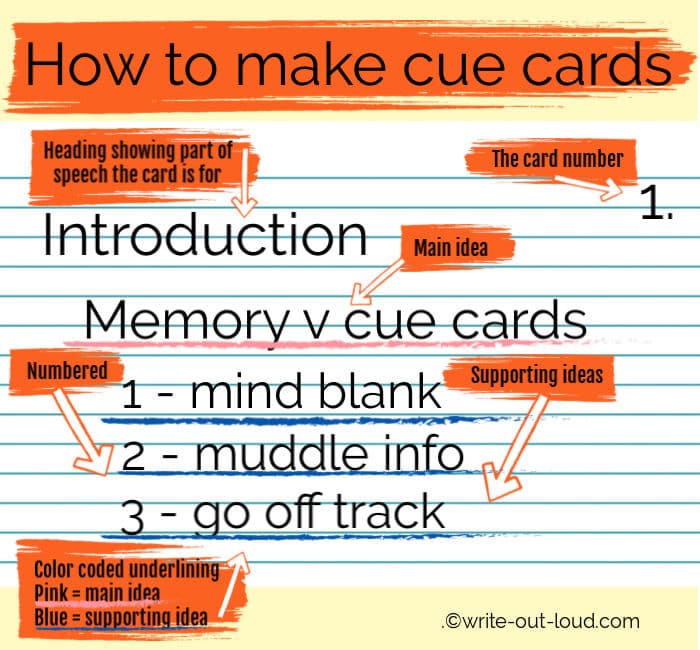
Use them, and with practice you will talk fluently and easily about each step.
This has the added advantage of making your speech more spontaneous and therefore 'real' for the audience.
(In addition, a set of cue cards is also very reassuring if you're feeling anxious about remembering the sequence everything comes in and what you want to say about each step.)
Do I really need to rehearse my speech?
Answer:
YES! Demonstration speeches are notorious for going awry. You need to rehearse to eliminate
all the possible glitches before you get in front of an audience.
It's only through rehearsal that you find out if your ideas translate well into reality. The smallest of oversights can trip you up. Rehearsal helps you find them before you have a audience watching you fall flat on your face.
Examples:
- Getting the main points muddled through not having thought them through carefully.
- Forgetting an essential piece of equipment.
- If your speech is about grooming your dog, not anticipating your normally placid Fido would take fright and bolt in front of a group of strangers!
- Spending far too much time on one or two steps which in turn means the ending is rushed and the question-and-answer session is dropped off.
Rehearsals let you identify problem areas before they become a very public embarrassment. Check out how to rehearse.

This page walks you step by step through the rehearsal process.
Can I use humor in my speech?
Answer:
Absolutely! Please do. Demonstration speeches and humor belong together. When you have your audience laughing with you, you know you're onto a good thing. The trick is to make it relevant. Click here for more about using humor in speeches.
How do I stop feeling anxious about giving my speech?
Answer:
The first thing to do is to prepare thoroughly. That's the best way to overcome anxiety. When you eliminate as many possibilities for failure as you can, you will feel more in control.

Here are 14 easily implemented and excellent strategies for dealing with fear of public speaking. (I know they work as I use them myself and, over the years have seen them work for umpteen of my students too.)
In addition to tackling anxiety head on you'll find links to pages to help with every aspect of delivery: pacing your speech, using vocal variety, how to get the power of the pause, breathing correctly, and more. (Yes, the page is a bit of a blockbuster: acute anxiety help for public speakers.)
Psst!
Are the words in your speech 'blah, blah, bland'?
Discover the joy of action verbs and make your writing vocally vibrant, succinct and precise.




From fear to fun in 28 ways
A complete one stop resource to scuttle fear in the best of all possible ways - with laughter.