- HOME ›
- Impromptu speaking tips & templates
Banish impromptu speaking blues
By: Susan Dugdale
How to prepare an impromptu speech: tips & templates to succeed
Impromptu speaking can be enough to frighten even the bravest of souls. If that's you, take heart.
Being asked to speak in public is a HUGE challenge for many people.
And being asked to come up with a good impromptu speech on a random topic as well as speak publicly at a moment's notice can catapult the task straight into the very-difficult-to-be-avoided-at-all-times-I'd-rather-die category.
I understand.
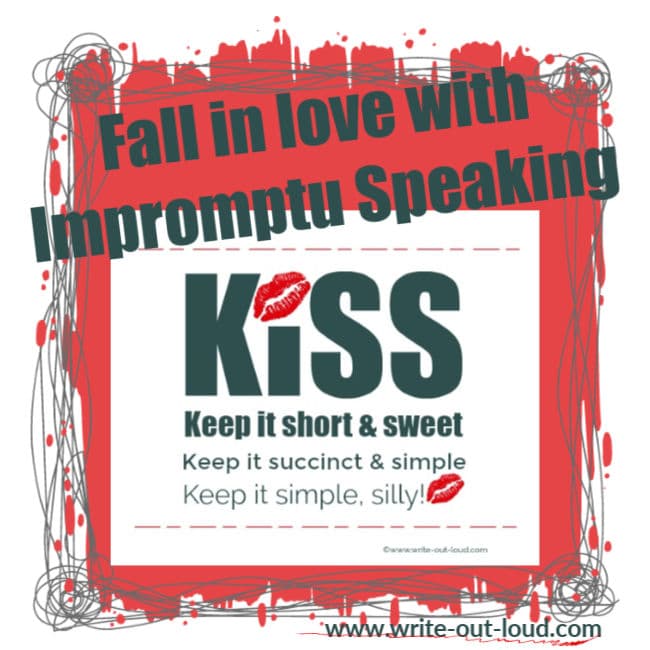
However having acknowledged your fear, let me introduce you to KISS*, an effective way to turn a difficult task into great success.
* KISS: Keep It Short and Sweet.
What you'll find on this page:
- the magic KISS formula to use for all impromptu speeches
- how to use KISS - the art of KISS in action
- 7 effective impromptu speaking templates to commit to memory - with a link to example impromptu speech outlines
- 8 impromptu speech tips to help you deliver your speech well
- 6 ways to manage public speaking nerves
- links to 100s of impromptu speaking topics (absolutely necessary for practice) and a collection of 17 impromptu speech activities with printables.
Fall in love with impromptu speaking with KISS
The KISS (Keep It Short & Sweet) principle gives you a basic structure or formula you can apply to all sorts of occasions where you are likely to be called on to "say a few words".
Like for instance:
When you're asked to wrap up and conclude at business meetings.
It's no problem.
Or you have to give an impromptu presentation, a project update, on the spur of the moment.
It's easy.
Or you're asked for a brief summary of your company's latest developments and have to deal with an unexpected question.
It's simple.
Whatever situation where you're being asked to speak with very little, or zero prep time, KISS will serve you well.
You may even grow to love making off-the-cuff speeches at short notice!
The art of KISS in action
Use the time you have between being asked to speak and actually getting to your feet to plan even if it's only a couple of minutes.
If you're in the middle of a social event or busy meeting find a quieter corner to concentrate.
Brainstorm - collect up your ideas
The very first thing, and the easiest way to start, is to jot your notes on whatever is handy: a paper table napkin, the back of envelope, a piece of paper, index cards...
Get down as many ideas as you can. You do not need the exact words - just the key points as they occur to you.
Now select ONE main point (the best or strongest) from your notes to focus on. Write that down and any opening/closing ideas.
The speech structure you need is the same that you would use for any other form of speech.
You need an opening, a body and a conclusion.
Focus on the body of the speech first
Sort the body of your speech first using which ever of the impromptu speaking templates below best suits your topic.
7 impromptu speaking templates (frameworks)
Now take that most important point you chose and expand it using one of these easy frameworks or templates. This will form the body of your speech.Info. About Impromptu Speaking Competitions
Are you here looking for information about impromptu speaking competitions rather than completely spontaneous, off-the-cuff, or unprepared speeches?
You'll find a good start here on this Wikipedia page.
And click this link for an excellent collection of impromptu speaking competition 'how-to's' ranging from organization of material to delivery and an example impromptu speech script
(Please don't be put off by the site looking old and tired. The information is gold!)
1. PREP (Point, Reason, Example, Point)
- Point: Impromptu speaking is an extremely valuable and an essential skill to have.
- Reason: Being able to speak easily in public is empowering.
- Example: I speak from personal experience. I remember the struggle to overcome the fear of public speaking: to stand to speak in front of others. I was the original Mrs Blush-and-Blurt: terrified of doing the wrong thing. However that has changed. I can now speak up for myself, on behalf of others and do so regularly.
- Point: The skills to talk competently and confidently in public have opened up opportunities I had never dreamed of previously.
(Click the link to read three 1 minute speeches examples using the PREP format.)
2. Past, Present, Future
- In the past the answer to the problem we face was...
- As of now, we have XXXXX answers to the problem...
- In the future we predict we will have XXXXX answers to the problem...
3. Cause, Effect, Remedy
- The cause of the problem facing us today is XXXX.
- The effect of the problem is XXXX.
- The remedy for the problem is XXXX.
4. Before, The Event, The Result

- Before Napier (New Zealand) was a typical small provincial town filled with ordinary people leading ordinary lives.
- Then in 1931 the earthquake (The Event) struck.
- The Result was devastation. The town was destroyed and 256 people were killed. Out of the ruins rose one of world's finest Art Deco centers.
The building in the photograph above is one of the city's most photographed.
(Digression alert: It's also a building I know well. I was employed there as a high school student trying to make enough money to go to university. The year was 1971, pre-equal pay, and I was paid 66 cents an hour. Some boys from my class were also working there. Their starting rate was $1.32. Double. I was not impressed.)
2 more useful impromptu speaking organizers are:
- Local, State, Federal
- Local, National, International
Would you like to see example impromptu speech outlines using these frameworks?
Click the link and you'll find examples of seven impromptu speech outline patterns: PREP, Problem-Solution, Past-Present-Future, Pros-Cons, Before-The Event-The Result, Cause-Effect-Remedy, and Local-National-International.
Each comes with a free blank printable that you can download for your own use.

Prepare the opening and the conclusion
Having planned the body of your speech, now focus on your opening and conclusion.
Take your lead from the impromptu speaking template you've chosen. If, for example, you've chosen Past, Present, Future you might open with a comment based on time.
For instance:
"Thank-you for invitation to speak to you about XXXX. To place this in context I'm going to take you on a journey. Are you ready? Firstly we'll go back in time, then we'll focus on what's happening now and lastly, we'll go forward..."
To close, summarize your points briefly and if possible, make your final remark the clincher.
8 impromptu speaking delivery tips
- Go slowly!
Hurrying will increase any feelings of unease you have. Take your time. Take a deep breath. Get up from your chair slowly. Walk to the front calmly. - Take your time to begin.
Look around, smile. Make eye contact with one or two people in the room. - Watch your body language.
Stand tall, making sure you are standing on both feet and that they are about a shoulder width apart. Resist the urge to slump or fiddle or put your hands in your pockets. And remember to breathe! For more on body language.
(If you're a person who holds your breath under stress click the link for easy-to-use breathing exercises to rid yourself of anxiety.) - Use your notes as reminders only.
Do not try to remember a whole speech. If you forget you'll get anxious. Instead move through the points you noted making clear transitions between each. - Talk conversationally.
Assume your entire speech is a conversation with someone you know well like a best friend. This will give your language a natural smooth flow. - Watch the words.
Avoid using vocabulary or jargon unfamiliar to your audience. That will alienate them. - Personalize your speech.
Use examples from personal stories. This works on two levels. Firstly, it lets the audience see you as a real person and secondly, it gives you authority or a right to speak on the subject. You become credible.
Check this link for more on storytelling in speeches. - Keep it short and to the point.
An audience is far more likely to listen if you stay on target and are succinct. In fact they'll love you for it!
Six ways to effectively deal with nervousness
First Aid (solutions) for problems arising from anxiety
What do I do if my mind goes blank?
1. Firstly, never apologize.
If you do, you transmit your anxiety to your audience. Without your alerting them they may never have noticed.
Now you've drawn their attention to how you're feeling, at least some of them will stop thinking about you'd been talking about, and will start to focus on you personally.
Will she continue? Oh my goodness, is she going to cry?
2. Remember the power of a meaningful pause.
Stop if you need to. Take a pause to marshal your thoughts together. Remember time appears much slower to you. You may think you've stopped for an eternity, but it's seldom perceived that way by the audience. They will think you are deeply pondering your next statement or very kindly giving them time to consider your previous point.
3. Ask for a drink of water.
Explain your throat is dry. Take the time between someone fetching the water and you taking a sip, to gather your ideas.
4. Paraphrase what you've already said.
It will jog your memory into providing the next point you want to make.
5. Ask for questions.
Get the audience involved and then answer their questions.
6.Practice
And lastly, remember impromptu speaking is a skill, and like all skills, it improves with practice.
Impromptu speaking topic starters
To help you become what you want to be; an accomplished impromptu speaker, I've several pages of speech topic starters.
- 150 impromptu public speaking topics
- 11 sets of themed impromptu speech topics
- 80+ themed Toastmasters table topics questions, with printables.
- 150 1 minute speech topics, plus 3 sample speech outlines and speeches
There's enough there for many hours of happy practice!
Sticking to your goal
Be kind but disciplined with yourself.
If you really want to become comfortable speaking off-the-cuff, you will.
However it does mean finding the courage to get through the initial discomfort of trial and possibly, error.
There is no other way to learn than by doing it.
Keeping it succinct & simple (KISS) will make a positive difference. Try it and see for yourself. I promise, it is doable!
Commit a few of the speech organizers to memory so they're there for you to choose from when you need them.
Do give this a go. It's an important skill to have in either your work or personal life.
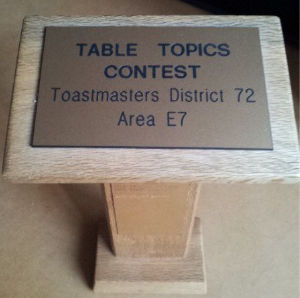
The photo is of my award for winning the impromptu speaking (table topics) competition between all the Toastmaster clubs in my area, E7, of District 72, New Zealand. It's there as proof that it's manageable.☺
Do you teach or lead a public speaking group?
Check this out - One Minute Speeches! They're perfect for practicing impromptu speaking skills in a safe, non-confrontational way, and loads of fun.
This is an instantly available package of printable topics + activity instructions. Have a look!

And this is my latest offering for teachers
A comprehensive bundle of 17 proven fun and effective impromptu speech activities, complete with full guidelines and printables. Suitable for middle school upward.
Take a look.

Famous last words
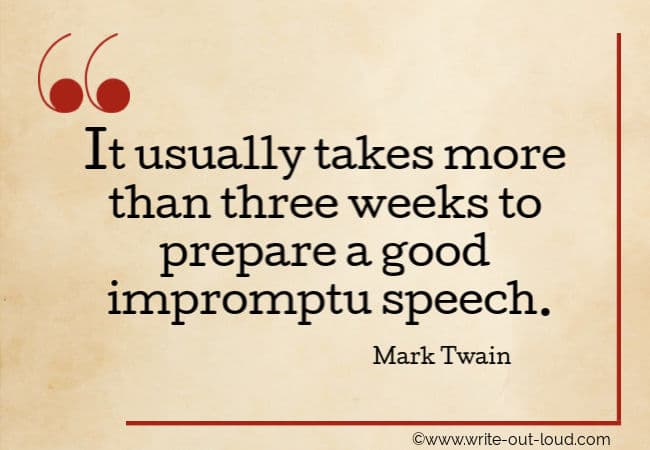
The very last words on the topic come from Mark Twain who was obviously no stranger to the concept of "pre-planned spontaneity". His famous tongue-in-cheek quote on impromptu speaking is above.



From fear to fun in 28 ways
A complete one stop resource to scuttle fear in the best of all possible ways - with laughter.