Action verbs in speech writing
Shun those weak wishy-washy nondescript verbs!
By: Susan Dugdale
Strong action verbs in speech writing give your words immediacy. They carry color and passion: communicating with clarity and precision. Use them, and they'll stop your audience inwardly groaning over yet another ho-hum, blah, blah, blah speech.
Let's, all of us, me included, drop those dull, generalized verbs and choose to write vividly and distinctively.

Here's an example so you can see what I mean.
Mary expressed her disappointment by pulling a face.
That's quite a few words and, although it does get the idea across about what Mary is doing and feeling, we can do better. Much better.
We'll rewrite the sentence using a dynamic action verb.
Mary grimaced.
or Mary frowned.
or Mary winced.
or Mary glowered.
or Mary scowled.
Each one of those verb choices is stronger because it conveys more precisely what Mary's does and feels as a result of being disappointed. One word contains everything we need to know.
In addition, that one word has replaced seven from the original sentence.
How about these sentences?
Which one contains the power verb setting the scene and the mood enabling us to imagine it immediately?
John sauntered down the street.
John walked down the street.
"Walked" lets us know what John is doing but "sauntered" does so much more. It tells us what he's doing, as well as the way he's doing it, by conveying his mood.
"Saunter" implies relaxed, leisurely, and pleasant. John is not merely out for a walk but for an enjoyable stroll.
Saying more with less
In speech writing the challenge is always to find the words that say more while using fewer of them. A well-chosen verb does just that. It cuts through the blah-blah verbiage going directly to the core of your message, and the hearts and minds of your audience.
Use dynamic interesting language and you'll find yourself listened to and appreciated more.
Word hunting - use a thesaurus
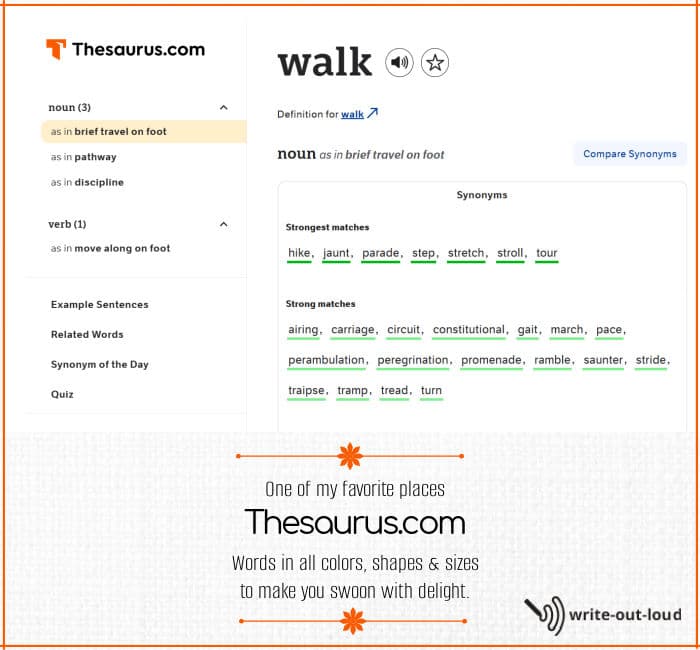
If you need a hand to jump start your action verb collection, use an online thesaurus. The link is to my favorite.
I love finding and collecting more words to use. A thesaurus is perfect for that.
Each entry word has a list of synonyms (words that are similar in meaning, as shown in the screenshot above) and antonyms (words that are opposite in meaning). In some instances, there will be even more information.
To give you another example, aside from "walk", I searched; "shout".
Here's a sample of synonyms from the results: bawl, bay, bellow, cheer, clamor, exclaim, holler, roar, scream, screech, shriek, squall, squawk, whoop, yammer, yap, yell, and there's still more!
Now I can differentiate and be specific.
For instance: The boss shouted but exactly how did he shout?
- Did he bawl?
- Did he whoop?
- Did he shriek?
See what I mean?
Each one of those words; bawl, whoop and shriek, gives a slightly different picture. They change how we interpret the sentence, and how we see the boss. That distinction makes our language more interesting to listen to. Our stories become more precise, colorful and alive.
The challenge
Our challenge is to go through what we've prepared as if we were in the audience and ask ourselves:
- Is the language I've used interesting? Does it convey my meaning easily? Would those listening be able to quickly pull up a vivid mental image of what I'm talking about?
- Are there words I would be better off replacing or ones needing to be taken out because they are either boring or unnecessary?
Yes, it's more effort. However, the rewards are worth it - a listening audience, and better speech writing.

Click for more about how to write a speech and structuring speeches using a speech outline




From fear to fun in 28 ways
A complete one stop resource to scuttle fear in the best of all possible ways - with laughter.