- HOME ›
- Activities and games ›
- 5 improv games
Improv games - warm-ups & icebreakers
5 fun speech & drama activities to start a class
By: Susan Dugdale | Last modified: 10-21-2023
Here's 5 fun improv games that were class favorites when I was teaching high school speech and drama.
They're great exercises that combine learning about mental flexibility, focus, communication, concentration, body language and empathy, with good fun.
Try them as icebreakers or warm-ups: - quick fire activities to get your class or group focused and ready for work.
Be warned - the first two are riotously noisy!
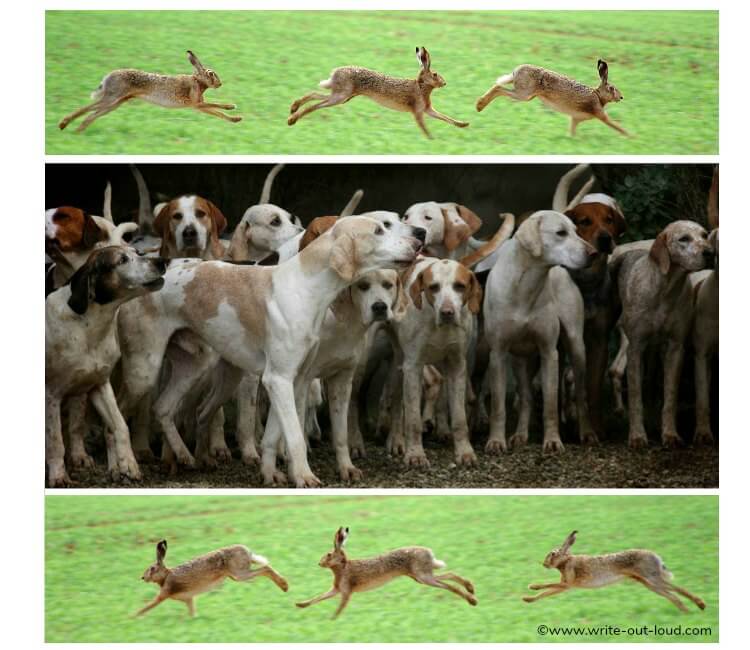
1. Hares and Hounds
You'll need a hall or a gymnasium to play this one as it needs a largish space. The game always worked well for me regardless of age group. It's a load of loud fun!
Instructions
- Split your class into two equal teams.
- Line them up in front of you with about a two metres between them.
- Instruct them to face one another. Each person should now be opposite another - their partner for the exercise.
- Name one team Hares and the other Hounds.
- Call for silence.
- Explain you will call either Hares or Hounds.
- Depending on which you call, people in the named team must tag their partner BEFORE they make it to safety on the side of the hall behind them. (Note: If the space is very large, that is the side walls are a long way from the middle of the room, mark out boundaries.)
The key is in the silence before calling, and then in split second reactions. The team tagging runs straight ahead toward their partner but the team to be tagged must turn around before they run.
Make sure no one stands too close to their partner. The two meter space between the lines must be there before calling the name of the team that tags.
You'll be amazed by how many players get confused and bewildered and run in the opposite direction!
Variations
After they've got the exercise sorted, flummox them completely by calling another animal or word beginning with H for example, horse, hippo, or heffalump.
Change the names the next time you play to Rabbits and Roosters and then call Raddish!
2. Murder (Yes, looks can kill!)

You'll find this game an excellent icebreaker for groups of 5 players plus. It encourages bold, exaggerated responses - the bigger, the better.
Instructions
- Sit your class in a fairly tight circle on the floor.
- Tell them to drop their heads ('Heads Down') and close their eyes.
- While their heads are down tell them to choose a person to fixedly stare at when you call 'Heads Up'.
They may not choose someone directly on either side of them. Anyone other than that is fine. - Call 'Heads Up'. If any player finds them their stare reciprocated, that is met by another, both players must scream loudly and 'die'.
- Once players are 'dead' they leave the circle.
- Close the circle up again and start again by calling 'Heads Down'.
- Play several rounds applauding new methods of dying - gurgling, choking, weeping etc.
- Vary the time between your calls to heighten tension.
And now for 3 quiet improv games:
3. Walk As
This exercise is borrowed from mime, best done in a hall, is good for people of all ages and for maximum impact needs to be done in silence.
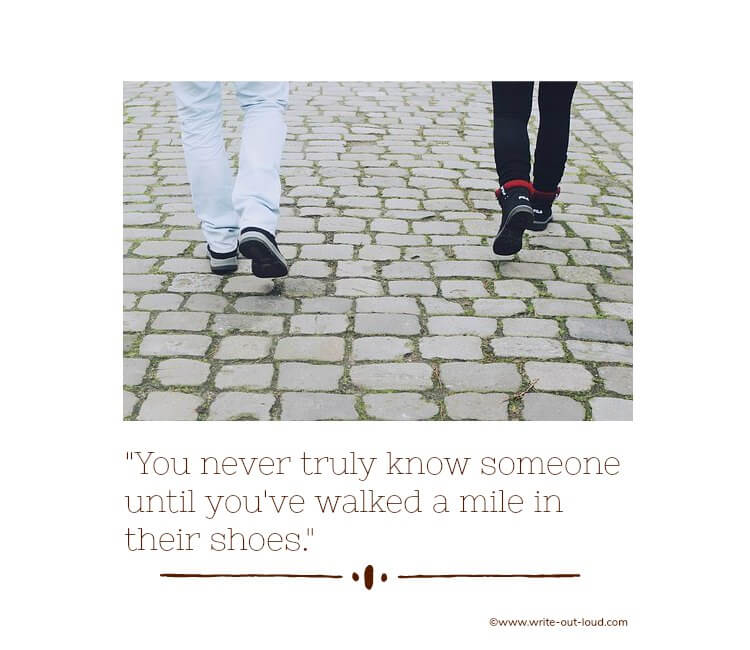
I'm sure you're familiar with the saying, but have you actively tried copying exactly how another person walks? This is a fascinating, illuminating exercise enabling a glimpse into what it is really like to be in another person's shoes.
Participants will discover what it feels like to go through the world for example, with their head down, with rounded shoulders, head up, without lifting their feet ... Whatever is observed in their partner they will attempt to copy.
Instructions
- Split your group or class into pairs.
- Ask one person of a pair to start walking how they naturally or normally would.
- The second observes for at least 10-20 seconds before following them copying to the very best of their ability everything the first does when they walk.
- After a several of the laps of the hall, have the first person stop and watch the second who will keep walking in the style of the first.
'Walk As' is great for observing where weight is carried, which part of the body leads, and what emotional/mental shifts occur in the second person to accommodate the walk of the first. It takes HUGE focus to do it well.
Change partners several times to have your group experience being in a variety of other people's shoes.
Have a feedback round to finish.
4. The Naming of Things
This game The Naming of Things is brilliant for concentration or focus and only works if each person is thoroughly in the 'now'. It makes us aware just how deeply embedded our associations with words are!

Instructions
Tell your class to walk authoritatively around the work space naming everything they see as something other than what it is. They must point to the object as they declaim its new name.
Example: 'A' sees the floor, points while loudly exclaiming 'dog'.
When they get proficient do the exercise with a drum beat to set a walking pace. Strike 1-2-3-4 and then pause in which the class names something as something else and then pick up the beat again.
For variation try - faster and slower beats plus varying the number of beats between the pauses.
5. Lines
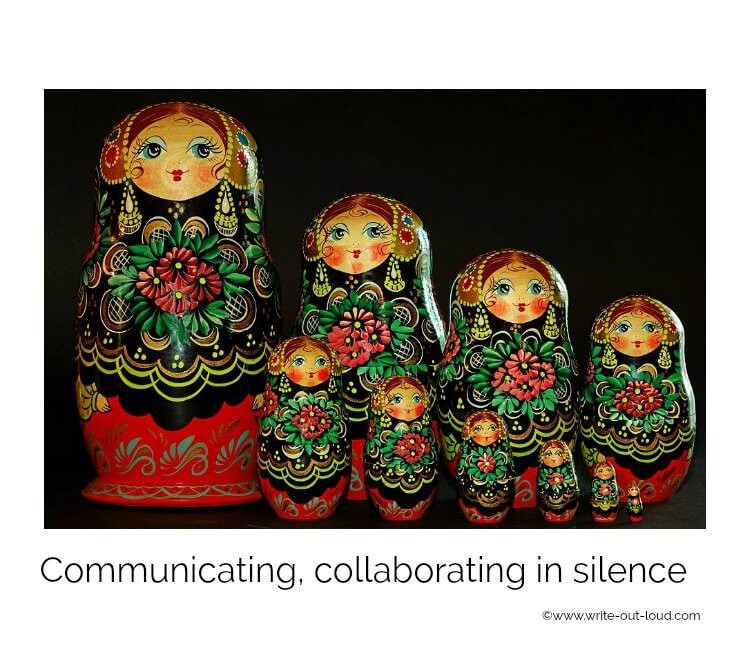
This is another of those improv games borrowed from mime and therefore is best done in complete silence.
When I played it if there was any verbal communication, the group had to begin again!
Instructions
You're going to tell your class to line up according a range of differing criteria.
Start with obvious physically observable criteria for example, from smallest to tallest, or shoe size and then move to more difficult ones, for example, lining up alphabetically according to the first letter of their middle name, or by birthday (date and month).
Allow about 3-4 minutes to complete the task and tell them to sit down in order when they're satisfied they've got it right. You then check the results.
There will be bad mime in all directions but it's a great exercise for focus!
Using improv games in public speaking classes
Even though these are essentially drama exercises, I think they are a useful addition to teaching public speaking. The line between the skills required for either is very blurred. Both share performance in front of an audience as an end goal.
A good public speaker needs what these improv games offer: an awareness of body language and non-verbal communication, while developing concentration, mental agility and flexibility, confidence and empathy.
And if you're teaching a public speaking class ...
You'll love my book!
A complete one stop resource for teachers to scuttle their students' public speaking fear in the best of all possible ways - with laughter!
What other teachers say:
"Thank you so much for making my class fun, and not scary!"
"My students are 8th graders - a tough crowd to engage but these games are working very well."
"Your materials provide great structure and content examples."
Make your speech class fun too.
Find out more>>
For more freebie public speaking activities
- word games to stretch imaginations, develop confidence and impromptu speaking skills
- 7 public speaking games for middle school and upward
- Return to top of improv games




From fear to fun in 28 ways
A complete one stop resource to scuttle fear in the best of all possible ways - with laughter.