- HOME ›
- Speech delivery ›
- Impact of a teacher's voice quality
How is your teaching voice?
An overview of the impact the quality of a teacher's voice has on learning & how to improve it
By: Susan Dugdale | Last modified: 04-15-2021
Your teaching voice is the one you use when you're standing in front of your class. It's your professional voice and often different in quality from your day-to-day speaking voice.
So, how is your teaching voice?
There is a good reason behind my question.
Even though it may be long ago, I'm sure you can remember the experience of listening to a teacher with a poor or weak voice.
Perhaps they droned. Whatever they were saying emerged out their mouths at the same monotonous rate, at the same monotonous pitch, tone and volume. Just as if it had been pushed through a blender. Result, pureed speech.
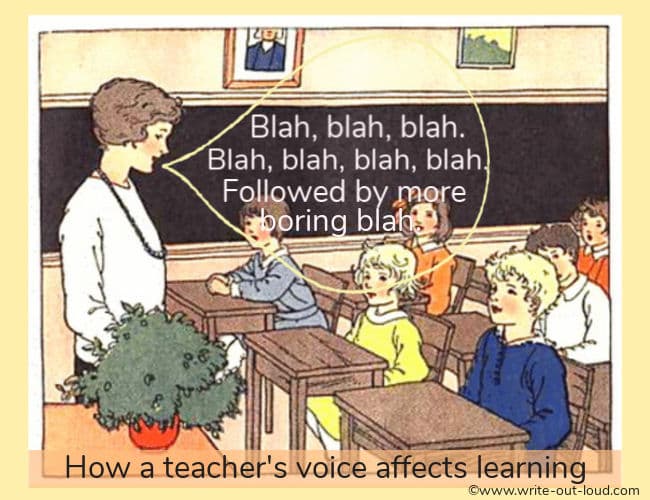
Or maybe their voice was shrill, or too loud, or they didn't articulate their words clearly.
That teacher may have been an expert in their subject but their voice didn't communicate in a way that inspired you to want to know more.
Instead you switched off.
If that happens when we're adults we may politely day dream - focus our attention inwardly and wait for the talk/lesson to end.
However, if it's children in a classroom, their response is likely to be less restrained. They will whisper, pass notes, yawn, and prompt the class clown to entertain them with diversionary tactics.
Do you know what affect your teaching voice has?
If you know your subject, have prepared your lessons carefully to meet the needs of your students and are still having difficulty maintaining attention, it might be time to consider your voice.
There is nothing to lose and a lot to gain. I promise you the exercises are fun and easily learned.
Awareness of the impact of voice quality is changing
When I did my teacher's training years ago we were taught nothing about either the impact of voice or how to care for it.
The little knowledge I had came from speech and drama tuition, something I had actively sought out for myself.
However there was no help or guidance for my fellow teacher trainees. The result was ignorance. They didn't know enough to know what they were missing out on. Thankfully, that is changing.
Communication & Voice Research
Now we have a growing awareness of how the quality of a teacher's voice impacts on children.
A review of recent research established, unsurprisingly, that:
"Prosodic characteristics such as adequate pauses, precise articulation, and lower speech rate are key resources for a teacher’s expressiveness. Those resources help in the modulation of the voice in the classroom and to capture the students’ attention, reinforcing the importance of the voice as a didactic tool in the educational process."
Impact of the teacher’s voice in the classroom: a literature review - Ana Luiza Vilar Rodrigues, Adriane Mesquita de Medeiros, Leticia Caldas Teixeira, Universidade Federal de Minas Gerais – UFMG – Belo Horizonte – MG - Brazil, 2016
We also know that the major components of communication (effective and non-effective) are a combination of what you say (the words) and how they are delivered.
I'll let communication expert Stacey Hanke explain:
"Most individuals are unaware of the static they create when they communicate. What do I mean by static? Static is created when what you say is inconsistent with how you say it.
For example, suppose you’re having a conversation and the other person says, in a boring, monotone voice, “I’m so excited to have this opportunity to work with you.” Their facial expressions are lifeless. They never look you in the eye and all the while they’re fidgeting with a pen. Most likely you’d question their credibility and knowledge, and not take action on what they have to say."
To find out more click this link: Six communication barriers and how you can avoid them.
(The article is primarily targeting people who present as part their work for example, a salesperson. However it is equally pertinent for teachers.
Watch the video
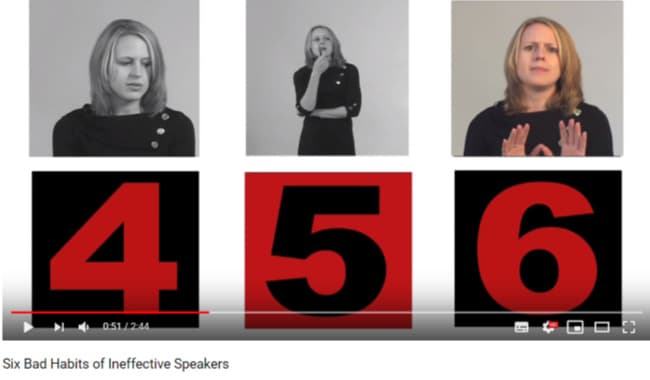
Please note although the video Stacey made to go alongside her text is no longer available on that page, you can watch it by clicking on either this link: 6 examples of ineffective communication or the image below.
Do take a few minutes to watch it. It's a gem!)
What does this mean for your teaching voice?
In a nutshell it means that what you do with your body while you explain the lesson is as influential as the words themselves.
If you want energized, focused, actively listening students then you need to mirror that in your actions.
The trick is to SHOW while you are TELLING what you've got to share is exciting, relevant and important. This cuts through the "static" Stacey Hanke is talking about in the extract above.
Your body language, tone of voice, and words must match each other.
Achieving congruency
Some people achieve congruence of body language, tone and words intuitively. They are the performers who know how to hold an audience's attention effortlessly.
Others of us need to learn consciously. In case you are tempted to judge yourself harshly; it is not a question of better or less than but merely one of difference. In fact, often the person who learns these skills consciously has more control and flexibility once they've mastered them.
Why? Because they can stand back from themselves, analyze their results and adjust accordingly. The person who just 'does it' often lacks an overview of their behavior.
Where do I begin?
- with body language
A great start to re-energizing your teaching voice is to understand body language. This page offers a basic overview.
I'm sure once you've read it you'll realize you know most of it already.
What you may not have consciously understood though is that you have the power to choose what story your body language tells.
Even though the page is an elementary beginning, you'll find enough to start experimenting with how you deliver your lessons.
- then vocal variety
Your next step is to look at vocal variety.
While your voice needs to reflect passion, it also needs flexibility. This means having a wide variety of tonal expressions and other skills to select from.
You can find exercises to develop vocal variety here. Rest assured they are fun, easy to learn and EFFECTIVE!
- pause power
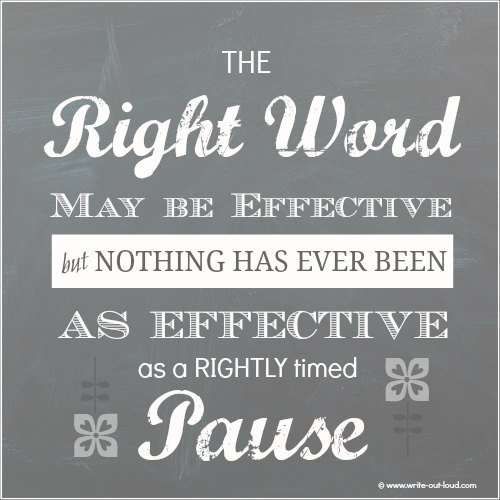
Do you know the trick of using the power of the pause?
Timing is the key.
- putting the brakes on motor mouth
Perhaps you need exercises to slow your speech down?
Your voice rattling off information at high speed will lose many students quickly. There are exercises for developing a flexible speech rate here.
Fast is one option. Be kind. Give yourself some more.
- getting clarity of sound
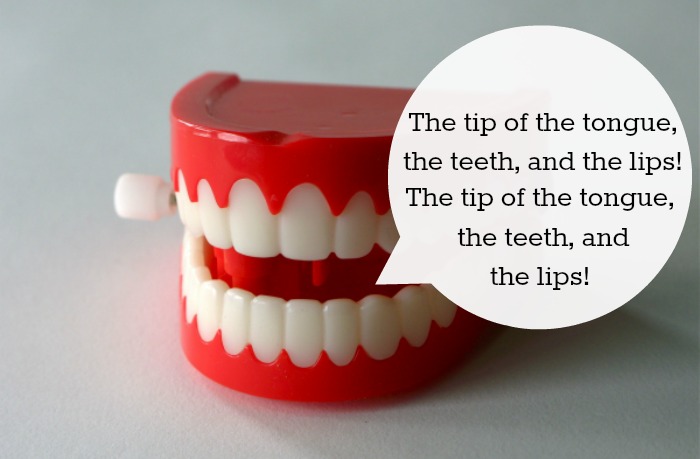
Do your students have difficulty clearly hearing your words?
If you habitually speak without sufficient articulation, here is a page of fun tongue twister exercises here to help.
And lastly, breathing
How you breathe underpins voice quality and health. Good breathing and postural habits are essential for maintaining a strong healthy voice.
Do read, and then practice these breathing exercises.
You'll find not only will they improve the quality of your voice but any stress or tension you are carrying will fall away as well.
Stage your learning
Begin with one element. For example, speech rate. Practice with that until you feel you have more control over it. And then add another aspect. Now practice with that as well as the one previously mastered. When you feel happy with your progress, add a third. Etc., etc. Keep building. Keep practicing!
Your voice is essential to your career
Your teaching voice IS important.
It's the vehicle for transmitting your knowledge, your passion, your concern...in short all the things that made you excited about becoming a teacher in the first place.
Have fun developing your voice.
And remember you're never just a teacher, you are a motivational speaker!
PS
If you have specific & ongoing voice health issues, please be sure to check out my voice health page. Get help before you actually need it.
And if you'd like more on how the quality of our voice affects how others perceive us check this page on voice image.
- Back to top of teaching voice page




From fear to fun in 28 ways
A complete one stop resource to scuttle fear in the best of all possible ways - with laughter.