- HOME ›
- Speech delivery ›
- Body language
Teach yourself body language for confident public speaking
- tips & exercises to support your speech with effective body language
By: Susan Dugdale | Updated Feb 2026
Why is it a truly excellent idea to become more aware of our habitual body language when we're speaking?
Because many of us have unconscious mannerisms that seriously undermine what we're saying. And in some circumstances, the consequences of that can be critical.
What's on this page
- The power of body language in communication
- Body language: what we think we do & what we actually do
- Oh, those 7 second snap judgements! - assumptions we make about other people based on our reading of their body language
- Working well with body language: 4 starting points
- Natural, 100% organic body language
- 5 simple ways to improve
- Gestures and public speaking
- Eyes & eye contact
- How to 'read' a speech effectively
- The stories our faces tell
- Smiling at the people you're talking to
- Summary - open and closed body language
- 6 specific exercises to improve body language
- The Mehrabian myth about body language: what the Professor really said about body language being more important than words
The power of body language in communication
Communication is made up of three elements:
- words - what a person says
- tone - how the words are said: lovingly, sadly, harshly, rapidly, slowly...
- action - body language: how a person gestures, stands, moves, their facial expressions, eye contact...
In order to fully believe what a person is telling us all three need to be harmony with each other.
The words must align with the way they are being said and the actions that accompany them.
Here's a story as an example
Let's pretend you're interviewing me for a job, and you've asked me how I feel about handling the responsibilities it involves.
I answer, swiveling on one foot, masking my mouth with my hand, while looking at the floor, 'Yeah', I say, 'I'm super confident.'
Can you see the interaction in your mind?
Do I get the job? Nope. Not a chance!
The messages we send via our body language can be the difference between being believed and trusted, or not.
So, to be credible/believable my body language needed to reflect my words. Being 'super confident' is standing up straight, on both feet, and looking directly at the interviewer. It is not swiveling on my feet, covering my mouth and making eye no contact while speaking.
To be an effective speaker we need to become aware of body language, particularly our own. When we know what we do, we can change it.
Body language: what we think we do & what we actually do
Because we seldom see ourselves as others see us, there is often a very large gap between how we think we are presenting ourselves and how we actually do.
That gap is where all our habitual unconscious mannerisms lurk. Like closing our eyes and scrunching our foreheads as we think, rubbing our chin with the back of our hand, twiddling a strand of hair, clasping and unclasping our hands, swaying from side to side...
Under pressure, particularly when we're the focus of attention, those deeply ingrained gestures come out to play without us being aware of them.
Think of someone you know who is uncomfortable when they're being observed by others. Perhaps your boss, a teacher you had, a friend...
Now imagine that person standing in front of an audience giving a speech.
What unconscious habitual gestures or body stances do you notice?
- Are they rattling coins in their pockets?
- Running their fingers through their hair?
- Shifting restlessly from one foot to the other or folding their arms across their chest?
- Pulling at their clothing?
- Shuffling papers compulsively?
- Wringing their hands?
- Screwing their faces up?
- Gazing skyward for inspiration? Or staring at the floor?
And if you didn't know this person, and you were seeing them for the first time, how would you interpret their body language?
- Would you question their credibility?
- Would you be less able to take in what they were saying because you were distracted by what they were doing?
And NOW think about YOURSELF. What do YOU DO?
What would you see if you were able to see yourself as others do?
A true story from my 'what NOT to do' file
Do what I say, not what I do
As an example here's an experience of my own:
A group of my students asked if they could video a class. We were rehearsing a play and I agreed knowing it would provide valuable feedback on the process. It turned out it was feedback for everybody, myself included.
I winced watching my hands flying like white whirly-gigs but that wasn't all. I saw face pulling as I thought something through, slumped stance...The list went on. The irony was I thought I had those habitual gestures under control! Not so.
Oh, those 7 second snap judgements!
The brutal truth is we make a snap-judgement about a person based on the combination of their appearance and body language, particularly if they're a stranger. We give people approximately SEVEN seconds or less before forming an opinion about them.* Any habitual gesture that doesn't enhance or support what they're saying is a distraction. Too many distractions, and we'll turn right off.
*For more read The Science and Power of First Impressions - Janine Jaramillo- University of Melbourne
Working with body language: 4 starting points
Here are four beginning points to help you work efficiently and effectively.
- If you can video yourself presenting do it. Seeing yourself will give you vital feedback, and a place to start. Or ask a friend for uncensored, honest feedback.
- List the mannerisms you want to become more conscious of. Then go for mastery over one habit you want to modify, or get rid of, at a time rather than trying to banish the lot at once, starting with the most glaringly obvious. And be kind. Talking harshly to yourself is not helpful.*
- Regular smaller practices are more effective than one or two intense longer workouts. (See my 6 suggestions on how and what to practice.)
- Practice what you can throughout the day. You do not need to wait until you are at home to practice standing well, breathing fully, or relaxing your shoulders. Do it in the lunch queue, in the supermarket, anywhere. (See 5 simple ways to improve.)
*Find out more about flipping negative-self-talk for positivity
Natural, 100% organic body language
What you're aiming for when you're giving a speech, or presenting, is natural, appropriate, and controlled body language: gestures that help you deliver your message more effectively.
And by natural I mean movement or gestures that arise organically from the text of your speech. They are not scripted overlays: a gesture or movement executed purely because you, or somebody else, thought it should be there. These invariably look forced and false.
5 simple ways to improve your body language
Regardless of whether you are presenting or not, here are 5 practical, positive and easily implemented suggestions that will change how other people see you, and how you feel about yourself.
They can be done anywhere, any time starting now.
1. Practice standing on both feet!
It might seem very basic, however many people stand on one foot with the other tucked in behind the upright leg, and then they swap over and the other foot has a turn. Soon it's the first foot's turn again, and so on. ..
The interpretation of wobbling on their feet is not: "Here is someone in control of themselves." It's the opposite.
2. Practice standing 'at ease'
Place your feet about a comfortable shoulder width apart.
Make sure you are standing on the whole of your foot so your feet are fully connected to the floor. This position supports all of your body while distributing your weight evenly through your hips and legs without undue stress.
The body language of someone standing comfortably like this says: confidence, capable, control and balanced.
3. Practice standing tall
Pull yourself up to full height. Imagine a string running through you from the crown of your head to your feet. Now imagine that string being gently pulled toward the sky. Your back will straighten. Your neck will hold your head high.
Notice the feel and look of standing straight. When you see other people standing similarly, you recognize them as being someone who feels good about themselves. They have energy, presence and power.
4. Let your shoulders relax
Practice by rolling them backwards and forwards. Pretend they are a coat hanger from which your chest and arms hang. In order for them to hang well your shoulders need to straight and relaxed.
Raised shoulders can signal heightened tension, defensiveness as if you are waiting to fend off negativity or anxiety.
Shoulders habitually slumped forward send a 'depressed', 'defeated' or 'closed' message.
5. Practice breathing deeply
Practice breathing deeply and evenly using your diaphragm while maintaining a fully upright relaxed stance.
And now while standing on two feet, at ease, tall, with relaxed shoulders and breathing fully see and:
- Notice how open your chest is.
- Notice how your hips carry the weight of your upper body.
- Notice how your shoulders carry your arms
But most of all NOTICE how connected, strong and balanced you are. Now, remember that feeling. ☺
For more about breathing well: breathing exercises to lower stress and enhance your speaking voice.
Gestures and public speaking
The key to good gesture in public speaking is to keep it natural, clear and appropriate.
Many of us, myself included, are apt to use a flurry of gestures, particularly when we're passionate about what we're talking about. We wave our arms, point, clasp and unclasp our hands, fiddle with what ever we are holding, scratch our chins...The variations are infinite.
Often what we are doing has little relationship to the subject matter of our speech and those gestures become a distraction.
Another true story from my 'what NOT to do' file
Roll up, roll down, roll up, roll down, roll up...

When I was a high school student, we had assemblies every morning. The highlight was not the notices or the speeches imploring us to wear our school uniforms correctly.
(Hat on at all times in public. No self-respecting girl would ever be seen without one. Oh, the shame!)
Instead, it was how many times would our much loved and respected headmaster roll his tie.
The stand he used was supported on either side by two pieces of wood fixed into a base. He'd place his notes on it, adjust his academic gown, balance his glasses on the end of his nose and begin.
At the same time his hands as if magnetized fixed themselves on the end of his tie. As he talked his fingers rolled his tie of the day up, and then down. Each journey was clearly visible through the uprights.
Practice gesture specifically related to your content
To be effective movement or gesture needs to arise organically from your content. For example, if you are describing something huge, you could indicate size with your arms open wide. Or maybe you want to point to something on a chart. Use one clear, large gesture.
Large gestures are ones involving the whole body.
For example: the arm moves out from the chest and is fully extended. It is committed, unambiguous.
Small or micro gestures are those either held more closely to the body or a fleeting facial expression. Because they are small they can be easily missed by your audience and/or misinterpreted.
If you are telling a story you could, if it's appropriate, incorporate a little 'acting' into your presentation. Perhaps you could take on a voice, or a gesture to illustrate a point. Again it needs to be bold and clear so the audience can read it how you intended. Once the acting is done, you move straight back into your ordinary presentation style.
For specific exercises to develop confident body language: 6 ways to improve body language.
For more about using: characterization techniques for storytelling in speeches. (This is powerful magic! Audiences love it because it energizes and pulls them into your material.)
Eyes & eye contact
Think of all the expressions we habitually use referring to eyes, and you'll realize how important they are in communication.
We 'eye' someone up.
We ask if someone 'sees' straight.
We like getting a good 'eye-full'.
The 'eyes are the windows to the soul' and seeing them is believing!
In Western cultures, (United States, England, Spain, Germany ...), we want the person talking to us to look at us. We don't like it if they turn their heads away, if their eyes flicker from one side of us to the other, or look down. We want to be looked straight in the eye. It is only then, that we feel met and communicated with clearly.
Potential interpretations of lack of eye contact
- shyness
- lack of self esteem
- shame
- deceit
- lying
- extreme anxiety
Although in some cultures NOT looking directly at the person you are talking to represents respect, Western society does not share this view.
(For more on cultural difference and eye contact: Making Eye Contact in Different Cultures - What Are You Saying?)
Practice looking at your audience
Choose a person and meet their eyes briefly but long enough to know you have made contact. Choose another and do the same.
Talking directly to one person as in maintaining the eye contact for too long is considered rude but shifting your focus through the members of your audience IS good. It makes them feel met.
If this is too daunting to start with, have a friend or two sit in different places throughout the audience where you can see them.
For much, much more: the importance of eye contact in public speaking: activities to teach and practice eye contact, cultural differences, the meaning of eye contact, why it is difficult to make, good versus creepy eye contact...
One more story from my 'what NOT to do' file
Ignore your audience and they'll ignore you
Once upon a time, (and a very long time ago it was too), I had a highly regarded lecturer whose academic work was brilliant but his lecturing was relentlessly dull.
He would arrive with numerous bits of paper; printed off articles and extracts, which he read aloud without looking at anybody, ever. Neither did the pace or pitch of his voice alter from beginning to end.
After several weeks only the most committed students remained in his classes.
How to 'read' a speech effectively
Practice looking from your notes to your audience
If you have to read your presentation, and don't know any better, the temptation is to stay head down looking at your notes for the whole of your talk. This is incredibly BORING for your audience. And rude. You have people in front of you who made an effort to be present. Ignoring them will make them feel cut out or alienated.
If you have to read your presentation use single-side printing, double spacing and number your pages. Use a larger than usual clear font and mark all the major points with a highlighter. This will lessen the possibility of losing your place when look up to meet your audience.
Practice will help a great deal.
Reading aloud well is an immensely valuable skill to have. Click how to read a speech effectively for much more, including 4 good ways to improve how you read aloud.
The stories our faces tell
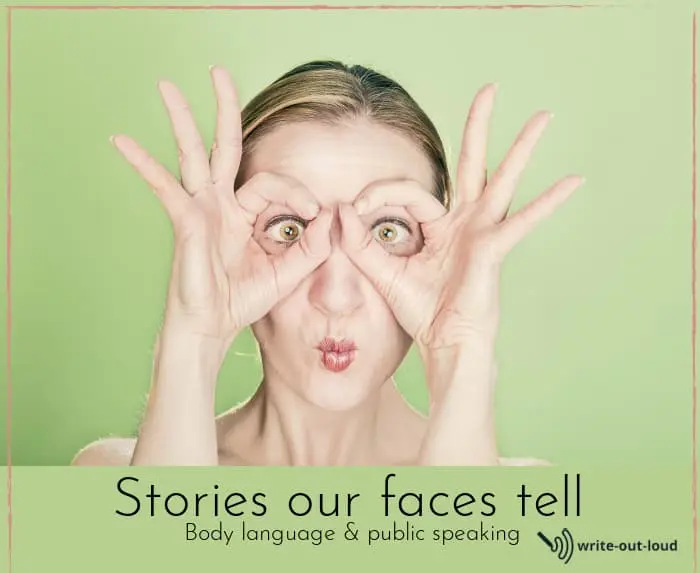
Face reading others
Many of us pull faces unconsciously. We may not be poking out our tongues or rolling our eyes but we're grimacing: biting our bottom lip and scrunching up our foreheads completely unaware of the effect it has on the people looking at us.
Meanwhile we read other people's faces constantly. We are looking for non-verbal cues to tell us who this person is.
We want the sub-text. We want to know what is going on below the words but more than that we want to know if the words we are hearing match what we think we're seeing on their 'face'.
What story is your face telling?
What are your habitual facial expressions? What do they mean?
Are some expressions universal? For instance, is an expression showing surprise similar regardless of where a person is from in the world?
Can facial expressions be controlled?
To deliver a speech effectively ALL your body language: your movement, gesture, and your facial expressions need to be aligned with the purpose and content of your presentation.
7 common facial expressions
Here are a few frequently used facial expressions along with their interpretations. Do you recognize any of them as something you do?
Raised eyebrows may be saying: 'I don't believe that.' 'I doubt, or I question what ever you are saying.'
A scrunched forehead may say: 'I'm thinking hard' or 'I'm angry and stressed.'
A wrinkled up nose signals distaste. 'I don't like whatever you've just told me or I've just seen.'
Biting at your lips can be seen as anxiety or intense concentration.
Tight lips can be seen as unwilling to share information or deliberate with-holding.
A rigid jaw is often interpreted as trying to keep things under control particularly anger.
For more: How to Read Facial Expressions
Practice consciously relaxing your face
Before getting up to present, if you can grab a couple of minutes in private to warm up, do it. Include these exercises to relax your face and throat. They'll help you deliver the message the way you want to.
Let the tightness in your forehead, cheeks, jaw, lips, and throat go. You'll be amazed how much better your face feels afterwards.
Do some deliberate face scrunches. Screw your entire face up into the tightest little ball of muscle you can. Hold. And now let go while breathing out. Repeat several times.
To get rid of tension in your jaw, lips and throat open your mouth as widely as you can and yawn hugely, dropping your jaw as low as it will go. Now wriggle it jaw gently from side to side. Repeat several times.
Massage gently with your finger tips the place where your jaw hinges next to your ears.
To lessen tension in your forehead massage your temples gently and the place between your eyebrows.
Smiling at the people you are talking to
The song sings 'When you're smiling, the whole world smiles with you.' It's true. A smile says 'I like being here. I like you.'
As a speaker your smile communicates ease and confidence. It breaks the ice, lightens the mood, connects you with your audience and helps you relax.
Practice smiling at your audience
You don't have to do it endlessly until your face hurts!
(And if you do, your audience will assume there's something seriously amiss with you!)
But if you can manage one, two, three or more genuine smiles in appropriate places particularly coupled with eye contact, it'll break the ice and help build a connection.
In summary -
Open body language
In body language Open is:
The person who stands on both feet, head held high, chest exposed, and arms by side. In addition, when they do gesture, it's strong, they smile where appropriate and make eye contact. We read these people as being open to experience the world. They are confident, capable and often leaders.
Closed body language
Closed is:
The person who hangs his head, folds his arms across his chest, crosses his legs, rolls his shoulders, fiddles, and avoids eye contact. These people have closed themselves off from experience. Their body language says 'keep out'. We read them as depressed, lacking in people skills, anxious, unreliable...
6 ways to improve body language
We've already established that to improve as speakers we need to become as aware as we can be of what our body language is communicating: consciously and unconsciously. Here are six more exercises that will help.
If you can video yourself as you do the first four of them, please do. Keep the recordings for reference.
After you've done more practice and are feeling more confident, record yourself again. Then compare your initial presentation with what you're doing now.
Use your findings to base your next steps on.
1. Retell children's stories
Choose a story you already know well and 'play'* with it. Here's a great collection of short stories, fairy tales, and fables to choose from.
For example, 'The Three Little Pigs'. What actions naturally arise from this part of the story?
 Illustration from 'Reading and Literature - the First Reader' 1911.
So, he (the wolf) knocked on the door and said:
'Little pigs! Little pigs! Let me in! Let me in!'
But the little pigs saw the wolf's pointy ears through the keyhole, so they answered back:
'No! No! No! Not by the hairs on our chinny chin chin!'
So, the wolf showed his teeth and said:
'Then I'll huff and I'll puff, and I'll blow your house down!'
*Play means: try huge, exaggerated gestures, try small buttoned-down gestures, try moving as you speak... Try out as many different ways of speaking and moving as you can. Notice the differences. Some will feel and look better than others. Keep those.
2. Share a moving memory
Retell a moving memory - something that made a lasting impression on you. Aim to talk for a couple of minutes and as you do be aware of what your body naturally wants to do to assist or add emphasis to your story. Try the same story several times more, each time refining your gesture.
3. Give directions
Give a person directions to find a location (street, shop, cinema, school park...) in your neighborhood.
How does your body language change if the person you are talking to, is not a native English speaker, is a little child, is deaf, is a close friend...
4. Use a piece from a speech of your own
If you have the text of a presentation or speech of your own, choose a couple of minutes worth of it to work through.
Before you begin, out loud read it through quietly.
What's the purpose of the section you've chosen? What do you want the audience to think, feel, or do as a result of having heard it? Are there bits needing emphasis? Will they be better said more slowly? Will there be a pause between them? Etc., etc.
Look for what you need to do to help your audience really get the message you want them to.
Now try the piece out loud, noticing your gesture as you speak. What arises organically, without you having to think too hard about it?
Keep working at the same piece, until you feel your words and your body language are working well together.
5. Learn from what you see around you
Study the examples of people presenting you see everyday: the news anchors, the weather reporters, politicians, tik tok heroes, well known youtubers... Analyze their work. What's effective? What's not? Why?
6.Watch
Try watching any of the 25 most watched and popular TEDTalks of all time and instead of listening to the speech focus on the speaker's body language. Turn the sound off! When you turn it back on again, notice how speech and movement combine to create the whole impression.
And finally...
If you focus on telling the story of your presentation rather than yourself the energy shifts from 'me' to 'message'. You'll find it does make a difference to how you approach working with yourself to lessen the inconsistencies you find.
PS. I know it's an insanely long page. But if you're still here you'll find this fascinating - Harvard Professor Amy Cuddy's Ted Talk on 'Your body language shapes who you are'. It's superb, and has been viewed millions of times since it was first posted in 2012.
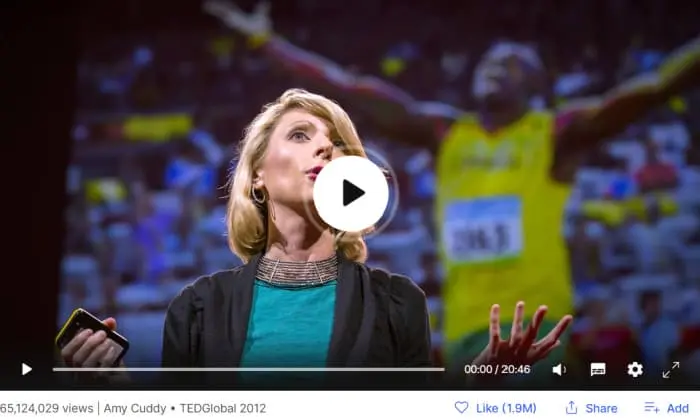
Cuddy's research generated an enormous amount of discussion on whether or not it was pseudo-science, and the validity of its findings were questioned. However recent research confirms posture/body language does indeed influence how we feel and behave. 'Fake it until you make it', aka power posing wins the argument after all.
For more read: The Debate On Power Posing Continues: Here’s Where We Stand
One very last thing. My article would be incomplete without mentioning it.
The Mehrabian myth: please don't fall for it!
If you've been searching for information on body language it's highly likely you'll have read articles saying that it's by far the most important element in communication: more important than 'how' you speak or deliver your words, and many, many times more important than the actual words you say.
And the articles will likely claim that this has been proven in university tests.
There are strands of truth in these assertions. But that is all.
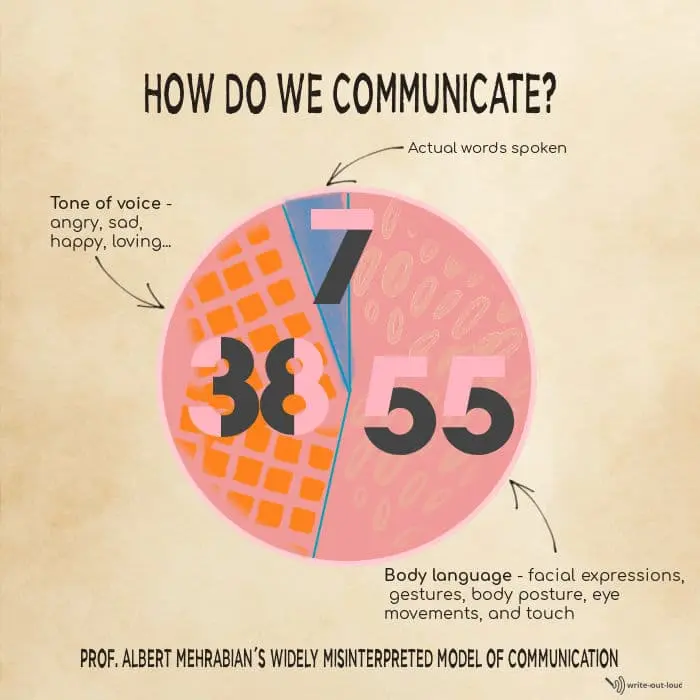
The 55%-38%-7% formula from Professor Albert Mehrabian's (Psychology, University of California, USA) research on verbal, non-verbal and body language in communication has been both widely quoted and misunderstood for many years.
It simply is not true 55% of our communication is imparted through what we do with our bodies and faces as we speak. Neither is it true to say that HOW we say the words we speak accounts for 38%, and that the words themselves are only worth 7%.
If it were then I could stand in front of you delivering an impassioned speech, complete with eloquent body language, and engaging vocal variety, using gobbledygook nonsense words and you would 'get it'. Totally. Because what I do while I speak and how I say the words makes up 93% of the complete communication package.
Try this:
"We need a more contextual and contemporary reimagining of our 'Outside the box' policy resources. After all, forward-looking companies invest in optional transitional projections. And we are one of those..."*
You, see? It's rubbish. It doesn't make sense.
Where Mehrabian's 55% 38% 7% rule applies
The formula, or rule, was never meant to be a representation of all communication. It came out of research studying the communication of feelings and attitudes. It applies to instances where the words a person says are at odds with how they're said, and the accompanying body language.
Mehrabian discovered that the lack of congruency or mismatch causes people to largely discount the words they hear and go with what they see: their 'reading' of the body language and vocal delivery of the speaker.
Hear it from the man himself: Albert Mehrabian - 55-38-7 Rule vs. Myth - a 2019 interview by Jess Todtfeld, from Success In Media.
*That stunning piece of drivel came from a fabulously good fun gobbledygook generator. ☺(Thanks plainenglish.co.uk)

For more related to body language:
- 60 speech topics highlighting body language and gesture -perfect for the Toastmasters Effective Body Language project
- 125 examples of narrative speech topics
- Storytelling in speeches: how to choose and work with a story
- Characterization techniques and tips for storytelling



From fear to fun in 28 ways
A complete one stop resource to scuttle fear in the best of all possible ways - with laughter.