- HOME ›
- How to plan a speech
Planning your speech: preparing to speak
- a complete, unabridged guide with multiple examples to help plan a successful speech ☺
By: Susan Dugdale
Planning your speech is where your success begins. I do not jest!
In your imagination you may hear yourself being stunning, the audience clapping wildly as they rise to their feet to give you a standing ovation.
You may see yourself being deluged in red roses and offered several speaking contracts. Obviously, they are all lucrative but you choose the one with optional extras: an extended holiday in the South of France …
But first you have to begin at the beginning: planning your speech. Without a plan you are whistling in the wind, dreaming.

What's on this page:
How to plan a speech step by step:
- gathering the information to write your speech
- brainstorming: what is a brainstorm, examples of brainstorms, getting started, with full step by step explanations and examples
- how to shape material to fit an audience, the speech setting, and time allocation
- an example speech outline
- how and why to research
- how to meet varying learning style needs: visual, auditory, and kinesthetic
- links to other useful pages: how to rehearse, make cue-cards...
Planning your speech from the start
A note about these notes!
These notes are general guidelines for ALL types of speeches. I know they are long.
(Actually that's an understatement! They are very long.)
I also know if you take the time to go through them they'll give you a solid introduction to thorough speech preparation.
They cover the basics of good presentation planning, research, writing and rehearsal: aspects you’ll want to consider regardless of the type of speech you’re giving.
Gathering your information
Once you have information about:
- WHY you are going to speak (the purpose of your speech),
- WHO you are going to speak to (your audience),
- WHAT your general or specific subject matter is,
- HOW long the speech is to be,
- and WHEN,
- and WHERE it is...,
you are ready to make a rough or draft outline.
This will be your guide for writing.
You may alter the outline as you go along, as better or different ideas occur to you and that’s OK. It shows you’re flexible and thinking but before we can change anything we have to have something to start with.
To get to the outline stage in the speech planning process we first need to collect up all the "why", "who", "what", "when", "how", and "where" information needed. And that begins with a brainstorm*.
*What is a brainstorm?
A brainstorm is the name given to a commonly used, and effective, technique for generating lots of ideas on a topic, or theme, fast.
Using a heading as a prompt to get you thinking, you quickly note everything you can think of relating to it. You do not edit yourself. You simply let the ideas flow until you can think of no more, making no judgements about whether it's a good idea, a silly idea, or a right or wrong one.
Ultimately, some will be more useful than others. You will sort through and order them later. However, the first step in the brainstorming process, is to accept everything you think of without hesitation. Stopping to decide what's OK and what's not breaks the flow.
If you'd like to see what a completed brainstorm looks like I have examples of them on my site. You'll see they provided the ideas that were then used to write the example speeches.
- one for a maid of honor speech for a sister
- one for a 50th wedding anniversary speech
- and another for a farewell speech for a colleague
Brainstorm to begin planning your speech
The brainstorm you are going to do is about making sure you thoroughly understand everything you possibly can about the speech you intend to give.
On a large piece of paper or in a word document write these headings with enough space between them for notes.
- WHY
- WHO
- WHAT
- HOW
- WHEN
- WHERE
WHY are you giving this speech?
What is the purpose of the speech? Do you intend to inspire? To motivate? To entertain? To inform? Or perhaps you want to combine several, like to inform, motivate and inspire?
Knowing what you want your audience to think, feel and do as a result of listening to your speech is the WHY underpinning your presentation. It will help guide what content you use and how you structure it.
WHO is your audience?
Write down as much as you know about the audience.
This will give you ideas about what they will want to hear and be interested in. It will also be your guide when it comes to shaping your material. (More about this later!)
Why is knowing who you're talking to vital?
Find out more about why being in harmony with your audience is so important. Check out building rapport.
For now, make notes covering:
- the number of people expected to be in your audience,
- their age group,
- gender,
- ethnicity, if appropriate,
- and the common, or uniting factors they share,
- and specific interests they may have.
Examples of WHY, WHO, WHAT...brainstorm notes
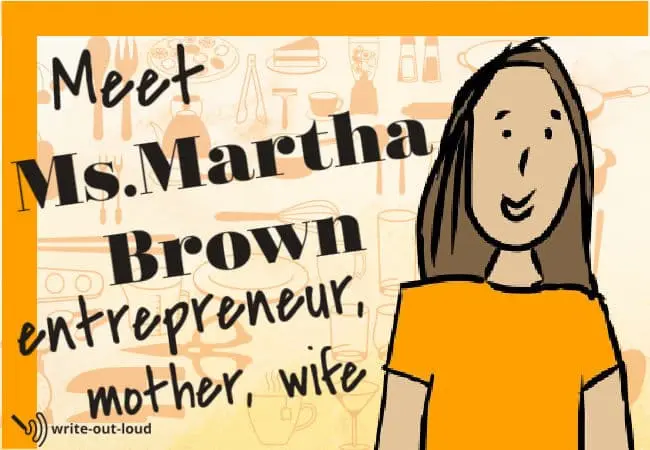
Meet Martha Brown. She's fictional. I've made her, and the presentation she's preparing for up, to show you how the brainstorming part of the planning process works.
Martha's been asked to give a motivational speech to a group of women whose background is similar to her own. She, too, came from a family who struggled financially.
Today she is one of the few amongst her relatives who has maintained a marriage, raised children and has a successful business. Her small catering firm specializes in delivering beautifully presented gourmet meals and finger food on demand.
The organizer of the event wants her to share her life story as a guide or inspiration.
Martha is conscious of her good fortune but also knows the starting point, or the seed, lay within her. She desired the change of circumstances so much she enabled them to happen.
WHY is Martha giving this presentation?
What's the principal purpose behind Martha's speech? What does she want her audience to think, feel or do as a result of listening to her?
Let's put ourselves in her shoes.
She wants to:
- motivate and inspire her audience
- give them hope
- show them there is a way out of the circumstances they find themselves in
WHO is Martha's audience?
These are Martha's notes covering the key points about her audience.
- Approximately 25 people (number)
- Mostly mid to late 30s (age)
- All women (gender)
- Mixed ethnic background but all speak English (ethnicity)
- City dwellers (uniting factor)
- Mostly work inside the home (uniting factor)
- Many have children (uniting factor)
- Interested in achieving work/life balance for themselves and their families and in particular a better financial situation (interest/uniting factor)
- All belong to the same church group (uniting factor)
WHAT are you going to talk about?
Write down the title and/or type of speech you have been asked to prepare. Now using your notes from the WHO section of your brainstorm, begin another set.
This time you are looking to see how WHAT you're going to talk about can be specifically shaped to meet and serve the interests
of your audience.
Let's look at an example of WHAT
How does Martha shape her life story to fit her audience?
She doesn't want to overwhelm them with information so they can’t think straight or digest it. That will turn them off.
They will think it’s too difficult and beyond them. They may listen, be interested, but they won’t identify with it.
She wants them to feel they can take from her experience and use it to enrich their own lives.
Her notes for WHAT may look like this:
- Speech Title
How to win a future for your family when the kids need feeding and the bills want paying. - Content - main points
- I am like you – I get too busy to plan ahead, I have a tendency to deal with what or whoever squeals loudest, I get tired …
- Before and after – life before I made the decision to start my own business – life after I made the decision. Comparisons – several examples.
- The hardest part of making the decision and acting on it was … Examples.
- The best part of making the decision … Examples. People who inspired me to act.
- What I’ve learned in the process about my family, others and myself … Examples.
- How I keep myself inspired … goal setting, listening and learning from others
- The future – a possible way forward for you, the women in the audience listening.
It’s not a speech yet but you can see the beginnings of its shape and
how she’s used her knowledge of the audience to ensure giving them
something they’ll enjoy listening to and identify with.
How? (How long will I speak for? How will I deliver my speech?)
There are two important 'hows' to consider.
1. How long have I got to speak?
The first is HOW long have I got to speak.
The time allocation you have been given will determine what you put into your speech and what you will leave out.
If you have a relatively short time, 3-5 minutes, you will need to either focus on one major topic with examples to illustrate or settle for covering a maximum of three lightly.
The purpose of your speech and your audience will help you make the most relevant choice. A longer time gives you more freedom to develop several ideas/themes fully.
2. How will I deliver my presentation?
The second 'how' relates to the method of presentation.
HOW will you deliver this speech?
For example:
- Will this be a speech told with humor?
- Will you have a 'show and tell'? (This is when you take objects relevant to your speech
to illustrate your points. It could be photographs or other items if they are
suitable to transport.)
- Could you give a demonstration?
Shaping delivery to meet different learning styles
When you consider this 'how' bear in mind the different needs of your audience. Most people have a preferred mode for receiving information. That is their learning style.
Some people understand well through listening. They are called 'auditory'.
Some people get most of their understanding through looking. They are called 'visual'.
Others receive and understand information best when they can touch, feel or do what is being explained to them. These are the 'kinesthetics'.
Most of us have a preference for one or two modes. For instance, I am 'auditory' and 'visual'. I want to hear and see.
A considerate speaker tries to include all three modes (learning styles) in their speech.
(For more on catering for learning styles with examples see the foot of the page.)
Delivery and time are yoked together
How you to choose to deliver your presentation is governed by the time you have available. If it is short, you may have to leave out a 'show and tell' or
a demonstration but you will always be able to include something to meet
all three modes satisfactorily.
'HOW' example from Martha's brainstorm notes
Let’s return to Martha’s Notes to see what she does with the 'how' segment of her brainstorm.
How long?
Time available = 10 minutes. (Maybe a little more but that depends on the
rest of the agenda of the meeting and how well it flows. Could be some
space for questions from the audience and answer.)
How to present?
Definitely with humor! Also take some fliers, business cards and
samples of finger food along. These can be available for people to pick
up at the end of the presentation.
WHEN will this speech be given?
WHEN has two aspects you'll want to take into consideration.
The first is the actual date you have to have it ready for delivery. That lets you know how much time you have for preparation. Is it three weeks, six weeks, or two days?
You'll use that information to plan your workflow. For example, allocating yourself one week to get your preliminary outline and any research required, completed.
The second aspect is the actual time of day and season you deliver a speech. This can have an impact on what you do and say.
For example:
You can use an early bird start in the middle of winter
on a wet Monday morning effectively by acknowledging the efforts people
have made to be there, and by making sure the heaters are on and there's hot
coffee available.
Finding ways of tying in what is happening in the 'here and now' is a good way to connect with your audience.
A word of warning:
Be conscious about presenting difficult or
challenging material when people are either both tired and hungry (just
before lunch or dinner) or when they’ve just eaten! Concentration spans
are not at their best in either situation. If possible save this type of
content for a mid-morning or afternoon slot.
Martha’s Notes, WHEN: 2.45pm, Wednesday, 2nd August – Summer heat
WHERE will this presentation take place?
The environment/room/space you are to speak can play a big role in shaping the final presentation of your speech.
Points to consider are:
- Where will I be in relation to the audience?
- Will they see me easily?
- Will they hear me easily?
- Do I need a microphone?
- Is there a place to put notes if I’m using them?
- Where can I set up my samples for people to take them easily?
- Are there power points if I want to use any electronic devices?
- Do I have to provide everything I want to use (e.g.: computer, screen, leads…)?
Many fully prepared, beautifully rehearsed speeches fail because insufficient thought has gone into where they are to take place.
It’s no fun when people can neither see nor hear you or the carefully thought through demonstration is stymied through lack of an electric socket in the right place!
Martha’s Notes, WHERE: Church meeting room.
It can seat everybody
comfortably and there’s room for a table to put out a display of fliers
and trays of food, paper napkins etc. Arrange the chairs in a horseshoe
or semi-circle so everybody can see clearly.
Pulling the brainstorm notes together in an outline
Once you've worked your way through making notes under your WHY, WHO, WHAT, HOW, WHEN, and WHERE headings, you're ready for the next step.
That's picking and choosing, then re-ordering and re-writing the material you've taken from the WHAT and HOW segments of your brainstorm until you're satisfied it flows well and meets your speech purpose.
After you’ve completed outlining your speech, you’ll be
ready to do any extra research required, and then you’re on to the task of
writing your speech.
Martha's completed outline
Here's Martha’s Finished Outline as an example.
Speech length: 15 minutes with extra time for a 'Question and Answer' session at the end of the presentation.
Speech title: How to win a future for your family when the kids need feeding, and the bills want paying
Introduction (2.5 minutes):
Thanks for coming today … Summer heat, we’d all rather be at beach
reading a book under a sun umbrella….etc. But I hope I’ve got something for
you that’ll more than make up for it. I look around the hall and I see a
lot of women just like me: women, who work hard, love their families,
etc., … want the best for them.
(Insert anecdotal humor, perhaps a small personal story about credit cards. For instance, the only way I could manage them was to banish them the bottom drawer of the filing cabinet. Or use them to test how sharp my scissors were.)
Main Idea 1 (3 minutes):
Introduce business and what it is.
Explain how it functions on a daily basis. Briefly outline long-term goals.
(Quick show-and-tell with flyers and food. Invite people to sample at end and ask questions.)
Main idea 2 (3.5 minutes):
My life before the business (tie to women in audience). My life after
business started. What I have achieved. The hardest part about starting,
staying in business. The best part about starting, staying in business.
People who have inspired me.
Main idea 3 (3.5 minutes):
What I’ve learned in the process about my family, others and myself … Examples.
How I keep myself inspired … goal setting, listening and learning from others
Summary: (2.5 minutes):
Very quick round up of principal points. The future – the way forward
for you, the women in the audience listening. Invite questions if time.
Remind them about the fliers and the food! Thank organizers.
Summary - Core speech planning questions
That’s it! Very short, sweet and simple.
There’s nothing magical about planning your speech. It's just methodical: one-step-after-another. If you find yourself flustered go back to the core brainstorm headings and ask yourself the key questions once more.
- WHY am I giving this presentation? What is my purpose?What do I want my audience to do, think, or feel as a result of having heard me speak?
- WHO is this speech for?
- WHAT am I going to tell them that’s relevant and interesting?
- HOW long is the speech expected to be?
- HOW am I going to present it?
- WHEN is the speech for? (Date, day, time, season)
- WHERE is the speech going to happen? (Hall, outdoors, stadium…)
Write your answers down and let them be your guide.
Remember this is not your finished speech.
It’s your outline*: a map of what you’re going to cover.
Don’t spend too much time trying to get it perfect. You’ll want that energy for researching, writing and rehearsing!
And guess what is coming up next?
* If you'd like more about outlining a speech, including a printable outline template to use, go to sample speech outline.
Getting from planning to delivery
Here are links to articles on:
- how to research your speech. The reasons for research are discussed under the heading below -"When and What to Research"
- how to write your speech
- how to prepare and use cue cards. The benefits of using cue cards over reading from a word-for-word script are enormous. Because you are freed from having to focus on your notes you can interact with your audience directly. Your speech becomes more spontaneous and "in-the-moment".
- how to use story telling to enrich your speech.
Do consider weaving your personal stories into your speech. They add tremendous audience appeal. - how to use props. If you're planning a "show and tell" type speech, this page is essential reading.
- how to rehearse.
Rehearsal will lift your speech from ordinary to extraordinary. You'll find out privately where the glitches are, rather than publicly. It gives you an opportunity to refine your delivery. I think it's absolutely essential!
When and what to research
If you already know your subject thoroughly, inside out, back to front and sideways, there will be no need to research and you can skip this part of planning your speech.
BUT if you don’t, the outline should point up the gaps needing to be filled with specific information.
In our example there seems little need for Martha to do any further research, as this speech is her personal story.
However, there are a number of ways she could strengthen her speech and add real benefits for her audience.
For example: she could bring along fliers from local training institutions providing courses especially geared for women setting up business on their own or she could provide a list of businesswomen in the community willing to mentor and advise women in start-ups. A reading list would be helpful, as would a resource list.
All of these ideas need researching before presenting.
Careful research adds authority to your work. It shows care, thought and dedication to getting it right. Your audience will appreciate and respect you for it.
NB. If you are presenting material as fact rather than as opinion, check it! Make sure you know rather than think you know. If you can’t find out, then say so.
PS. Remember those modes or preferred learning styles?
Did you pick how Martha planned to meet each of them in her outline?
For the 'auditory' learners she would tell her story using her voice in a lively, interesting-to-listen-to way! Nothing turns an auditory focused person's ears off faster than a monotone drawl.
For the 'visual' people, she would provide fliers and food to see. Plus her appearance and body language would 'say' to them, this is a vibrant, purpose-filled person who loves what she does.
And lastly, she would use 'word pictures' to illustrate the points she made in her speech. The 'visual' would literally 'see' where she was coming from by using their imagination to recreate her images in their own minds!
For the 'kinesthetics', Martha planned to actively tell her story. She would use vivid 'action' words describing how she did things.
Example: 'I started a business.' is bland. It doesn't communicate any of the effort or feelings involved.
By contrast: 'I started my own business. What a journey! I know you've watched your children learning to walk. Well, that was me! I fell. I skinned my knees and bruised myself. I got up, took two steps and crashed again...'
You get the idea. This is action, living and real.
The 'kinesthetic' folk will appreciate and know what she is talking about.
Additionally, Martha's fliers and food will appeal too. They can hold them, actively read the fliers and taste the food.
Lastly, they will be aware of what Martha does
while she's talking to them. Is she conveying energy, excitement and
action in her body language? If so, she'll have them with her!


About the Author: Susan Dugdale, founder of write-out-loud.com, is a qualified teacher of English and drama with over 40 years of experience. Drawing on her professional expertise and her personal journey from shyness to confidence, Susan creates practical, real-world resources to help people find their voice and speak with power.




From fear to fun in 28 ways
A complete one stop resource to scuttle fear in the best of all possible ways - with laughter.