- HOME ›
- Resources for eulogies ›
- How to write a eulogy
How to write a eulogy - step by step
Guidelines to help prepare a loving funeral speech
By: Susan Dugdale
Having a eulogy or funeral speech to write is a gift, and a privilege. Despite the circumstances.
And perfectly understandable and reasonable questions like the two below can make the task seem extraordinarily difficult.
- Just how do you squeeze a lifetime's worth of memories into one six-minute speech?
- And make it a special, memorable, unique speech to capture the essence of a person?
However, there is a way through. If you follow the step-by-step guidelines below you can and will give a sincere and fitting funeral speech or tribute.
I understand about being caught in the maelstrom of feelings triggered by the death of someone you love. I know finding the clarity to make decisions about what to write in a eulogy can feel overwhelmingly impossible.
There is so much we want to say. Trying to compress a whole life into a few minutes seems ridiculous, almost an insult.
But you can do it, and do it well. Let me show you how to write a eulogy, step by step.
What's on this long page
You'll find:
- help to understand the importance of spending time carefully crafting a eulogy
- help to understand the purpose and value of a eulogy
- the background information you need before you begin to write
- what to include in a eulogy (and what to leave out)
- how to collect the material you need to write it
- the step-by-step process of writing the eulogy
- a free printable fill-in-the-blanks eulogy planning template with examples. (It will guide you through the whole process of collecting material, structuring and writing: making it easier.)
- links to a diverse collection of 70+ sample eulogies to read to help inspire you and give you courage to begin
- how to rehearse and prepare yourself for delivering the eulogy as best you can
- People also ask | 13 FAQs about eulogies with answers (and examples) to set your mind at ease: e.g., how to start a eulogy, how to end a eulogy, what makes a powerful, heartfelt eulogy, do you read a eulogy, how to stop yourself from crying while giving the eulogy...
Please don't rush. Take your time and, go gently.
Why go through the process of writing a eulogy?
Some people question the need to go through the step-by-step process of writing a eulogy: organizing their thoughts and putting them down on paper or into a document.
They say they would prefer to stand up and speak spontaneously, from the heart, letting inspiration and love for the person they're talking about carry them through.
While that sounds fine, there is a very good reason to sidestep that temptation.
It's because, for many people, giving any type of speech without conscious careful preparation is a challenge. They tend to drift off topic or lose the thread connecting their ideas.
Now, add to that the pressure of the occasion and, understandably, feeling upset. Do you see what might happen?
Preparation will give your eulogy structure - a definite pattern, a beginning, middle and end. That structure will help you contain and express your feelings as you choose to, lessening the likelihood of being overwhelmed by them.
Without the safety of form your funeral speech may become a tearful ramble with no obvious purpose or direction. That is distressing for everybody: yourself as well as those listening.
Taking the time to fully prepare the speech is the best way to express all you want to, the way you want to.
What is the value and purpose of a eulogy?
When you understand what a prepared eulogy can do you'll realize it's a gift to the living. Your words will help everyone, (yourself included), on their journey through the grief of loss.
A eulogy is a reflection
In many ways a good eulogy is like a mirror or a reflection. We listen to the stories told to hear and see in our imagination what the life of our loved one was all about. We want to understand, to have it make sense to us.
A eulogy may not provide answers to difficult questions, but it allows us to focus more clearly.
A memorable speech prepared with loving care celebrates the whole person: their strengths, their joys, challenges and achievements.
At a time when many are emotionally fragile your courage to stand in front of friends and family and speak will be truly appreciated.
Take a deep breath and follow the steps.
How to write a eulogy: preparation
Before you actually begin writing anything down there are number things to think about and do. Considering each of them prior to starting will make the process easier and your eulogy more effective.
1. Who are you writing for?
When you stand to give your eulogy, does what you say represent other people beside yourself?
For instance:
- Are you writing on behalf of the immediate family?
- Have you been asked to be the principal spokesperson, or will others be talking too?
- Are you writing as a work colleague, a close friend...?
The answers to those questions put you, the eulogy giver, in context which is important to those listening. If they don't know, they'll want to know how you fitted into the life of the person you are celebrating. It provides them with the background to what you share.
The answers also help you, the eulogy writer, because it defines the scope of what you talk about.
For example, if your relationship with the deceased was primarily work based, you'll reflect on achievements and events drawn from your time working together. You'll leave talking about close family relationships alone because they're not within your sphere.
If you are the principal or only spokesperson your scope is much broader. You'll want to cover important relationships: family and significant friends, as well as major achievements, and life changing events, leavened with a few well-chosen stories.
When doing the writing yourself is too difficult
We know life stories can be complicated. And grief can make them harder to tell. If you'd like help, talk to professional eulogy writer, Theresa Sjoquist.
2. How long is a eulogy expected to be?
The general rule is somewhere between 3 to 7 minutes. If you're unsure ask for guidance from the person conducting or organizing the service. It can change depending on the number speakers.
The time allowance governs how much material you can fit into your eulogy.
3. What to include in your eulogy
- A brief introduction of yourself and where you fitted in the person's life.
- Personal stories: anecdotes, songs, poetry, reflections ...
Anything at all that speaks true.
4. Subjects to bypass
Be honest without dwelling on or re-living negativity.
The eulogy is not an occasion to 'get even', air unresolved conflicts or expose private family secrets.
If the person was bowed down with unresolved challenges, talk about them compassionately, if you must.
Remember a funeral speech is an opportunity to honor and even the most difficult personality or life will have aspects worthy of celebration.
(And while we're discussing what subject matter it's best or diplomatic to avoid: political opinions or religious differences don't belong in a eulogy either. Neither do cliches: "Time will heal all wounds", "It was for the best", "Their suffering is over now" and so on.)
5. Make a special folder
Set up a special folder on your computer to store all the material you need to write your eulogy. This is where you'll put your notes for stories you think you might use, scraps of poetry, and so on. Labelling everything clearly and putting it in one place will help when it comes time to write.
6. Ask for contributions
If you're speaking on behalf of others ask friends, family or work colleagues for their recollections and stories to add to your own.
Get them to write their ideas down in a document and send it to you which you can then file in your eulogy folder. If they can't do that, talk with them, and note their thoughts yourself.
There is no need for you to carry the responsibility of putting together the eulogy alone. Let others share in the privilege of shaping the speech to honor your loved one's life.
7. Do you want to include a poem or a quotation?
Many people want a piece of poetry or a quotation to help them express what they wish to say.
Here are three possible sources to explore:
1. Browse through my collection of funeral poems and a large selection of widely diverse inspirational quotations.
I've made recordings of a number of the most frequently read. Here's the link that will take you to them, including Funeral Blues by WH Auden: 8 readings of best-loved funeral poems.
2. In your quest for a quotation don't overlook the person whose life you're celebrating. Perhaps there are memorable phrases that were uniquely their own. May be it was a line from a song or a poem.
For example, my mother had a signature saying. "Let there be peace and let it begin with me" inspired her throughout many years of a sometimes very difficult life.

3. What about writing your own poem?
It's not as difficult as you may think and you'll have something very special and original to offer.
You can find out here how to write a poem in free verse.
8. Writing the eulogy: tone
What tone do you want to use?
Do you want it to be solemn? Do you want it to be lighter, perhaps even humorous? Or do you want a balance of both?
To help decide, ask yourself: what would your loved one have wanted? Be guided by your answer.
There are no "right" or "wrong" ways. This a decision for yourself, the family and friends. A life contains joy as well as sorrow and laughing through tears can be a real reflection of that.
9. Please tell the stories!
Do resist the urge to list in chronological order achievements or milestones. These can be dry, dull facts.
Instead tell the stories about the achievements or milestones. They may have been heard many times but in their retelling the essence or life force of your loved one lives on. This is the real person who people want to hear about and remember. Lists don't give that.
10. Ordering the content you've collected
Once you've got everything together you think you need, go through the collection of reflections, stories, quotations and poem fragments etc., selecting what gives an accurate and balanced portrayal. You won't be able to include everything but what you do choose, you'll want to resonate with the 'truth' of the person.
Put your choices of material in the order you want them to come in when you write the eulogy.
(If it helps either print out all the documents in your folder or put the headings of each one on post-it notes and move them around until you are happy with how they are sequenced.)
The order might look this:
Introduction:
Statement of who I am and relationship to loved-one
Verse or quotation
Body:
- Story one, or reflection, or poem or song or reading
- Story two, or reflection, or poem or song or reading
- Story three, or reflection, or poem or song or reading
Conclusion:
Restatement of main message or theme from body of eulogy
Closing snippet of poetry or quotation
Where to start writing the eulogy
Begin with the body of the funeral speech
This is where you will be sharing the stories you've selected and ordered making this person unique, special and loved.
If you have notes but can't get straight into writing, telling your story to yourself or to another person while recording it may help kick start the process.
Remember to go straight to the core of each story. Long preambles are not needed. Include enough to make sense and no more.
For example:
(This is a true story. I didn't use it for my Mother's eulogy but telling it here is a little like giving her another small one years later.)
Leaving home and the yellow blouse

"I'm going to tell you the story of the yellow blouse.
I was 18 and leaving home. We had very little money and certainly none for luxuries and that's what new clothes were. Ours were hand-me-downs from cousins.
What money Mum got from her government paid widow's benefit each week was carefully placed in a series of jars in a cupboard above the sink in the kitchen. Each had a label. This was for 'Food', that for 'Electricity' etc. The jars were often empty but miraculously, our stomachs never were.
The day came for going. I had made 'new clothes' from old ones. They were folded, ready for packing. As I closed the lid on my suitcase, my mother gave me a parcel.
Inside was a new store-bought yellow blouse, beautifully sewn and made of fine cloth. 'A girl must have at least one quality garment.' she said. It was extraordinary. I knew the path to that blouse had been 5 cents by 5 cents by 5 cents over months. I also knew this was love."
Link your stories/poems/songs/readings/quotes together so one leads into another. Think of them as beads you are threading to form a necklace. Each is part of the whole.
Write the conclusion
What enduring message do you want your listeners to carry away with them?
It may be a simple thank you for the life you've shared with your loved one or it could be a special quote expressing an idea or feeling you know is appropriate. As this is the last opportunity to pay tribute think carefully. You'll want to get it as "right" as you can.
Write the opening
Now you have the rest of your eulogy it will be easier to write the opening.
Unless you're being introduced by someone else be sure to include who you are at the very beginning.
Once that is done think about the major events, relationships and general characteristics making up this life special.
For example:
"Sophie was my Mother but she was also Mother to four more: Fred, Isobel, Warren and Gwen. Many of you know her as aunt, cousin, friend and colleague but whatever the relationship, we all know her as the woman who played many roles.
She was the bright and beautiful young women who married my father after a war-time whirl wind romance. She was the determined young bride who taught herself to cook and sew.' (And so on ...)
'We all have memories of Sophie. I want to share some of my most precious with you now ...":
This leads into the body of the speech comprised of the specific stories you plan to tell.
Would you like to read a few eulogy examples before you begin?
They may help you decide what you want to do, and give you the courage to start. Reading what others have done is a good thing to do.
Here are two eulogy examples written by me and we also have a growing and wonderfully diverse collection of 70+ funeral speeches contributed by site visitors from all around the world.

Would a printable eulogy planning template help?
I've taken all the information on this page about the step by step process of writing a eulogy, and put it into a free 15 page printable. You'll find instructions and examples alongside fill-in-the-blank slots for you to enter what you want to say.
Complete it and you'll have a well structured first draft. Of course, you'll still need to edit, polish and rehearse it, but you'll be well on your way.
Make your task easier: get the eulogy planning template.

Writing a eulogy: practice & rehearsal
Use the record function on your phone and read your first draft out loud as if you were delivering it. This will help you make sure that what you've written makes sense.
(It also helps if you have someone listen to you to give you feedback. A pair of independent ears will pick up things you might otherwise miss.)
Play back your recording and listen carefully.
- Does your material flow smoothly from one idea to the next?
- Are the opening and closing remarks fitting?
- Have you varied your language and sentence length to keep it interesting to listen to?
- If you hear yourself repeating the same phrases over and over again, either cut them out or find other language to express the idea.
- Listen to hear if you are rambling without real point or direction or you've repeated the same or a similar story without realizing it.
- Does your speech fit the time allowance?
(If you've not been given a time allowance, approximately 3-7 minutes is about average. Although this may seem very brief, it does have advantages. Firstly, it gives other people who may be speaking time to do so. Secondly, it focuses your speech and helps you to decide what is important to say.)
Now make any adjustments needed and write your second draft.
Go through the same recording/timing process again and if possible, get someone whose opinion you trust to listen and give you feedback.
When you're satisfied, prepare your final copy.
Grieving?
You'll find comfort and support in this free series of inspirational messages. They're my gift to you.
Suggestions for delivering your eulogy
These will help ensure you give your eulogy the way you want to.
Prepare your notes for printing
If you've written your eulogy in a word document on your computer, BEFORE YOU PRINT IT OUT:
- Make sure the font is large enough to be easily read at a glance.
- Double space each line for easy reading.
- Number your pages clearly.
- Select single-side printing.
- If you're using a poem or reading include the text in the body of your notes.
It's simpler to deal with one item (your notes) rather than try to manage several under pressure. But if you must use the original text, make sure you bookmark your place clearly, so you do not have the added pressure of trying to find the right page while everybody waits.
At the venue
- If it's available, use a lectern or stand for your notes rather than hold them. You can either stand to one side or behind it. When you hand-hold notes the temptation to rattle, or mask your face with them, might be too much to withstand.
- Practice breathing deeply before you stand to talk to calm yourself. You'll find more information on how to breathe to release tension here.
- Have a glass of water available.
- Do not worry if you "wobble" or falter. Tears and being unable to speak for a moment or two are natural. Do not fight them. Have a tissue handy. Blow your nose, wipe your eyes, have a sip of water and carry on.
People will not judge you. Instead, they will admire your courage and a few tears are not a loss of dignity.
- If you do have to stop, do not apologize. Nobody is expecting a flawless performance.
The British have a saying: "stiff upper lip". It means concealing or keeping feelings under control. In the midst of great emotional or physical pain a "stiff upper lip" hides the inner turmoil. This is not being asked of you and is expected less and less of the British too!
Being able to acknowledge and show feeling openly is healthy and honest. The ideal is to ride the wave and continue. - If you want to, take a support person to stand beside you. Their presence will be a steadying influence, and if you have to take a moment or two out, they'll give you the strength to carry on.
- If you have time, practice in the venue.
There are fuller guidelines on how to rehearse a speech here.
People also ask: 13 FAQs about eulogies with answers
Below are some of people's most frequently asked questions about eulogies. I've answered each of them with examples and ongoing links to either pages of my own or others I found offering good useful information.
(N.B. Some of the questions have already been answered above.)
How do you start a eulogy? Give me an example introduction.
Answer:
There is more than one way to begin a eulogy. Have a look through these four example openings to see if can find one you’d like to adapt to fit the eulogy you are writing.
1. Use a habitual phrase or saying
Use a habitual phrase or saying that everyone who knows the person will immediately recognize.
As an example, my mother had, ‘Let there be peace and let it begin with me’ written out on numerous note cards. She placed them in prominent positions everywhere: on the dashboard of her car, the fridge door, on the kitchen windowsill, in her bag... That saying could easily be used as an opening. E.g.
‘Let there be peace, and let it begin with me’. That was Pauline’s signature saying. Those cards were everywhere: in any of her cavernous handbags, in the pockets of her coat, on the back of the toilet door...
I’m Susan, her eldest daughter. Thank you for coming together today to celebrate her life.’
2. Use a rhetorical question
Use a rhetorical question that you know will trigger happy memories in many of the people present.
For example:
‘Who can ever forget Aunt Mary’s special occasion cakes? Birthdays, Christmas, christenings, anniversaries and more. As she said, anything went better with cake.
Hers were off the scale good: good to taste, good to look at, good to share. Sublime.
I’m Henry Smith, Mary’s nephew. I was lucky to be on the receiving end of quite a few. And now it’s my privilege to give her eulogy.’
3. Use a list of qualities and habits
Use a list of qualities and habits that everybody will recognize as being true of the deceased.
For example:
"Kind, lover of ridiculous hats – the sillier the better, fearless, honest, and for many of us, an inspiration. That’s my Uncle Andrew.
I’m Lucy. My Mother, Stephanie, is Andrew’s older sister.
4. Immediately establish your connection or relationship
Immediately establish your connection or relationship to the deceased. This is useful if you are talking to a very large group of people, many of whom don’t know you, or where you fitted in their life.
For example:
"My name is Robert Naido. I was extremely fortunate to work alongside Ben for many years at Timberlake High school. As a young inexperienced teacher, he was my mentor, and inspiration. He is why I am still teaching, and it’s also why I feel privileged to be asked to share my memories of him with you today."
What should I say in a good eulogy?
Answer:
A ‘good’ eulogy is one that both satisfies and serves the people listening to it. As you speak your words allow them to connect with their own memories and feelings.
You’ll see them nodding their agreement, smiling, and perhaps wiping away a tear or two because what you’re saying is an honest, sincere, moving combination of humor and seriousness that genuinely reflects the person they knew and loved. It’s a careful selection stories and reflection, perhaps anchored around specific milestones, that will be particularly meaningful to everyone present. That’s vastly different from a simple recitation of key milestones.
For example, something like this:
Amy was born in 1962 in Brooklyn, New York. She is the eldest child of Fred and Myrtle Black. The family moved to...etc., etc.
A good eulogy also has structure, a beginning, middle and end. It is not a shambling collection of hastily collected thoughts, and it is approximately 3 – 7 minutes long.
Following the guidelines above and using the printable eulogy planner will keep you on track.
What are some examples of a eulogy?
Answer:
There are over 70 examples of eulogies on this site. They’ve been sent to me by people from all over the world: UK, USA, South Africa, Philippines, India, Australia, and more. There are eulogies for mothers, fathers, grandmothers and grandfathers, sons, sister, brothers, colleagues, and friends. Some are brief. Some are longer. Some are a poignant mix of humor and grief. All of them have been submitted by their writers to help people who had a eulogy to write. They understood having examples to read lessened the burden. Use this link to find them: examples of a eulogy.
What are the three parts of a eulogy?
Answer:
The three main parts are a beginning, a middle section and an ending. This is the same three part structural format that underpins any successful speech.
In the beginning (introduction) you will acknowledge or greet everybody present, introduce yourself, state your relationship to the deceased, thank people for coming, and use a quotation/signature saying, rhetorical question or some other opener if you choose to.
In the middle section what you share will depend on whether you are the only person giving the eulogy, or one of several.
If you are the only person a brief biography covering date and place of birth, key childhood/birth family members and events, plus giving the names of the person’s spouse/partner, children and grandchildren is useful. This information provides context for the those who met the deceased outside of their immediate friends and family circle for example, in a workplace, as a member of a club etc.
Then add stories, memories, significant achievements, note talents, hobbies and passions, including any unique and special qualities.
If there are multiple people speaking, you can go straight to your stories and memories.
In the ending talk about what the deceased meant to you, what you gained and learned from them being in your life. If you choose to, add a brief reading or quotation before closing with a last farewell.*
* If you’re representing the whole family, or any other group of people, you will need to broaden what you say to make sure you include all the people who need to be. For instance, if it's family, what they meant to their partner, daughter, grandchild, and what was learned by those people. They need to see the importance of their relationship with the deceased reflected in what you say.
How to end a eulogy
Answer:
Here are four examples of ways to
end a eulogy. Each is a heartfelt, sincere summary of the speaker’s loving regard for the deceased. They all come from eulogies their writers
sent to me to share.
1. Eulogy for Dad by Byron Tweedy
This is the closing paragraph from Byrona Tweedy’s eulogy for her Dad.
“I’m so fortunate and grateful that I had a father so capable of expressing his love for our family and me. Although he will be forever missed, I feel comforted knowing that he accomplished more than he could have dreamed in life. I’ll hold you in my heart forever, dad; I love you.”
Read the whole of her eulogy for her father: Eulogy for Dad
2. Eulogy for my Grandmother Bertha
Here’s the last part of Craig Curran-Morton’s eulogy for his Grandmother.
“...Perfect
She
was perfect. Perfect in every respect.
-
Her laugh
-
Her smile
-
Her big kisses
-
Her hugs
They
were perfect and she was the perfect grandmother. And we are all a
little closer to perfection to have had her in our lives.
I
love you grandma. You will be missed.”
Read Craig's funeral speech: Eulogy for my Grandmother
3. Eulogy for my Grandad, my Friend
Corinne McPartland added some lines of a poem to the ending of her eulogy for her grandfather:
'Seeing as you loved a poem to fit an occasion, I will now leave you with a few lines of one I found, which I hope describes how you may have passed from death to eternal life:
"On
with the dance! Let joy be unconfined; No sleep 'til morn, when youth
and pleasure meet, to chase the glowing hours with flying feet."
I
love you, Granddad and am glad we have shared a friendship that has
overlooked age, created so many wonderful memories and one that will
last a lifetime - until we meet again.'
Read Corrine’s eulogy for her grandfather: Michael McDonnell: my Grandad, my Friend
4. Eulogy for my co-worker Donna
James Lang wrote this as the ending to his eulogy for his colleague and friend of many years, Donna:
“Over
the last year and a half of her life, whenever I saw Donna, on
parting she would say, “Love you much”.
Donna, I
love you much. I am a better person for having you in my life. Thank you for everything that you did for me.”
Read eulogy for my co-worker Donna
What makes a powerful, heartfelt eulogy?
Answer:
This is a similar question to the one above: What should I say in a 'good' eulogy?
A powerful, heartfelt, or good eulogy shares the same core characteristic. That is bringing the person to life in the imagination of listeners through telling carefully selected stories everyone can relate to. They can be funny, poignant, about significant milestones...Stories well told are much more powerful than a list of dry 'did this', 'did that' facts.
Have a look at these for examples of great storytelling. They’re each powerful eulogies in their own ways.
- Eulogy for My Mother-In-Law and her Lasagna by Jo Lloyd-Davies
- Eulogy for my brother with Downs Syndrome by Cyprian Payne
- Jimbo Bro - my wee brother by Chery
What should you not put in a eulogy?
Answer:
A eulogy is given in public: to anybody
who decided to come along to the remembrance service.
What doesn’t belong in it are private matters concerning the deceased, their family members, your personal judgments about aspects of the deceased’s life, comments about differing philosophical, political or religious beliefs, cliches like ‘it was for the best’, their ‘suffering is over now’, and ‘time heals all wounds’, tales of raucous or bad behavior, accounts of unresolved conflict, or stories focusing on yourself.
What you say needs to be appropriate for everyone to hear which doesn’t mean minimizing or hiding from difficult truths. It means considering why you’re speaking (giving the eulogy) and choosing your words to fit the occasion: respectfully.
What are the steps to writing a eulogy?
Answer:
Briefly, the 3 principal steps to writing a eulogy are:
- collecting the material you need: the stories, readings, poems...,
- writing it using a 3 part structure: introduction, body (middle) and conclusion,
- rehearsing it
The guidelines above will lead you through the entire process from beginning to end-delivery – giving the eulogy.
Do download and use the eulogy planner. It will make the process less stressful, simpler and easier for you.
How long should a eulogy be?
How long should a eulogy be at a
celebration of life?
Whether it’s a celebration of life, or a funeral service, the optimum length for a eulogy is between 3 – 7 minutes. If you are the only person speaking that could perhaps be extended to 10 minutes.
To be sure, before you prepare the eulogy find out from the person organizing the celebration/service what time allocation has been put aside for your speech. Then use that as a guide.
For more see this article: How many words per minute in a speech. You’ll find a helpful quick reference guide for number of words required for a 1 through to 30 minutes, depending on whether you talk at a slow rate, a medium rate or a fast one.
Please note, it’s only by saying your speech out loud as if you were delivering it, and timing it as you do, that you’ll find out how long it actually takes.
Who usually gives, or says, a eulogy?
Answer:
Who gives a eulogy at a funeral service
varies hugely. Sometimes there is one speaker, and sometimes there
are many. It depends entirely on the type of service it is, as well
as how it’s being organized.
For a full answer please see: Who speaks at a funeral? Who gives the eulogy?
What
do you say at a celebration of life?
Answer:
What you say depends on what’s fitting for the role and the relationship you had with the person who has died. You could, for instance, offer a
short speech (eulogy), a poem, a song, an amusing story, or a favorite memory.
The key thing to remember about what you choose to say, is that the event is a celebration.
A celebration of life service is an opportunity to give thanks, to honor and acknowledge the positive presence of the deceased in your life. It’s about the special qualities and talents making them a unique person.
If you’ve been asked to speak, or want to speak, and don’t know
what to say, or where to begin, ask the person organizing the event
for more information.
For example:
- How long to speak for - one minute? Two minutes? Three minutes?
- What they’d like you to cover
- Where you come in the speaking order, if there is one.
- And then, read some eulogy examples to get an idea of the kinds of things people talk about.
Do you read a eulogy?
Answer:
For many people the safest way to deliver a eulogy is to read it.
That means having everything they want to say written out
word-for-word in a document, and then printed off.
When they stand to speak, they’ll read from a copy of their eulogy placed on the lectern or pulpit in front of them. If they become temporarily overwhelmed by the enormity of the occasion, the complete text is a reassuring presence, enabling them to pick up from where they left off to take a breath, wipe their eyes, or blow their nose, relatively easily.
Opting to read rather than give the eulogy from either memory or extemporaneously using note, or cue, cards does not mean that you don’t need to practice. You will deliver your eulogy so much more effectively if you rehearse it. That means reading it out loud as many times as you can before you have to actually deliver it.
When you are familiar with the flow of the text, you’ll be far less likely to get flummoxed, overcome by emotion, when you come to particularly difficult passages to say, and if you do, you’ll recover more quickly. Repeated practice helps a great deal.
For more on how to read a speech effectively
How do you get through a eulogy without crying?
Answer:
The very
first thing to acknowledge and accept is that tears at a funeral
service are natural. They’re a very normal response to grief.
The fear lying behind the question is not so much will you shed a few quiet tears and have to pause to catch your breath before you go on.
It’s more along the lines of, will I stand up to give the eulogy and then be completely overwhelmed by grief? Will I sob uncontrollably, be unable to get any of the words out and have to sit down?
Feeling anxious about that happening is totally understandable. You want to do your very best to honor your loved one, and yet you feel so utterly vulnerable.
Here are a few suggestions I know will help.
- Remind
yourself tears are part grieving. If you cry no one is going to think
ill or less of you at all. Be kinder to yourself. There’s no need to
bite back your emotions.
- Practice a
lot out loud. Hearing yourself say the words makes them familiar.
Even the difficult parts become easier to say. The shock you feel is
a little less each time. It no longer sweeps you away. You may wobble
a little, but you can recover and continue.
- Breathe.
When we are tense or anxious, we hold our breath and unfortunately, that makes us
feel even more anxious.
To help yourself, as you are practicing reading aloud from your script, use the punctuation as an opportunity to take a breath. At the end of each sentence there is a period, or full stop. Use it to take a breath. When you see a comma, take a breath. Between paragraphs, take a breath. (My article How to use pauses effectively explains the process in more detail.)
And if you do feel the emotion rising, your eyes beginning to tear up and your throat tightening, stop. Take a moment to take a long slow in-breath, followed by a long slow out-breath. Repeat if necessary, and then, when you’re ready, pick up from where you left off.
For more on breathing well and breathing exercises - Make sure
the copy of your eulogy is very easily read. You don’t want to be
scrabbling around trying to find your place if you had to stop for a
moment.
Each page needs to be printed single sided, numbered clearly, with 1.5 line spacing, and in a large clean font you can read at a glance. - Either have a support person to stand beside you as you speak for reassurance or have one sit where you can see them. Their role is to encourage, to give you strength, to remind you to breathe. If absolutely necessary, they can take over from you.
What is the most comforting thing to say at a funeral?
Answer:
Many of us
struggle to find the right words to say to those who are recently
bereaved. It’s not because we don’t care, but because we do.
So what can you say, that is genuinely comforting?
For examples of what not to say, and what to say please see: Funeral words: examples of comforting things to say at funerals.
You'll find out how to avoid using platitudes and to say something meaningful, honest, and kind.

In conclusion:
Remember having a eulogy to write is both a gift and a privilege.
It's a gift twice over. Once because you are giving your energy, time and love to honor the life of your loved one. And secondly because it will aid the healing process for everybody including yourself.
Giving a eulogy is a privilege because it signifies your value or importance in the life of the loved one and in the lives of family and friends. Being asked to speak shows trust and respect. You are being trusted to encapsulate a life fittingly and deliver the unique essence of the person everyone loved publicly.
I hope these notes are of service to you. If you have questions, ask them through my contact form here. I would be happy and honored to assist.
Go well.
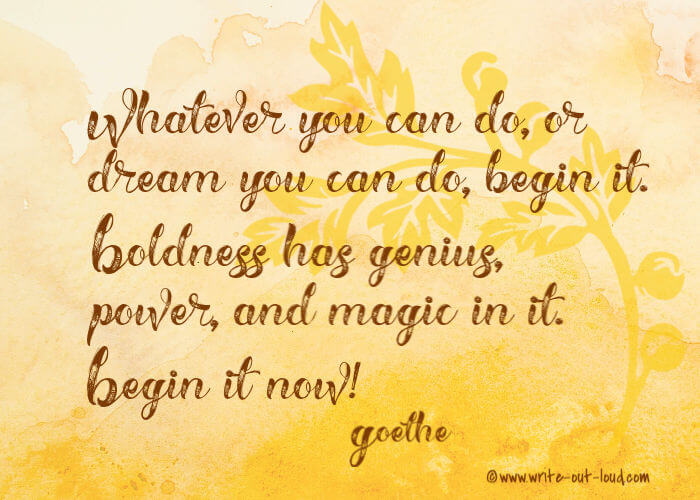
The quote above is widely attributed to Goethe. Despite disagreement over its origin, the sentiment expressed is fitting for your task. Have courage, and begin.
Sharing your writing
If these pages helped you to write - the sample eulogies in particular, please consider sharing what you wrote.
People are always searching for eulogy examples to help them begin their own writing process. If you could share, it would be very much appreciated.
Your eulogy would feature in a special section - free sample eulogies
It would have its own page and appear just how you want it to.
Do think about it. If you have any questions, please ask them.


From fear to fun in 28 ways
A complete one stop resource to scuttle fear in the best of all possible ways - with laughter.