- HOME ›
- Speech delivery ›
- Better public speaking skills for professionals
How professionals build better public speaking skills
Learn simple techniques to manage nerves, improve delivery, and speak clearly in meetings, presentations, and Q&As
Have you ever sat in a meeting with a solid idea, only to choke when it's your turn to speak? You know your topic backward and forward. But the second everyone turns to look at you, your mind goes blank, your voice gets shaky, and the words just don't come out right.

This is the reality for many people all over the world. In fact, fear of public speaking affects between 2% and 75% of people, according to Psychology Today.
And it's not just about formal speeches. It can also happen when you're explaining something in class, presenting a group project, or even just speaking up in a casual team meeting.
But the truth is that no one was actually born a great speaker. It's a skill you can develop with practice and a few simple techniques.
Some of those skills and techniques are what we'll be looking at here.
Build a strong foundation
Good communication starts with physical delivery. This means learning how to control your voice so people can focus on your message rather than straining to hear it.
- Voice Control. This is your starting point. Speak at a comfortable volume and vary your tone. A little energy makes a world of difference. Pair this with steady breathing. It supports your voice, so you won’t run out of steam mid-sentence.
- Articulation. Articulation is next. Enunciate your words clearly. Avoid mumbling or letting words run together when you transition between ideas.
- Pacing. Don't be in a hurry to deliver all you have to say. Slow down. Don’t allow nervousness to make you rush your words, which can make you harder to follow.
- Strategic Pauses. Don't forget the power of silence. A strategic pause after a key point lets your message sink in.
Here's the most important part: you don't have to wait until you're before an audience to put these tips to work.
Solicitor and former winner of The Irish Times Debate, Clíodhna McHugh, puts it well when speaking on The Women's Podcast: "Practice as much as you can, practice by yourself, practice in front of the mirror."
When public speaking difficulties need more than practice
Although practice helps with public speaking, it may not be enough if you're dealing with stuttering, chronic voice strain, articulation problems, or other forms of speech disorders.
According to the American Speech-Language-Hearing Association (ASHA), issues like these affect millions of Americans, with aphasia and stuttering affecting 2 million and 3 million people, respectively.
These aren't things a pep talk or a few practice runs will fix. But a speech-language pathologist (SLP) may be able to help. An SLP works with people who have different speech and communication difficulties and can help them find better ways to communicate.
Most SLPs have a master's degree in their field. Some even pursue their master’s in speech pathology online so they can balance work and school at the same time. It's a flexible path, but it still requires a whole lot of training.
Cleveland State University points out that SLPs are trained to provide care that can improve communication and quality of life for people with communication disorders.
If your communication difficulties go beyond normal stage fright or what regular practice can address, getting individualized support from an SLP may make a real difference.
Connect with your audience
Once your foundational skills are solid, shift your focus to the people listening. The goal here isn’t to deliver a flawless performance, but to connect with your audience. Here are some points on how you can do that:
- Make Eye Contact. Pick a few friendly faces across the room and talk directly to them for a few seconds at a time. If you're speaking in a class or business setting, position your friends or close colleagues strategically around the room, so you have familiar faces to look at.
- Ditch the Script. It's totally okay to have a prepared speech when speaking in public. But avoid reading every single word off your slides or paper. Your speech should be more to remind you of your points than a bulletin you read from. Reading directly from your notes makes you sound robotic and uninspiring.
And use stories to make your message easier to remember. A 2024 Quarterly Journal of Economics publication found that the impact of stories when people receive information faded by 32% over the course of a day. This is in stark contrast to stats and figures, which fade by a staggering 73%.
- Watch the Room. The people listening can give you clues about how well they're following what you're saying. Look around from time to time and pay attention to their body language. If they look confused or lost, stop and rephrase your point.
Body language isn't just for the people listening. Yours carries a surprising amount of the message too, so use it well. Stand upright. Let your hands move naturally instead of staying glued to your sides and try not to fidget. Fidgeting pulls focus away from what you're saying.
Manage public speaking anxiety
Public speaking anxiety is common. As already mentioned in the introduction, it affects large numbers of people, from students to working professionals.
But because you get nervous before any public presentation doesn't mean you're bad at speaking. It just means you need to learn how to channel those nerves.
Here are some ideas on how:
- Outline key ideas. Memorizing your talk line by line can create panic if you forget a single word. Instead, stick to the main concepts and use your notes to guide you.
- Rehearse. Practice your talk in front of a trusted friend, classmate, or colleague. If you don't have anyone to practice with, stand in front of a mirror and pretend you're talking to an audience. This can help boost your self-confidence.
A study in Frontiers in Psychology found that similar strategies, including co-planning, co-monitoring, co-evaluation, effort regulation, and help-seeking, helped students feel more confident about speaking in public.
- Focus on Value. Don't get carried away trying to deliver the perfect performance. That's not the point. The goal is to share useful information, not to be 100% perfect.
The tips above will work, but they take regular practice over time. Don't expect to overcome your anxiety on the first try. Be patient. It's a slow and steady process.
Putting the skills to work
Let’s look at how to put these strategies to work, whether you’re building your public speaking skills in a small group or standing on a big stage.
ScenarioSchool or work presentations |
What to doOrganize your main points clearly, then speak to your audience. Remember to make eye contact. |
|
Group meetings & discussions |
Listen first, then share your contributions. Don’t rush. If you have a suitable example to buttress your point, use it. |
|
Q&A Sessions |
Make sure you understand the question. And don’t be in a hurry. Think deeply about your answer before responding. |

In any of these scenarios you can also use the PREP outline method when you are asked an unexpected question. PREP is an acronym for Point. Reason. Example. Point.
The goal is to give a straightforward answer: make your point, explain your reasons, give a suitable example, and restate your point. (Click for examples and a printable PREP outline.)
3 frequently asked questions - with answers
Can public speaking anxiety ever completely go away?
Can public speaking anxiety ever completely go away?
Not entirely, and that's completely normal. Most experienced speakers still feel a bit of nervousness before they get on a stage. But with repeated practice, the anxiety becomes manageable rather than overwhelming.
How do I know if I need to see a speech-language pathologist or if I just need more practice?
How do I know if I need to see a speech-language pathologist or if I just need more practice?
If your challenges are mainly about feeling nervous, stumbling over words occasionally, or forgetting what to say, consistent practice will help. However, if problems show up almost every time you speak, regardless of having practiced and not just during high-pressure moments, then you may need professional support.
What's the most important public speaking skill to focus on?
What's the most important public speaking skill to focus on?
If you’re to focus on one thing, let it be pacing. Most people tend to stumble over their words when nervous. Proper pacing can help with that. This way, your audience is more likely to process and understand what you're saying.
Lastly, you don't have to be an extrovert to speak confidently in public. Most people you see comfortable on stages today learned this skill over time. You can too.
Hopefully, this guide has shown you some of the places to start. Pick one area this week. Start small, and you’ll be amazed at your progress after a short while.




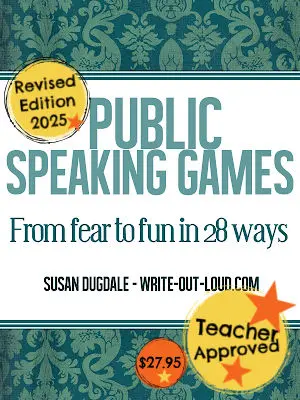
From fear to fun in 28 ways
A complete one stop resource to scuttle fear in the best of all possible ways - with laughter.