- HOME ›
- How to write a retirement speech
How to write a retirement speech: an easily followed guide
Quick steps, examples, and quotations for a good retirement speech
By: Susan Dugdale | Updated July 2026
The prospect of writing a retirement speech either for yourself, or for someone else might, initially, seem daunting.
Click the link to begin preparing your speech immediately
The reality is, fortunately, that it's not as hard as it first appears to be. ☺
Follow the steps I've outlined below, and you'll finish with a speech you'll be happy to give, and listeners will be happy to hear. That's a promise.
What you'll find on this page:
- how to quickly and efficiently collect material for the speech - content prompts to use to brainstorm*
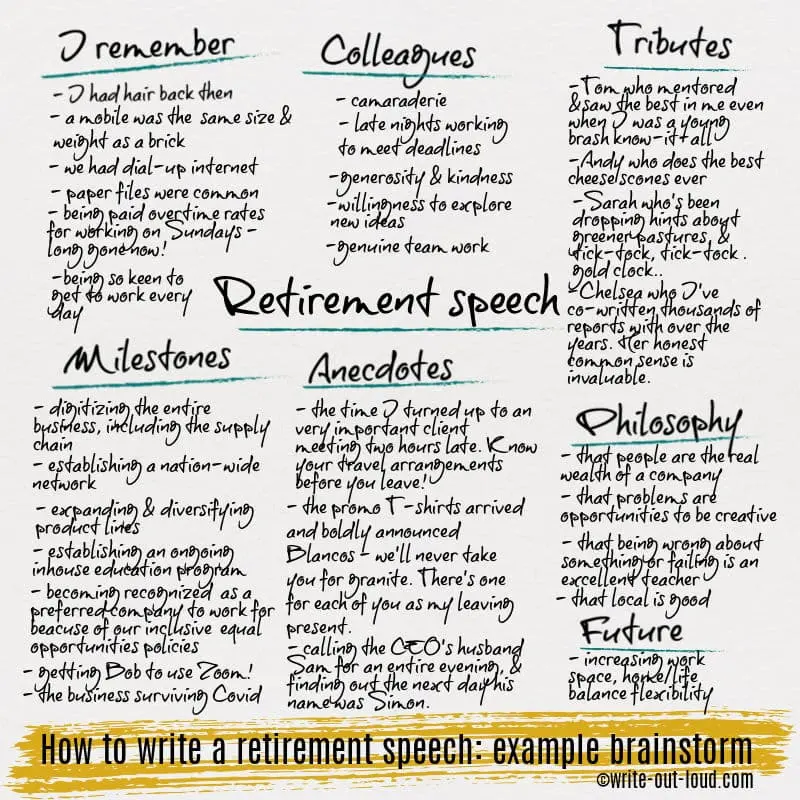
- an example of a completed retirement speech brainstorm
- notes on tone, theme and speech length
- how to write your speech
- how to test a speech if you're writing it about a colleague who is retiring
- links to an example retirement speech and a collection of suitable quotations you may like to use
* brainstorm - the name given to an invaluable prewriting technique used to generate lots of potential ideas about a topic
Beginning the process of writing: brainstorming to generate ideas
Before you attempt to write you need to collect a few ideas together.
The most efficient way I know to do this is to do a brainstorm. (Click to see a brainstorm example.)
First grab yourself a large sheet of paper or open a new document.
Give yourself a time limit
Before you begin set yourself a time limit - say 30 minutes.
Then use the retirement speech starter suggestions and the content ideas* next to each one to kick-start your imagination into action.
Put down as much as you can under each starter. Do NOT self- edit. Nothing is too trivial. You don't have to spell properly or write complete sentences. All you have to do is allow your ideas to flow and note them.
You will rearrange, expand, trim or delete them later but for now it's important you put whatever thought occurs down, to capture it before it disappears.
*You can see these starters and the content suggestions they generated in action in my sample brainstorm.
Retirement speech starters: potential content generators
I remember...
Suggestions: starting out 'x' years ago, what was most important to the company, what I looked like back then, what the pinnacle of technological sophistication was ...
Colleagues...
Suggestions: those who've been influential, friends, major campaigns/accounts worked on together... What special qualities will you miss about these people?
Tributes...
Suggestions: Who have you admired and why? Who has inspired you? Name and thank them. Especially those who contributed majorly in either little or large ways, making your work life easier or more pleasant; from the cook in the canteen who regularly kept back a sandwich just for you, or the lift operator who always held the door for you up.
Milestones...
Suggestions: significant personal achievements, the firm's major achievements...
Anecdotes...
Suggestions: amusing daft stories about either yourself or perhaps the people you worked with. (But mostly featuring you, because people appreciate a person who is self-aware and secure enough to make fun of themselves, one who doesn't need to call out blips in behavior, or lapses in logic in others in order to make themselves look good.)
The future...
Suggestions: Personal future: what I'm looking forward to, where I'll be, what I'll be doing...
The firm's future: where do you see it going? What challenges does it face?
Philosophy...
Suggestions: the values that have been important over the years, still are and why
Example brainstorm for a retirement speech
Getting it together: considering tone, theme + time
Now that you have the raw material, you're almost ready to shape it. But not quite.
Before you begin to write the speech, you have three more important elements to consider. What you decide will have an impact on the final outcome.
1. What tone do you want your speech to have?
Because many retirement speeches are delivered at either a dinner or a party, most people strive for a balance of light-hearted self-deprecating humor, sincerity and respect.
Put yourself in your colleagues' shoes and ask yourself what you would appreciate and enjoy listening to.
- Do you want to hear a diatribe about the opportunities the company missed through bureaucratic bungling over the last humpteen years?
- Is a detailed personal brag sheet charting your meteoric rise appropriate?
- What about a breakdown of the company's culture?
- Or talk of in-group events, or people, that nobody, aside from a small section of the audience, either understands or knows?
- Or worst of all, an embittered harangue citing the numerous instances (large and small) when your contributions were maligned, and your leadership potential was overlooked by varying nincompoops, but principally the halfwits who comprise the senior management team?
By all means keep the speech real. However make it more about the positive aspects of the business and the people who work there rather than yourself.
2. Consider using a theme
A theme is useful to tie all the segments of your speech together. It's a core idea uniting and giving them cohesion.
Here are some ideas you could make work well: team effort (through uniting one achieves more), friendship, loyalty, the value of ongoing education, that youth is wasted on the young, humor, the importance of believing in one's dreams...
3. How long are you going to speak for?
How long you are expected to speak for governs how many words you write.
A relatively informal retirement speech to be given at a social gathering is usually 3 - 5 minutes long. That's between 625 - 750 words depending how fast you speak.* Much more and you run the risk of losing people's attention.
In a formal setting you may be expected to speak for 10 minutes, and then some.
If you are unsure of what's being asked of you, find out. Whatever the time limit, its good practice to finish within it. In the famous words of Franklin D Roosevelt, USA's 32nd President - March 4, 1933 – April 12, 1945: "Be sincere; be brief; be seated."
*(Most people speak at a rate of between 120 - 150 words per minute. See my page on speech rate if you want more information.)
Read an example of a retirement speech
Sometimes it's incredibly helpful to read a sample leaving speech before starting to prepare one of your own. This example is an example retirement speech for a teacher. It was written using the guidelines on this page.
And now write your speech
Go back through your notes, select what you want, put it in order and write exactly as if you were talking out loud to a respected friend.
You'll need an:
- opening, where you introduce yourself and your role in the organization you're retiring from, if you need to.
(The opening sets the tone for the speech. Is it humorous? Is it heartfelt? Could any of your material from the 'I remember' starter work well here?) - middle, which will be a selection of the ideas you wrote down using these starters:
- Acknowledgements - tributes to colleagues, mentors, family members who have supported you
- Milestones + Anecdotes - personal and company standout events
- Philosophy - lessons learned - insights to help and inspire colleagues
- Future - plans for self - and a conclusion. (Something positive to leave people with.)
Remember the time allowance. You are better to make a few points well rather than try to cram your speech full and, then rush gabbling through it in order to meet the time constraints.
If it worries you that you've had to leave out either people or events, say so. Your audience will understand.
Borrow the words of others - use a quotation
Look through this large selection of retirement quotations. You'll find sharply witty, warmly funny, inspiring, as well as some sad thoughts about retiring. Take any that appeal to weave through your own words. Maybe you'll find just the opening or ending you want!
If you're writing about a colleague retiring
If you are writing a farewell or retirement speech about a colleague remember: "Do unto others as you would have done to you".
Your job is to make the person feel valued and appreciated for who they are and what they've brought to the workplace. If you're the only speaker remember you're talking on behalf of your workmates too and pull one or two of them in to help with the brainstorming process.
Test your speech on colleagues
To gauge whether or not what you've written will be well received or has covered all the most important points, firstly put yourself in the shoes of the person leaving and secondly, read the speech through to several colleagues whose judgement you respect.
Be very aware of revealing personal or sensitive information. The person retiring because of ill-health or for special family considerations may not want it made public. Ask before speaking. If you don't feel you can ask, then you probably shouldn't be saying anything about it.
Other useful reference pages:
- how to write speeches: step-by-step detailed instructions with examples
- how to rehearse your speech: absolutely necessary if you want to give a polished presentation
- tips on using humor effectively: avoid the traps that trip the unwary

About the Author: Susan Dugdale, founder of write-out-loud.com, is a qualified teacher of English and drama with over 40 years of experience. Drawing on her professional expertise and her personal journey from shyness to confidence, Susan creates practical, real-world resources to help people find their voice and speak with power.




From fear to fun in 28 ways
A complete one stop resource to scuttle fear in the best of all possible ways - with laughter.