- HOME ›
- Public speaking fear ›
- Anxiety help ›
- Visualization for confident speaking
Visualization & confident public speaking
Learn how to effectively manage public speaking fear using visualization
By: Susan Dugdale | Published Jan.2026
Some people call it mental rehearsal. Others call it guided imagery. And it’s also referred to as creative visualization. All three terms are names for a technique to positively manage public speaking anxiety.
For teachers looking to empower their students, or for anyone wanting to challenge a fear-filled response to having to speak in public, visualization offers
a practical, effective way to calm those pre-speech jitters.
What's on this page?
Use the links to jump to the section you want.
- What is visualization? How does it work?
- The 3 types of visualization: outcome, process and rational
- How practicing conscious visualization flips negativity
- A simple 5-minute visualization exercise to try
- Proof of effectiveness of visualization for reducing public speaking anxiety - a collection of reputable academic studies
Especially for teachers:
- How to introduce students to visualization for confident public speaking - with a sample script to use
- 3 sample printable teacher-led guided visualization scripts for confident public speaking - one for high school students, one for junior to middle school students and one diaphragmatic breathing
- How to practice reading a script aloud, with an audio sample
Especially for students:
- 2 sample visualization scripts for confident public speaking to use by themselves: one for junior to middle school students and one for high school students

What is visualization? How does it work?
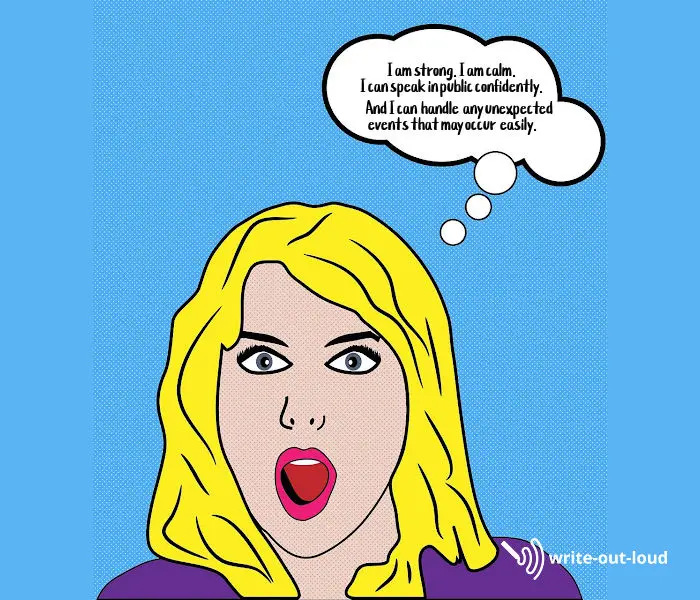
At its core, visualization combines mentally rehearsing a process or sequence to hone skills and enhance performance with diaphragmatic (belly) breathing. It’s about carefully and calmly creating vivid pictures in the mind, which allow us to 'experience' an event before it actually happens.
It is a proven technique: one regularly used as part of training programs for athletes, (Why Elite Athletes Use Visualization Techniques - Athleticism) as well as by aspiring high performers in other arenas: The 5 Types Of Visualization Every High Performer Needs To Know.
For
anyone plagued by the fear of speaking in public, visualization helps to boost confidence and curtail anxiety.
Types of visualization: a synergistic approach
There are three principal types: outcome, process and rational visualization.
While they can be used individually, their combined power makes visualization much more effective.
1. Outcome visualization
This is perhaps the most well-known form, where individuals picture themselves achieving their end goal. (For instance: receiving congratulations after giving a successful speech or confidently delivering a class presentation.)
While knowing exactly what you want to achieve is good, and a great place to start, if it's your sole form of rehearsal, despite how vividly you've imagined the desired result, it's not going to deliver bouquets and thunderous applause.
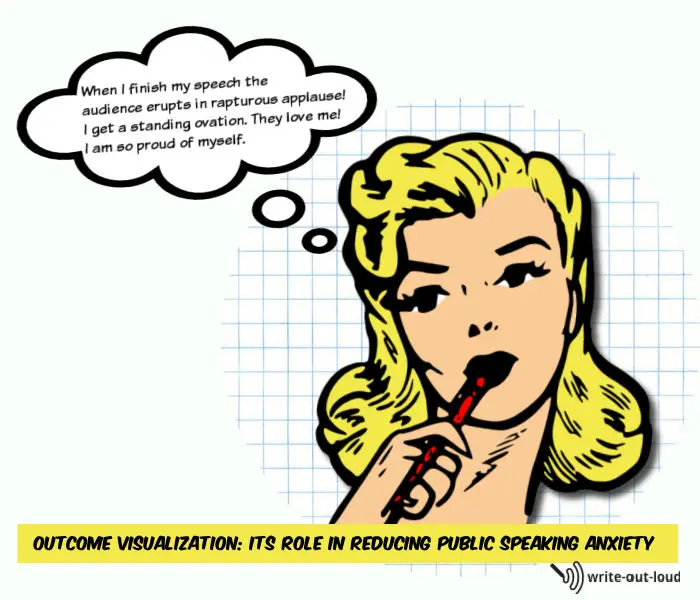
Without preparing each aspect of a presentation/speech thoroughly none of that will happen. It's wishful thinking. Practical commonsense tells us that.
Outcome visualization only becomes genuinely useful and effective in partnership. It needs both process and rational visualization to make it meaningful.
2. Process visualization
Process visualization maps the journey, breaking down the steps needed to achieve the desired outcome. For a speech, it would involve imagining every stage of its development in sequential detail from:
- finding out when it needs to be delivered, how long it needs to be
- selecting the subject,
- researching the audience in order to understand how best to angle the topic to fit their needs,
- knowing the purpose, or want you to achieve, with the presentation,
- doing the necessary research,
- knowing how much time you have for your presentation,
- outlining the content,
- writing the speech,
- organizing any visual aids that are required,
- rehearsing... and so on, all the way through to leaving your seat and going to the podium to delivering each part of the speech clearly.
Process visualization is a beginning-to-end walk through or overview of all the steps in their right order that need to be taken to achieve the best possible outcome.
3. Rational Visualization
Rational visualization anticipates potential challenges to achieving the desired end goal and equips students with coping strategies. It turns their scary 'what ifs' into 'I've got this.'
For instance, the challenges might be:
- the data show not working,
- getting a mind blank and being temporarily unable to think of the next point you wanted to make,
- or a person getting restless and obviously checking their phone
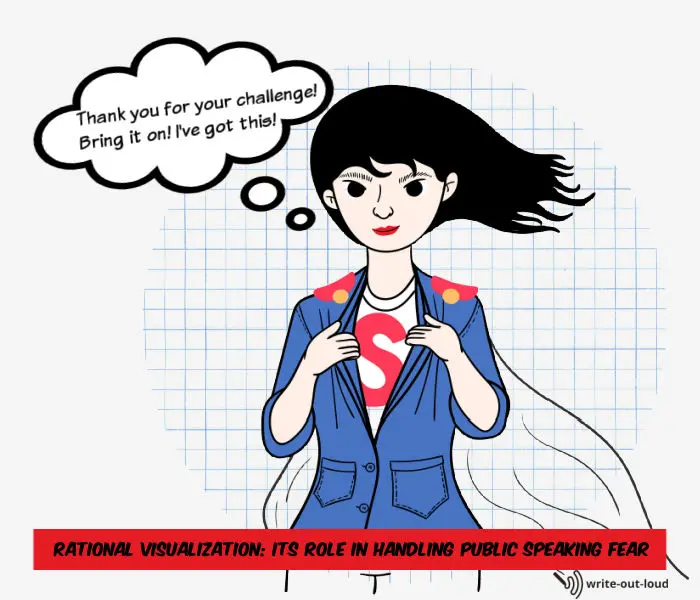
You work out the strategy you’ll use to meet each one and then you visualize yourself putting them into action and effectively coping with the situation. This works to reduce fear in two ways:
- It develops some practical strategies to use when things go sideways. For example, you’ll make sure you’ve got hard copy materials you can use in case the data show doesn’t work.
You'll have an excellent set of cue/note cards that you can quickly and easily refer to if your mind goes blank.
And you'll rehearse a non-confrontational way to re-focus the person using their phone.
Knowing you’ve got a 'Plan B' in place will mean you’re less concerned about the possibility of the data show not working or of having a memory lapse. - In your mind you’ll have rehearsed coping effectively* with things get challenging.
For example, if you’ve rehearsed how you’ll recover from a mind blank, you’ll no longer have a voice in your head saying, ‘If my mind goes blank it will be a humiliating disaster.'. Instead, you’ll be able to say to yourself 'While hope I don’t get a mind blank, if I do, I know I can recover from it.'
*an essential part of resilience training
For more about thinking and planning ahead to meet possible glitch points (with a handy printable Bring-It-On checklist).
Try this simple 5-minute visualization exercise
Do you feel nervous about public speaking? Here's a short visualization exercise you can do for yourself anywhere, anytime, you feel fearful or want to boost your focus and confidence. It combines diaphragmatic breathing with outcome and rational visualization. (The process, adequately preparing the speech for presentation, is assumed.)
Follow these steps:
- Find
a quiet moment.
You could be in your room, sitting on a park bench, outside a classroom or in your car.
- Close
your eyes or just
look down and soften your focus.
- Take
3 slow, steady breaths and
relax.
Breathe in through your nose to the count of four:1...,2...,3...,4… Then hold for four:1…,2...,3...,4... and breathe out through your mouth: 1...,2...,3...,4... As you breathe feel any tension you’re carrying leave your body.
- Visualize
yourself succeeding.
Picture the presentation setting as clearly as you can. See yourself in it. You are calm, fully prepared to present. Imagine it going very well.
- Mentally
rehearse a challenge.
Now something unexpected happens. Imagine dropping your notes, blanking for a second, or hearing a disruptive sound. See yourself pausing, taking a deep breath, successfully coping, and carrying on with confidence.
- Repeat
a positive message
to yourself.
Use one like: ‘I am calm. I am clear and confident. I am ready.’
or:
‘If something goes wrong, I’ll stay calm, take a deep breath, deal with it effectively and carry on.’
Say it to yourself in firm reassuring voice.
That’s it. The more you use
this technique, the more natural it becomes, and the more your brain
will learn to expect success, not fear.
If you let it, your imagination can train your nerves to work with you, not against you.
How practicing conscious visualization flips negativity
Many of us already use visualization very effectively. However, it's usually negative rather than positive!
Why do we remember the worst things most clearly? Understanding survival & the role of fear.
Have you, like me, ever wondered why it is that it's our bad experiences, both large and small, that we can recall in minute painful detail?
Like the time I was demonstrating a warmup routine which included star-jumps in front of the entire school and the elastic in my track pants snapped. (They were bright pink. As was my face!)
Or when I was asked, in front of a large audience, to talk about the character I was playing in a play, and I blanked, gaped, and was passed over. I can still see the questioner's puzzled look.
Or when I got the phone call to tell me my mother had died unexpectedly while on holiday in England. (It was night, the end of a long day. I'd just come home from a parent-teacher meeting and the person giving me the news was in shock herself.)
Remembering kept us safe
The reason for their intense and immediate recall is due to our brains being wired for survival. It is part of our evolutionary inheritance.
Our ancient ancestors survived because they remembered their negative experiences. For instance, which plants and berries made them ill. Or which animal tracks belonged to hungry predators on the lookout for dinner.
Remembering helped them avoid danger. Because memory was key to their survival, the more vivid the memory, the safer they were.
Today, while we're generally not avoiding large animals who want to eat us, our brains continue to give our negative experiences more weight. It's their way of helping us watch out for similar dangers in the future.
How does our brain do this? Enter the amygdala.
The role of the amygdala
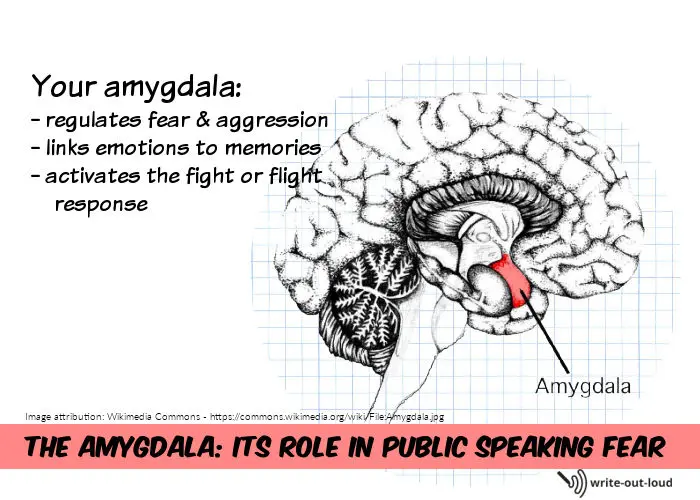
The amygdala is the brain’s emotional alarm system. It kicks into gear whenever we feel frightened or fearful, releasing stress hormones like cortisol and adrenaline. These chemicals enhance the brain’s ability to encode and store memories, especially emotionally charged ones.
The negativity bias: it's natural
We’re more likely to dwell on a single criticism than ten compliments largely due to the way our brains instinctively process embarrassing or frightening experiences. We magnify their emotional impact as part of trying to protect ourselves from danger.
Replaying bad memories strengthens them
Each time we recall a bad memory, (e.g., publicly forgetting what we intended to say while delivering a speech), the neural pathways involved become stronger and more prominent. This makes it easier for our brain to revisit that memory and relive it in vivid detail.
Because the brain does not make a distinction between a physical or a social threat, one bad experience can have a significant and lasting impact.
For instance, if a person forgets what they wanted to say or was laughed at while giving a speech, or has received harsh feedback, the brain flags public speaking as 'dangerous.'
All it takes is one or two bad experiences and an assumption is made that all future public speaking experiences will be the same. (Because I failed once, I'll probably fail again.)
It's an overgeneralization reinforced through mentally replaying the failure over and over. This is the power of visualization working against ourselves. It intensifies and strengthens fear.
Physical symptoms of fear
Because the images we create are so strong and so real, they activate the fear-or-flight response which in turn brings all the classic physical symptoms of heightened fear or anxiety out to play.
Our heart races. We get a dry mouth and shaky hands. The butterflies in our stomach flap furiously making us feel nauseous. Their collective message is: 'I’m in danger when I speak in front of others.'
The good news: the brain can be rewired
Just as the brain strengthens bad memories through repetition, it can also be retrained to highlight positivity using a combination of outcome, process and rational visualization.
Let's flip the focus for ourselves and our students.
Imagine what could happen if the same amount of time and energy that we put into conjuring up ghastly nightmarish stories of humiliating failure was channeled into carefully and realistically constructed stories of competent, confident success? It would be amazing!
Introducing visualization to students
In my experience, the biggest hurdle you'll face is convincing/showing students, particularly older ones, just how powerful their imagination is. Many are already deeply cynical, and without a considered introduction, visualization could be dismissed as 'fairy land wu-wu' nonsense.
Covering these three aspects should give your students the reassurance they need to open their minds and give it a chance.
- The power of one bad experience
Explain how we strengthen the hold a negative experience has by re-living it. For example, every time we replay the story about being terrified of public speaking in all its ghastly detail, the stronger it becomes and the more difficult it is to overcome it.
For older students, an explanation about the role of amygdala plays could be very useful too. - Cite examples of studies
Ground what you say about the effectiveness of visualization by giving examples of studies where the practice has been proven beneficial.
For instance, rational visualization, encourages thinking ahead and anticipating what could happen. Like a slide show not working properly or temporarily forgetting what you going to say next and having solutions ready to use if needed.
It's effective because the situation has already been thoroughly rehearsed in the mind and if it does occur, it is much more likely to be dealt with easily. - Imagining v doing
Visualization is not an alternative to practicing in real life. You still have to prepare yourself thoroughly. It is an ally - a strong support. Visualization will help keep you focused on what you want to achieve, and the steps you need to take to get there.
I've prepared an introductory piece that you're welcome to adapt for your own use. That's here: sample introduction to visualization.
Visualization scripts for teachers & students to use
To help you get from 'what a great idea' to 'let's do it', here's five printable guided visualization scripts for you to use.
Three are teacher-led. The other two are scripts for students to use by themselves after they've been shown how the technique works.
I hope they'll serve as practical starting points. Once you become more at home with the process and have seen how they work, I'm sure you'll adapt them to make them your own. (Please note: the link for each of the printables will open in a new tab.)
Sample scripts for teachers
- A teacher-led script for diaphragmatic breathing
- A teacher-led script for high school students
- A teacher-led script for junior to middle school students
Practicing with your chosen script
Practice reading your chosen script aloud before using it. Run it through several times and as you do imagine your class listening and responding to your voice. That will give you a gauge on both the time you need to allow to complete the exercise without rushing, and its flow.
To give you an idea of the pace and pitch to use I recorded the first step of the teacher-led script for junior to middle school students. You can listen to it here: First 50+ seconds of the visualization script read aloud.
Sample scripts for students
- A script for junior to middle school students to use by themselves
- A script for high school students to use by themselves
Proof of effectiveness of visualization for reducing public speaking anxiety
These studies collectively support the use of visualization as a practical and effective technique for reducing public speaking anxiety.
- Ayres, J., & Hopf, T. S. (1985). Visualization: A means of reducing speech anxiety.
This study found that visualization is an effective, nondisruptive method that can be used in typical public speaking classes to help reduce speech anxiety. (See more: tandfonline.com) - Ayres, J., & Hopf, T. S. (1992). Visualization: Reducing speech anxiety and enhancing performance.
The research revealed that standard and performance visualization techniques were generally more effective than other interventions for reducing self-reported negative thinking associated with speech anxiety. (See more: tandfonline.com) - Ayres, J., & Hopf, T. S. (1999). Vividness and control: Factors in the effectiveness of performance visualization.
This study compared the effects of imagery control and vividness on self-report measures of public speaking apprehension, finding that both factors significantly influenced the effectiveness of visualization techniques. (See more: tandfonline.com) - Hopf, T. S., & Ayres, J. (2000). An examination of the long-term effect of performance visualization.
This investigation examined whether performance visualization impacts the way individuals with high communication apprehension envision themselves as public speakers over time, indicating positive long-term effects. (See more: ResearchGate) - Wongprasert, T. K., & Ayres, J. (2000). Effects of Performance Visualization in Mock Employment Interviews.
This study tested the effectiveness of performance visualization in reducing communication apprehension during employment interviews, finding that participants exposed to visualization reported significantly lower apprehension levels. (See more: eric.ed.gov - The link goes to a directory page featuring 10 studies, including this one and several others already mentioned above.)
Other onsite resources for dealing effectively with public speaking anxiety
- 14 different ways to calm fear of public speaking
- Managing public speaking nerves: beating negative self-talk, creating a 'bring-it-on' list, using a reality check scale...

About the Author: Susan Dugdale, founder of write-out-loud.com, is a qualified teacher of English and drama with over 40 years of experience. Drawing on her professional expertise and her personal journey from shyness to confidence, Susan creates practical, real-world resources to help people find their voice and speak with power.



From fear to fun in 28 ways
A complete one stop resource to scuttle fear in the best of all possible ways - with laughter.