- HOME ›
- Speech topics ›
- Speech topics for children
Speech topics for children: 8 themed lists
141 best speech topics for kids: approx. 11-14yrs, grades 5 - 8: middle school
By: Susan Dugdale |Updated February 2026
Providing suitable school speech topics for children is often a real challenge.
(And, yes, I know that's an understatement! I've been there as the parent AND as the teacher. Finding that gem of an idea to light up a child's imagination can be a mutually exhausting exercise. Hopefully this page will provide the speech topic you need very quickly. ☺)
What's on this page
- Tips for students to make the right topic choice
- 8 themed lists of speech topic suggestions sorted by grade level (Grades 5-8) and speech type: personal, persuasive, demonstrative and informative.
Finding suitable speech topics for children
As their teachers or parents, we want stimulating, interesting subjects for them to work with. However we also need them to be aligned with their age group.
If we make the topics too adult, we risk pushing them into areas they're too young to cope with. If we make them too simplistic, we run the risk of minimizing or patronizing their growing sense of awareness.
As in everything, we need to find the balance.
Finding that balance is much easier when children know how to structure their ideas. Taking online writing classes can help them find the right words to turn their raw thoughts into a clear, confident speech. This foundation is often the key to letting their imagination really shine during a presentation.
These speech ideas have worked well for me with middle-school students (Grades 5-8 US or Years 6-9 UK): children between 11 years to approximately 13-14 years old.
You'll find some are more suitable for an imaginative child and others for a practical, factual child.
Tips for students: help to make the right topic choice
To find just the right subject, think about what you're passionate about! A topic you care about will make your speech more engaging. If it doesn't interest you, skip over it and find one that does.
In addition, you'll need to consider your audience, the purpose of your speech and the time limit that's been set for it.
Your audience:
- Will they be interested in your topic? Why? What can you share about your topic that you know they'll absolutely want to know about because it benefits them in some meaningful way.
Your speech purpose:
- Is the purpose of your speech persuasive? Are your trying to convince your audience about something? For example, that 'smacking a child should be illegal' or that 'good manners are important'.
For more about persuasive speeches: their characteristics and more. - Is the purpose of your speech informative? Are you sharing information on a subject? For example, the road rules for inner-city driving or the food groups that must be included in a person's diet to maintain optimum health.
For more about the key features of a good informative speech. - Is the purpose of your speech demonstrative? Do you need to show your audience how do something? For example, how to tie a bow tie, or how to use the Heimlich maneuver.
Find out more about demonstration or 'how to' speeches - Or is the primary purpose of your speech to entertain? Are you aiming to make your audience laugh or enjoy themselves?
For more about crafting a genuinely entertaining speech.
Time constraints
Usually when you are given a speech assignment you are also given guidelines about how long it should be. For example, between 3 and 5 minutes long. 3 minutes is the minimum time you are expected to speak for, and 5 minutes is the maximum.
When you choose a topic you need to be mindful about the time it will take to cover it well. If you can't do that inside the time frame that's been given, go for another topic - one that will fit without compromise.
Once you've found your topic use these resources to help craft and rehearse your speech to make it the best you possibly can.
Grade level guide plus type of speech
As a guide, the topics within each list are grouped according to an approximate grade level and a specific speech type: either personal (calling for self-reflection), persuasive, demonstrative, or informative.
At grades 5-6 level (Upper elementary/early middle school) lots of the topics are self-referencing and/or factual. They ask for recounting of personal experiences with, depending on the subject and the child, the beginnings of being able to form and give an opinion and use abstract reasoning. The need to research is low.
For example: 'What I like most about my school' or 'How does a rainbow work'.
In middle school (Grade 7), the topics strengthen abstract thinking alongside being able to the weigh pros/cons of a subject and provide simple evidence.
For example: 'Co-ed schools are better' or 'Do animals communicate? If so, how?'
In grade 8 (Upper middle school) many of the topics encourage: ethical reasoning, (What is morally right or wrong, and according to whom?), considering policy thinking and societal systems (Developing an awareness of how policies: health, educational, environmental..., intersect and impact how we co-exist), as well as developing sustained arguments. At this level opinion needs to be supported by examples.
For example: 'What rights should a child have, and why?' or 'What is global warming?'
The grade classification is only indicative. If a student outside the suggested grade range of a topic, wants to use it, let them and adjust the expected outcomes accordingly.
And if by small chance you reach the end of the page and no speech idea has leaped out to grab you, there's another 50+ elocution topics for kids waiting here.

School Speech Topics for Children - Community, School & Social Issues
Grade 5 topics + speech type
Personal
- What do you like most about your school?
Persuasive
- Good manners are important
Grade 5–6 topics + speech type
Informative
- Chat rooms can be dangerous
- Does advertising influence our food choices?
Persuasive
- Earbuds are anti-social
- Parents should monitor how we use the internet
- Bullying behavior needs to be dealt with promptly and firmly
- Do certain types of pop music teach the wrong values?
Grade 7 topics + speech type
Informative
- Does watching violent TV programs affect children’s views on violence?
Persuasive
- Should students have the right to choose what school they go to?
- Should students have a greater say in what classes they study?
- Wearing a school uniform lessens social distinctions
- Co-ed schools are better
- Failing a class can be a positive thing
- Clothes and being fashionable are way too important
- Parents should not pay (bribe) their children to get good grades
Grade 8 topics + speech type
Informative
- The words we use influence how people behave toward us
Persuasive
- What rights should a child have and why?
- Smacking a child should be illegal
- Everyone should do some sort of regular community service
- More green space should be set aside for community use
- Recycling should be compulsory
- Large non-electric cars should be banned
- Everybody should have access to healthy affordable housing
- Extra tuition should be available free of charge
- Class sizes should be limited to 20
- The school leaving age should be abolished
-
Standardized tests are not a reliable measure of intelligence
Speech Topics for Children - Arts & Culture
Grade 5 topics + speech type
Personal
- My favorite festival is…
- Who is your favorite book/cartoon character and why?
- My favorite story/poem/song as a little child was…
- The type of art I like to look at is…
Grade 5–6 topics + speech type
Personal
- I learn the piano/violin/trumpet/drums… because…
- What inspires you about dance/art/drama/music or film?
- If I was a famous screen star I would…
Grade 6 topics + speech type
Informative
- What is pop art?
- Strange facts about artists, dancers, musicians, etc.
Personal
- Who is your favorite screen hero and why?
Grade 6-7 topics + speech type
Personal
- If you were to write a book for your age group, what would it be about?
Informative
- Why are film stars so popular?
Grade 7-8 topics + speech type
Persuasive
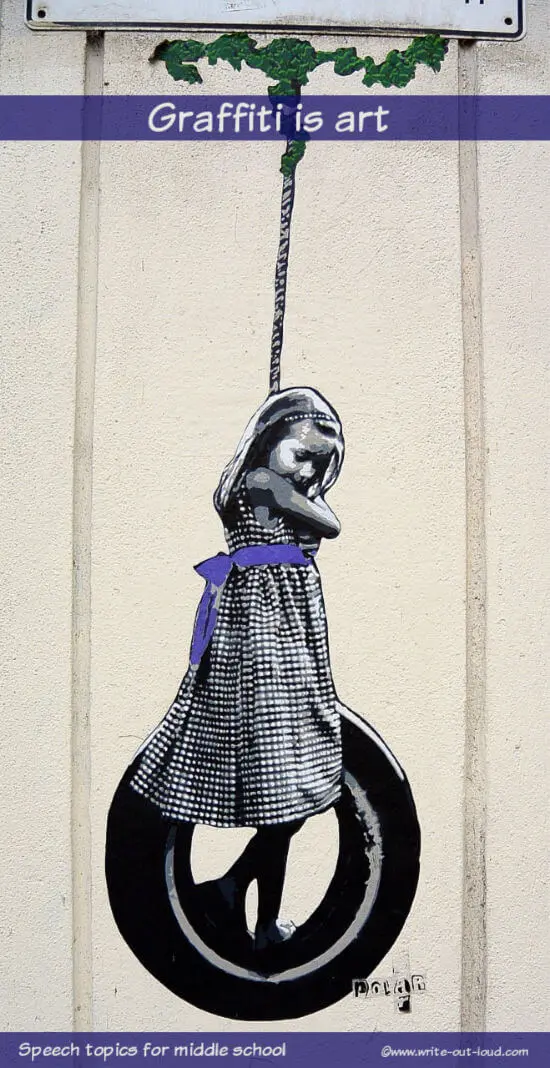
- Graffiti is art.
Informative
-
Explain a cultural festival or practice of significance to you that others may not know about or appreciate.
Speech Topics for Kids - Fun & Whimsy
Grade 5 - 6 + speech type
Personal
- A day in my life as a table/pencil/car/potato/etc.
- Why I am on the top of Santa’s nice/naughty list
- The silliest practical joke I ever played
- If I had three wishes they would be…
- My secret life as a hero
- When I’m famous it will be for…
Grade 6 - 7 + speech type
Persuasive
- If I ruled the world…
- If I was a parent, the ground rules I would make are…
- I am a fashion guru and the new trend will be…
Demonstrative
- My greatest and best invention
Grade 7 - 8 + speech type
Personal
- What I think of people from the viewpoint of a tree in the school grounds
- If I rewrote The Three Little Pigs / Cinderella, it would go like this…
Demonstrative
- How to write using invisible ink
- My secret code: how to invent and use a coded language
Informative
-
Weird and wonderful words — what do they mean?
School Speech Topics for Children - Sports & Games

Grade 5 - 6 + speech type
Personal
- My favorite sporting hero is...
- I enjoy learning gymnastics, martial arts… because…
- In winter I love to ski, ice skate…
Grade 6 - 7 + speech type
Personal
- What I learned through learning to play…
- The best indoor games are…
- The best online games are…
Demonstrative
- Explain the game of checkers/draughts/chess
Persuasive
- The best summer sport is…
- Winning is not so important as participating
- Extreme sports are dangerously exciting
Grade 7 - 8 + speech type
Persuasive
- Everybody should learn to play a team sport
- Sport should not be compulsory
- In sport, the rules are there to protect the players
Informative
-
Strange sports or games
Speech Topics for Children - Food

Grade 5 - 6 + speech type
Personal
- The best meal in the world is…
- The foods I do not like are…
- My favorite food to make is…
- When we eat out, my favorite thing to order is…
- Healthy food I really like
- My favorite Christmas/celebration food
Grade 6 - 7 + speech type
Personal
- The best birthday party food
- Mealtimes in our house – a description
Informative
- What’s in my lunch box compared to what’s in my friend’s
Demonstrative
- How I learned to cook
Persuasive
- The best sandwich fillings in the world
Grade 7 - 8 + speech type
Persuasive
- Table manners — are they important?
Informative
- What food do you eat most of? How many different ways is it served?
- Fashions in food: what used to be eaten regularly but isn’t now
Speech Topics for Children - Seasons & Nature
Grade 5 - 6 + speech type
Informative
- Why do we have seasons?
- Why do we have day and nighttime?
- Why does the sky appear blue?
- How does a tree grow?
- Explain how snow is formed
- How does a rainbow work?
Grade 7 + speech type
Informative
- How and why does a tree change leaf color in fall?
- Why are there tides?
- What are stars?
- How does gravity work?
- What type of wind affects where you live most?
Demonstrative
- Show the patterns formed in frost
Grade 8 + speech type
Informative
- How come the earth goes round and round?
- How is a diamond made?
- What is global warming?
Persuasive
- How and why should we conserve nature?
Speech Topics for Children - Animals/Birds/Fish
Grade 5 - 6 + speech type
Informative
- Why is a dog called “man’s best friend”?
Personal
- What birds or wild animals do you see locally?
- Tell an inspiring true story about an animal
- What animal makes a great pet and why?
Demonstrative
- How to look after a pet properly
Grade 7 + speech type
Persuasive
Are there bad dogs or bad dog owners?
Informative
- What is horse sense?7
- Do animals communicate? If so, how?
- How has the horse been used through history?
- Research strange plants (carnivorous etc.)
- Research strange or rare animals
- Retell a myth or legend about an animal
Grade 8 + speech type
Persuasive
- Do animals really think?
- Is hunting animals fair?
- Is eating meat fair?
- What rights should animals have?
- Are zoos good places and why?
- Restrictions around fishing – what do you think? Yes? Or no?
- Should pet cats be banned because they catch birds?
Informative
- Conserving animals in your local area
- Symbolism of animals (lion = courage, etc.)
Speech Topics for Kids - Hobbies/Interests
Grade 5-6 +speech type
Personal
- My doll/car/card collection
- The best board games to play with friends
- The best rainy-day activities are…
Demonstrative
- How to tell a joke
- How to fold paper (origami)
- How to make finger puppets
Grade 6-7 + speech type
Demonstrative
- How to make a model car/plane
- How to sew your own clothes
- How to knit
- How to take a good photograph
- How to play an instrument
- How to scrapbook
- How to ride a horse/skateboard
Grade 7-8 + speech type
Demonstrative
- How to put on a play or concert
- How to make a garden
- How to do a magic trick
Informative
How to learn another language
Persuasive
- The best online games for kids
Personal
- The best skill I’ve ever learned
Speech topics sorted by grade and speech type
If you'd prefer to have a list of topics sorted by grade and type of speech rather than by theme, you'll find them here.
These printable pdfs are an amalgam of the eight themed lists on this page. (Please note the pdf will open in a new window.)
More children's speech topics and resources for preparing effective speeches
If you're here looking for a topic for your own child, go through both these pages with them: the one you're one now and this one: 50 elocution topics for kids: creative speech ideas for children. Suggest other possibilities and adaptions of the topics as you go. You'll need to find a subject they genuinely care about and it's best if the final decision is made by them!
Get help to prepare, write and deliver the speech
1. Gathering ideas
Preparing a speech begins with gathering ideas about the topic. The easiest way I know to do this is to brainstorm - to note down as many thoughts covering as many aspects of your subject as quickly as you can without stopping to edit or order them. You will use these to base your speech on.
For example, the topic is:
"That more 'green' space (parks) should be set aside for community use"
We need more green space in cities because:
- many people live in apartment blocks without access to a yard/garden of their own and need places for exercise and relaxation
- studies show they reduce stress and boost overall health. We feel better when we have 'green' spaces around us.
- they bring the community together reducing loneliness. People regularly using the same park for the same purpose are more likely to talk to each other. Eg. walking their dog, watching their child play on the swings...
- they improve the quality of our environment, for instance, better air quality
If you're unfamiliar with the technique you can find out more about it here: What is a brainstorm? You'll find ongoing links to examples that I've done as preparation for writing specific speeches.
2. Writing your speech
How do you convert your brainstorm notes into a speech that is ready to be delivered?
That's most easily achieved through following a step-by-step process. You can find out more about it here: How to write a good speech in 7 steps.
The article takes you through outlining a speech - selecting the best of your brainstormed content to use for each of the 3 essential parts of a speech.
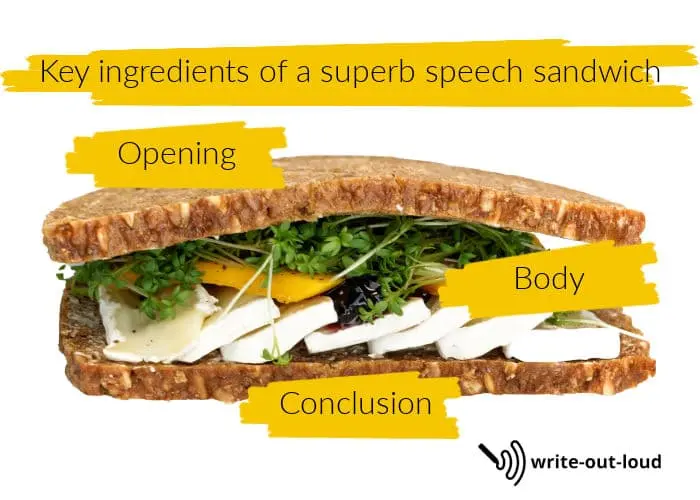
- The introduction/opening which grabs the audience's attention and lets them know what you're going to be talking about.
- The body which is the main part of the speech where you present what you want to say about your topic in a clear, organized way using examples and evidence to support your points.
- The conclusion/ending which summarizes your main points and finishes with a strong memorable statement leaving your audience with something to think about.
Read and find out about crafting those sections to fit your speech purpose, your audience and your time allowance.
There are numerous examples to illustrate as well as a printable outline document to download for your own use.
Go to: how to write a speech step-by-step
3. Rehearse your speech
Finishing writing your speech is not the last part of the process. A speech is spoken, not read. It is heard, and to make hearing it a positive experience for the audience, it needs practice or rehearsal. To get the best results rehearsal is essential.
Rehearsal lets you know whether you've got the timing right. Is it too long? Or too short?
It lets you know if your material, what you say, moves logically and smoothly from point to point.
It lets you try out various openings and endings and select the ones which work the best.
And here's one huge point that often gets overlooked. If you find giving a speech stressful, practice will lessen it. Rehearsal familiarizes you with the task, and the more familiar you are the less anxious you become.
For more on rehearsal: why to, and how to; go to how to rehearse a speech.
Writing a speech for children
Were you looking for information to help you write a speech for children rather than speech topics for them to use?
If so, you'll find this page How to write a speech for kids useful.

About the Author: Susan Dugdale, founder of write-out-loud.com, is a qualified teacher of English and drama with over 40 years of experience. Drawing on her professional expertise and her personal journey from shyness to confidence, Susan creates practical, real-world resources to help people find their voice and speak with power.




From fear to fun in 28 ways
A complete one stop resource to scuttle fear in the best of all possible ways - with laughter.